Ordinary holiday gift money is tax-exempt...social norms define the threshold
Minor children are eligible for deductions up to 20 million won every 10 years
With the Lunar New Year holidays, there is growing interest in whether the New Year’s cash gifts children receive are subject to gift tax. In conclusion, ordinary New Year’s cash gifts are generally not taxable. However, the details can change depending on the amount and how the money is used, so caution is needed.
According to the National Tax Service on February 18, gift tax is imposed when any asset with economic value is transferred without consideration. However, in its booklet “Basic Tax Knowledge on Inheritance and Gift Taxes,” the National Tax Service clearly states that living expenses, educational expenses, congratulatory money, and holiday allowances that are socially accepted are not subject to taxation. In other words, ordinary New Year’s cash gifts exchanged within a typical household do not require concern about gift tax.
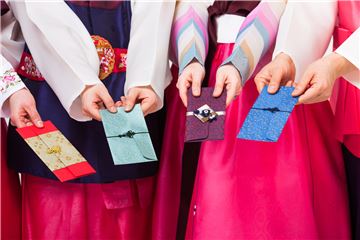 Image of New Year's cash gifts to help explain the article. Getty Images Bank
However, this comes with the condition of being within the bounds of “social norms.” If the amount is excessive, or if it is used as a means of building up assets, it may be regarded as a gift.
Even if it is deemed a gift, a certain amount is still eligible for deduction. A minor can receive a gift tax deduction of up to 20 million won over 10 years from a lineal ascendant (parents, grandparents, etc.), and up to 10 million won from other relatives. In other words, no tax is imposed on amounts received by a minor child within the 20 million won limit for each 10-year period, and if this threshold is exceeded, the excess portion is subject to a 10% tax rate for amounts up to 100 million won.
If the New Year’s cash gifts are used for ordinary purposes such as tuition or living expenses, the likelihood of a problem arising is low, even if the total amount is somewhat large. Through its official blog, the National Tax Service explains that the following are treated as non-taxable gifted assets: (i) tuition, scholarships, and other similar monetary benefits; (ii) commemorative gifts, congratulatory money, condolence money, and other similar monetary benefits that are recognized as ordinarily necessary; and (iii) items for wedding trousseau that are recognized as ordinarily necessary.
However, if grandparents cover a grandchild’s educational expenses even though the parents are financially capable, this may be regarded as a gift. In addition, if New Year’s cash gifts are accumulated in an account and later used as funds for acquiring assets such as real estate, an explanation of the source of funds may be required.
In particular, if parents continuously and repeatedly trade stocks through an account in their child’s name and thereby generate investment gains, those gains may be regarded as profits created through the parents’ contribution and become subject to additional gift tax. Unlike simple safekeeping or long-term passive investment, active management of the funds can be a risk factor.
© The Asia Business Daily(www.asiae.co.kr). All rights reserved.
![Clutching a Stolen Dior Bag, Saying "I Hate Being Poor but Real"... The Grotesque Con of a "Human Knockoff" [Slate]](https://cwcontent.asiae.co.kr/asiaresize/183/2026021902243444107_1771435474.jpg)















