Prime Minister Takaichi Sanae of Japan, who achieved a landslide victory in the general election, met on the 16th with Ueda Kazuo, Governor of the Bank of Japan, the country’s central bank.
According to the Nihon Keizai Shimbun (Nikkei), NHK, and other outlets, Governor Ueda told reporters after holding a roughly 15-minute meeting with Prime Minister Takaichi that afternoon at the Prime Minister's official residence, "We exchanged views on the general economic and financial situation," adding, "I cannot speak about the specific details."
Regarding whether Prime Minister Takaichi made any policy requests, Governor Ueda replied only, "There were no particular requests."
Nikkei reported that this was the second one-on-one meeting between Prime Minister Takaichi and Governor Ueda, and the first since the Liberal Democratic Party’s landslide victory in the House of Representatives election (general election).
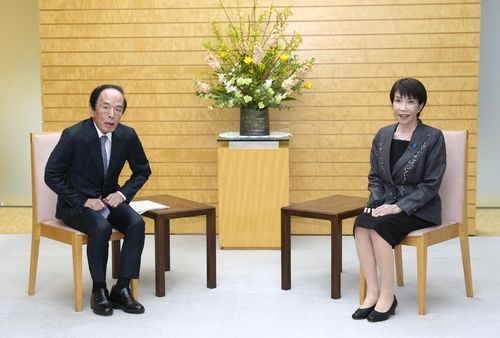 Takaichi Sanae, Prime Minister of Japan, met with Ueda Kazuo, Governor of the Bank of Japan, at the Prime Minister's official residence on the 16th. Kyodo News/Yonhap
Earlier, Chief Cabinet Secretary Kihara Minoru said at a regular press conference that the timing of the meeting between Prime Minister Takaichi and Governor Ueda was "set in consideration of each other's schedules, in the context of the government and the Bank of Japan always communicating closely."
Despite the short duration, the meeting drew strong interest from financial markets. This is because Prime Minister Takaichi has in the past supported "Abenomics" and has favored expansionary fiscal policy and accommodative monetary policy. In fact, since Prime Minister Takaichi took office in October last year, the yen and Japanese government bond prices have been weak in financial markets, while stock prices have been strong.
Since taking office, Prime Minister Takaichi has refrained from making specific comments on monetary policy, instead emphasizing only "responsible, proactive fiscal policy." However, even proactive fiscal policy can, through increased government spending financed by government bond issuance and expanded money supply, become a factor that induces a decline in government bond prices (a rise in interest rates) and a weaker yen.
After the ruling Liberal Democratic Party’s landslide victory in the general election, the yen has unexpectedly shown a strengthening trend, and Japanese government bond prices have remained largely unchanged.
The yen-dollar exchange rate had risen to the 157-yen-per-dollar range in early February, but has gradually fallen and was trading in the 153-yen range on the 16th.
© The Asia Business Daily(www.asiae.co.kr). All rights reserved.
![Clutching a Stolen Dior Bag, Saying "I Hate Being Poor but Real"... The Grotesque Con of a "Human Knockoff" [Slate]](https://cwcontent.asiae.co.kr/asiaresize/183/2026021902243444107_1771435474.jpg)
















