As youth employment has declined for 39 consecutive months and the unemployment rate continues to rise, employment indicators keep deteriorating. On top of this, the spread of generative artificial intelligence (AI) is adding to concerns over youth employment. Both in the actual decline in jobs and in perception surveys, anxiety is most pronounced among people in their 20s.
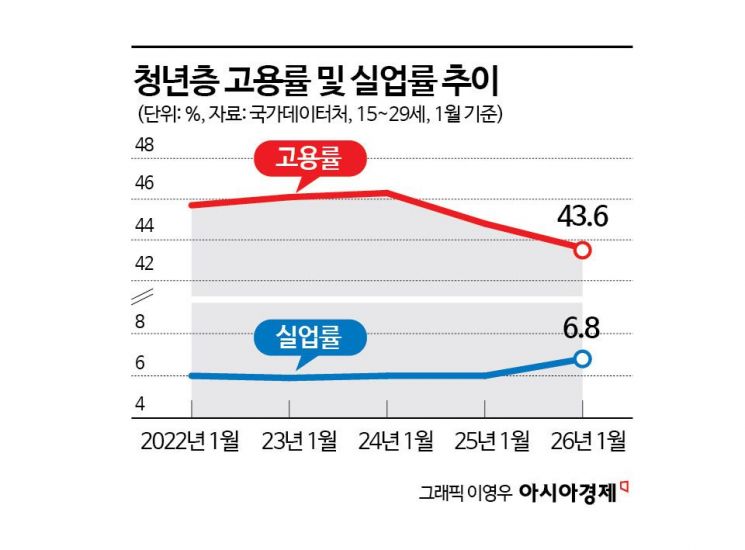
According to the National Data Office on the 16th, the number of people employed last month was 27,986,000, an increase of 108,000 from the same month a year earlier. The number of employed people has risen for 13 consecutive months, but the growth has slowed to the lowest level in about a year. In particular, the number of employed young people (aged 15 to 29) fell by 175,000, marking a decline for 39 consecutive months since November 2022. The youth employment rate also dropped to 43.6%, down 1.2 percentage points from a year earlier, extending its downward trend for 21 consecutive months.
By industry, the prolonged slump in manufacturing and construction is weakening the foundation for youth employment. The number of employed in the construction industry decreased by 20,000 and in manufacturing by 23,000, with both sectors recording declines for more than a year. Meanwhile, employment increased in some service industries such as health and social welfare services, but this was far from enough to offset the sluggishness in key industries.
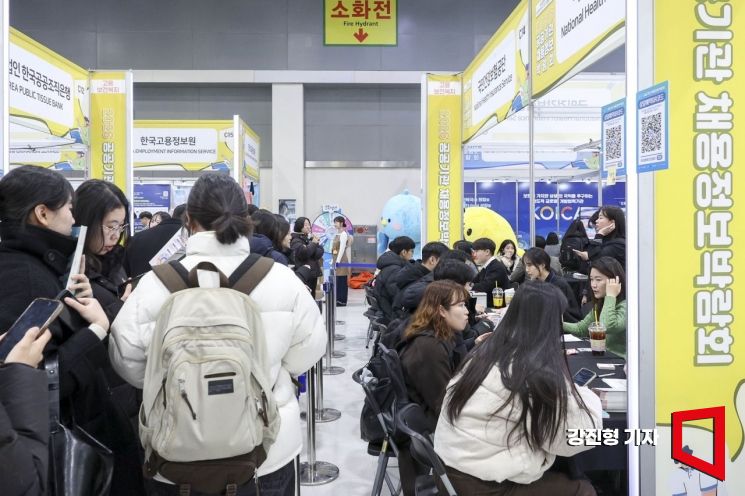 Job seekers participating in the '2026 Public Institutions Job Fair' held at the aT Center in Seocho-gu, Seoul, on the 27th are visiting the National Health Insurance Service to obtain employment information. 2026.1.27 Photo by Kang Jinhyung
Unemployment indicators also worsened. The number of unemployed people last month was 1,211,000, up 128,000 from a year earlier, and the unemployment rate rose 0.4 percentage points to 4.1%. The youth unemployment rate climbed 0.8 percentage points to 6.8%. The number of people who are neither working nor looking for a job and are classified as "taking a break" also increased, with the youth population in this category alone growing by 35,000, signaling early signs of withdrawal from the labor market.
In addition, the spread of generative AI is heightening anxiety about the employment outlook for young people. According to a Bank of Korea report, since the launch of ChatGPT, youth employment in the field of computer programming, systems integration and management has fallen by 11.2%, and in information services by 23.8%. Contrary to expectations that technological advancement will create new jobs, the analysis shows that in the short term, job losses have appeared in IT and information service sectors, where many young people seek to enter.
Perceptions on the ground show a similar pattern. In a survey of 1,000 office workers conducted by the civic group Workplace Gapjil 119, 48.2% of respondents said, "AI will replace jobs." Among respondents in their 20s, the proportion was highest at 58.1%. This indicates that both actual employment indicators and perception surveys highlight a pronounced sense of crisis among young people.
Experts diagnose the youth employment crisis as the result of a combination of cyclical factors and structural changes. They point out that as economic downturns reduce new hiring, the accelerating pace of technological change is raising the barrier to entry into the labor market. In particular, as the spread of AI boosts productivity and accelerates job restructuring, there is growing concern that employment anxiety among young people may go beyond a short-term phenomenon and develop into a structural problem.
© The Asia Business Daily(www.asiae.co.kr). All rights reserved.