Korea Benefits from Escalating China-Japan Tensions
Depreciation of the Won Also a Key Factor
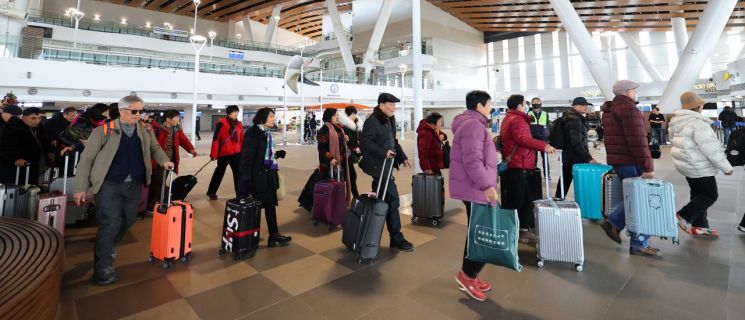 A group of Chinese tourists arriving through the Incheon Port International Passenger Terminal in Yeonsu-gu, Incheon. Yonhap News
With just two days left until the Lunar New Year, the biggest holiday in China, Chinese travelers are reportedly showing the strongest preference for trips to South Korea. Analysts say that, as tensions between Japan and China escalate, demand that once flowed to Japan is now being drawn to South Korea instead.
On the 15th, the South China Morning Post (SCMP) ran a feature story titled, "Why South Korea Has Emerged as a Popular Destination for Chinese Tourists During This Lunar New Year Holiday."
According to analysis by China Trading Desk, about 250,000 Chinese tourists are expected to visit South Korea during the 40-day Lunar New Year holiday period. This means that one quarter of the total 1 million projected travelers will be entering South Korea.
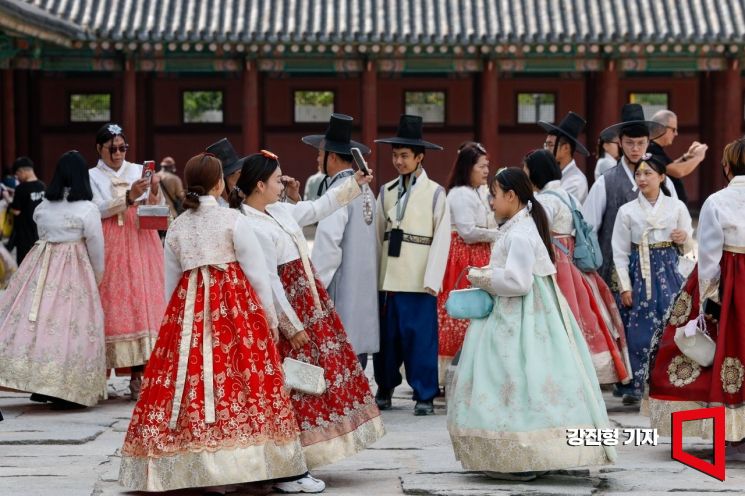 Groups of Chinese tourists are spending time at Gyeongbokgung in Jongno-gu, Seoul. Photo by Kang Jinhyung
While the heightened conflict between China and Japan is a major reason Chinese tourists have turned toward South Korea, the reduced travel costs stemming from the depreciation of the Korean won have also played a key role. The yuan, which had stayed around 180 won until 2024, surged to the 200 won level early last year, and is currently at 209.37 won, maintaining an all-time high.
Another factor cited is the easing of Korea-China relations, exemplified by President Xi Jinping’s visit to South Korea during the last APEC meeting and his talks with President Lee Jaemyung.
Meanwhile, China and Japan are heightening tensions over their territorial dispute in the East China Sea surrounding the Senkaku Islands (known in China as Diaoyudao), with the standoff extending to coast guard vessels and military aircraft from both sides. On top of this, Japan’s efforts to bolster its defense capabilities and strengthen its security alliance with the United States, combined with China’s military buildup, are intensifying strategic competition.
Diplomatic clashes over the release of contaminated water from the Fukushima Daiichi nuclear power plant, as well as differing positions on the situation in the Taiwan Strait, are also fueling conflict. When issues of historical perception are added to the mix, relations between the two countries are locked in a phase of structural tension.
© The Asia Business Daily(www.asiae.co.kr). All rights reserved.
![Clutching a Stolen Dior Bag, Saying "I Hate Being Poor but Real"... The Grotesque Con of a "Human Knockoff" [Slate]](https://cwcontent.asiae.co.kr/asiaresize/183/2026021902243444107_1771435474.jpg)

















