Holiday meaning diverges by generation
54% of respondents in their 30s say, "I will not meet relatives"
Two out of three Koreans say they will not perform ancestral rites (charye) this Lunar New Year, according to a recent survey. More people also appear to be choosing short overseas trips or nearby domestic travel. An increasing number of citizens are opting for rest and personal happiness over formalities rooted in traditional holiday customs.
Although this Lunar New Year holiday period is relatively short, demand for overseas travel has surged. According to Incheon International Airport Corporation, from February 13 to 18 about 1.22 million passengers (total arrivals and departures) are expected to travel overseas through Incheon International Airport. The airport expects the busiest departure day during the Lunar New Year holiday to be the 14th, and the day with the largest number of arriving passengers to be the 18th.
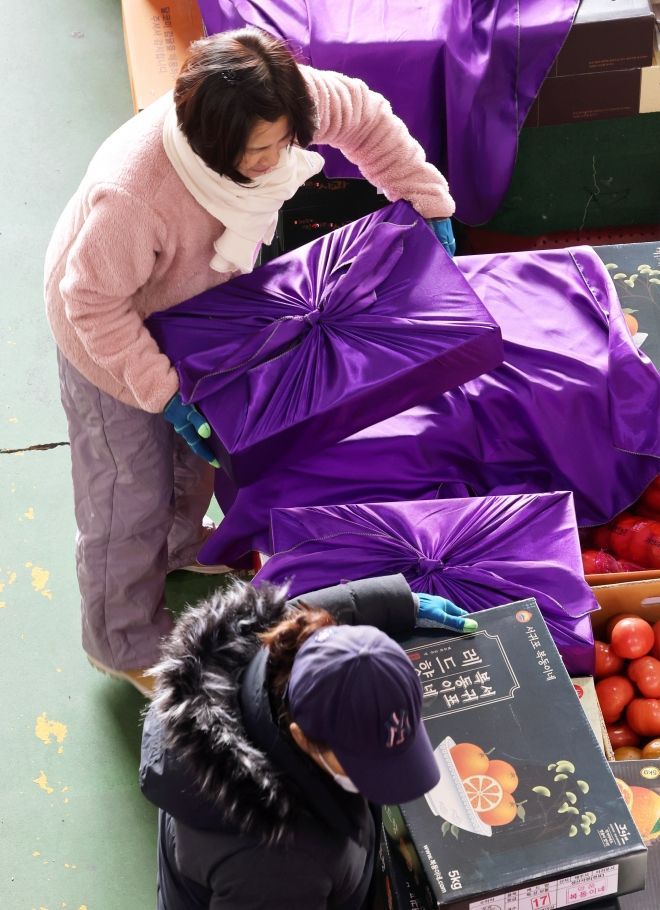 On the 12th, five days before Lunar New Year, merchants at the Seobu Agricultural and Fishery Wholesale Market in Maewol-dong, Seo-gu, Gwangju, were packing gift fruit boxes. (This photo is not directly related to the article.) Yonhap News
According to an analysis of Lunar New Year holiday (February 14 to 18) booking data (based on stay and usage dates) released by Nol Universe, Japan accounted for 50% of all overseas accommodation reservations.
In addition, a survey on “Plans for the 2026 Lunar New Year Holiday Schedule” released by Korea Research on the 10th found that only 35% of all respondents (1,000 people) said they would “hold charye or memorial rites” this year. This is a 5 percentage point decrease compared with last Lunar New Year. Only 44% said that charye or memorial rites are necessary, falling short of a majority.
The meaning of the holiday differs completely by generation. Regarding the meaning of this Lunar New Year, respondents aged 18 to 29 chose “a time for rest and recharging (52%)” and “a holiday no different from any other (48%)” at higher rates than other age groups.
In particular, 54% of respondents in their 30s or younger said, “I will quietly rest without meeting relatives who live separately,” making this the only age group in which a majority gave this answer. While 79% of married respondents planned to meet family, only 56% of unmarried respondents did so, showing a large gap.
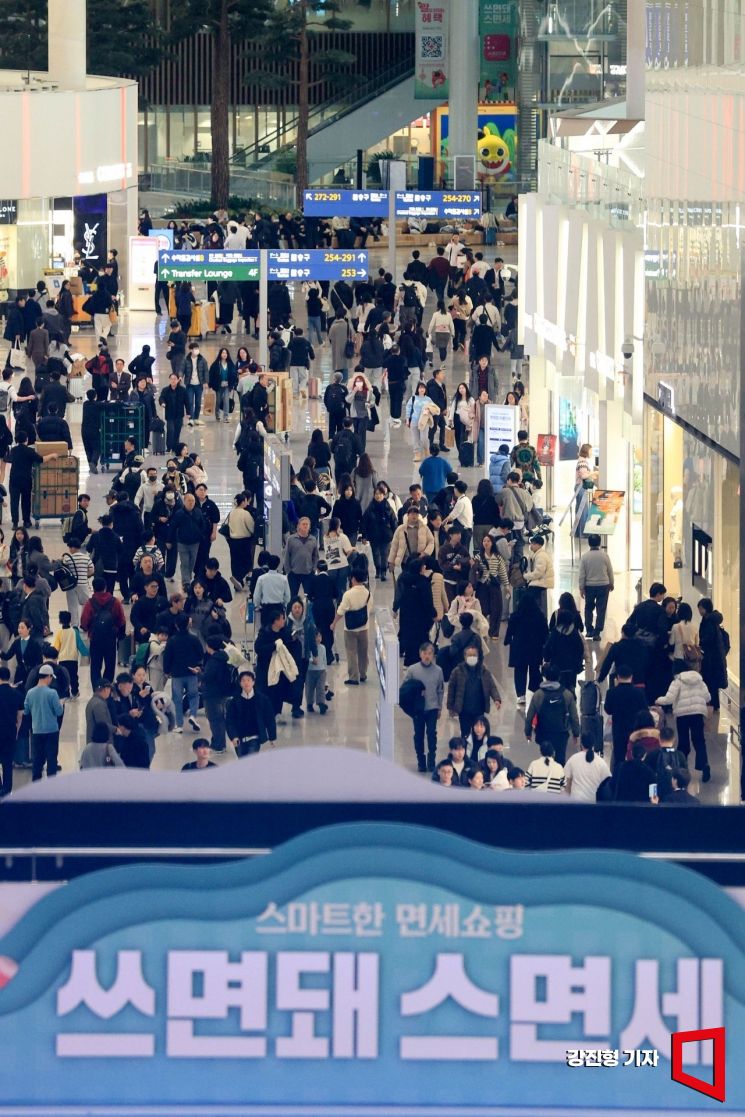 On the 12th, ahead of the Lunar New Year holiday, the duty-free area at Incheon International Airport Terminal 2 was crowded with travelers. 2026.2.12 Kang Jinhyung, Reporter
By contrast, among those in their 60s and those aged 70 or older, “commemorating ancestors and deceased family or relatives” accounted for 38% and 37%, respectively, nearly a 30 percentage point difference from the 9% recorded among respondents aged 18 to 29.
The burden of holiday duties on married women remained high. Among married women, 38% said they felt an “economic burden” this Lunar New Year, 12 percentage points higher than married men (26%). In addition, 29% of married women said it is a period when they feel “physical fatigue,” nearly four times higher than the 8% recorded among married men. This appears to reflect the reality that the burden of holiday preparations and care work is still concentrated on women.
Meanwhile, this survey was conducted by Korea Research as a web survey of 1,000 men and women aged 18 or older nationwide from February 6 to 9, 2026.
The sample was constructed using proportional allocation sampling by region, gender, and age, and the sampling error is up to ±3.1 percentage points at a 95% confidence level. Detailed survey results are available on the Korea Research regular survey website “Public Opinion in Public Opinion.”
© The Asia Business Daily(www.asiae.co.kr). All rights reserved.


















