Condemning Russia for Violating the Biological and Toxin Weapons Convention
Two years after the suspicious death in prison of Russian anti-government activist Alexei Navalny, a conclusion has been reached that there is a very high likelihood he died after being poisoned with a lethal toxic substance. The United Kingdom, France, Germany, the Netherlands, and Sweden issued a joint statement on the 14th (local time).
These countries announced that an analysis of samples taken from Navalny's body detected epibatidine, a toxin found in poison dart frogs native to Central and South America. Epibatidine is a poison that occurs naturally in wild dart poison frogs, but it can also be synthesized artificially in a laboratory. The toxin acts on the nervous system, causing respiratory distress, convulsions, seizures, and a reduced heart rate, ultimately leading to death.
 A photo of Russian opposition activist Alexei Navalny covered with flowers left by mourners. Photo by AP Yonhap News
They added that this substance does not occur naturally in Russia. The countries pointed out that although Russia has claimed that Navalny died of "natural causes," the extreme toxicity of epibatidine and the reported symptoms indicate that poisoning is a very likely cause of death. Citing the fact that Navalny died while in custody, they argued that "Russia had the means, motive, and opportunity to administer this poison."
Navalny, who had led large-scale anti-Kremlin protests against President Vladimir Putin, was serving a 19-year sentence on charges including contempt of court and extremism when he suddenly died on February 16, 2024.
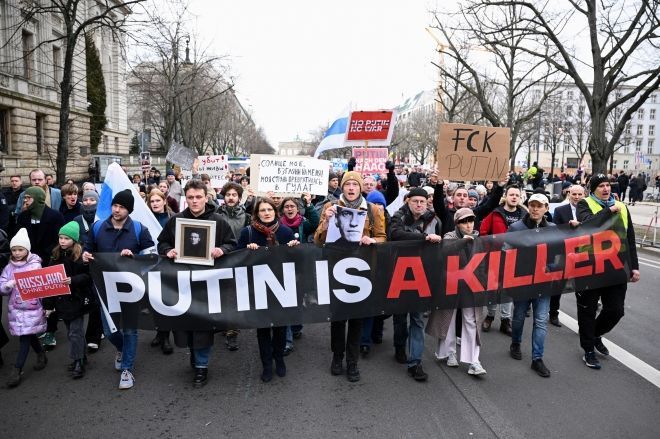 German protesters hold banner reading "Putin is a murderer" - February 18, 2024 (local time) On a street near the Russian embassy in Berlin, Germany, protesters protesting the suspicious death of Russian dissident Alexei Navalny are marching while carrying a banner that reads "Putin is a murderer." February 19, 2024, Berlin ? Reuters, Yonhap
At the time, the Russian authorities announced that Navalny had "felt unwell after a walk and died of natural causes," but Navalny's wife, Yulia Navalnaya, accused President Putin of poisoning her husband. The five countries reaffirmed their view that Russia has repeatedly disregarded international law and the Chemical Weapons Convention (CWC), and stated that this case may also constitute a violation of the Biological and Toxin Weapons Convention (BTWC).
They also said that the five countries' permanent representatives had sent a letter to the Director-General of the Organisation for the Prohibition of Chemical Weapons (OPCW) to notify him of the breach of the convention, and warned that they would "use all available means to ensure accountability." The statement also expressed concern that Russia "may not have destroyed all of its chemical weapons."
Navalny's wife, Yulia Navalnaya, also wrote on X (formerly Twitter), "Scientists from five European countries have proven that my husband was poisoned with epibatidine," adding, "This poison causes paralysis and respiratory arrest." She said she had been convinced from the beginning that he was poisoned and insisted that President Putin must be held responsible.
© The Asia Business Daily(www.asiae.co.kr). All rights reserved.


















