Korea Studies Advancement Center Releases Traditional Charye Table Etiquette
How should one set the table for ancestral rites during the Lunar New Year holidays? The Korea Studies Advancement Center has drawn attention by releasing traditional table-setting etiquette that distinguishes between charye (New Year ancestral rites) and jesa (ancestral memorial rites).
According to the center, the origins of the Lunar New Year charye table go back not to the Joseon Dynasty but to the Goryeo period. The History of Goryeo, compiled in 1451, contains records that charye was conducted in a Buddhist style. Originally, tea (cha) was offered on the charye table, but during the Joseon Dynasty, when Confucianism became the state religion, people began offering alcohol instead of tea.
Based on a review of old documents such as archives from head families (Jongga), Joseon-era diaries, and the Family Rituals of Zhu Xi (Jujagarye), the center concluded that the Korean charye table was composed as a simple rite. In other words, only a minimum of foods such as alcohol, fruit, and rice cakes were offered. There were no separate rules specifying the kinds of food, the number of dishes, or their arrangement. It is presumed that the practice of setting out soup, jeon (pan-fried dishes), and namul (seasoned vegetables) developed later.
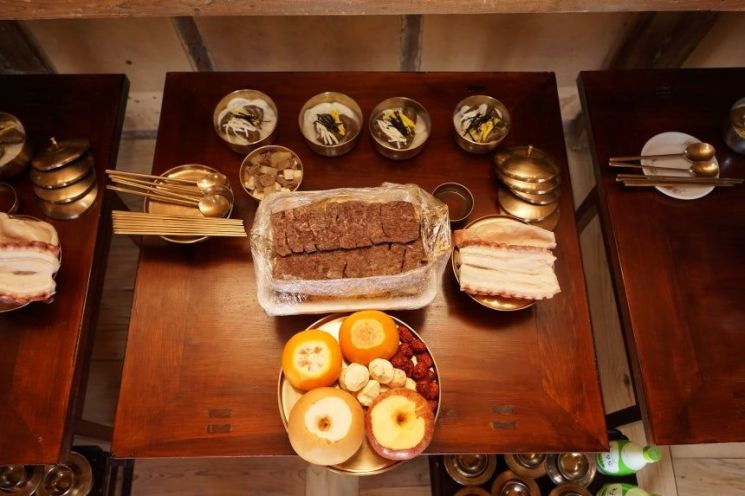 Ancestral ritual table setting at the main ancestral house of Kim Eongi of the Gwangsan Kim clan in Andong. National Institute of Korean Studies
Toegye Yi Hwang, a Neo-Confucian scholar of mid-Joseon, also followed the Family Rituals of Zhu Xi for jesa and charye tables, and his table setting consisted of only about five to six items: alcohol, rice, soup, grilled meat (jeok), dried meat or fish (po), and fruit. It is said that Yi Hwang was also wary of the custom of preparing an excessively lavish charye table. Numerous passages in Toegye's collected works and in the writings of his disciples state that "what matters is not the quantity of food, but the sincerity with which it is offered."
The center explained, "Joseon scholars referred to charye simply as 'ye' (ritual propriety) and regarded it as one of the everyday forms of etiquette," adding, "A simplified way of setting the charye table is closer to tradition, and they placed importance on the act of observing the rites itself rather than on the scale of the table setting."
There is also an analysis that the reason modern charye tables have grown in scale is because charye and jesa have become conflated. Since Lunar New Year is a holiday when the entire family gathers, the amount of food to prepare has increased, and for this reason, some interpret that the charye table has become more elaborate than the jesa table.
Kim Miyoung, senior research fellow at the Korea Studies Advancement Center, suggested, "In line with the original meaning of charye, it is necessary to simplify the table setting by reducing ritual offerings such as jujubes, chestnuts, and soup, and instead centering it on foods that the family can enjoy together."
Meanwhile, according to a survey on "Lunar New Year charye table costs" released by the Seoul Agro-Fisheries & Food Corporation, the cost of preparing this year's Lunar New Year charye table for a family of six to seven has risen by 4% compared with last year. The cost of purchasing items at traditional markets was 233,782 won, and at large discount stores it was 271,228 won, up 4.3% and 4.8% year-on-year, respectively.
© The Asia Business Daily(www.asiae.co.kr). All rights reserved.
!["The Woman Who Threw Herself into the Water Clutching a Stolen Dior Bag"...A Grotesque Success Story That Shakes the Korean Psyche [Slate]](https://cwcontent.asiae.co.kr/asiaresize/183/2026021902243444107_1771435474.jpg)
















