Draft rules released...public comments invited
"Vehicles must stop even without driver intervention"
Expected to be enforced mandatorily from July 2027
The Chinese government has released a new draft regulation that significantly strengthens safety standards for Level 3 (L3) autonomous vehicles. Observers say the standards have effectively been raised to a level close to L4.
China's Ministry of Industry and Information Technology announced the draft of the "Safety Requirements for Autonomous Driving Systems of Intelligent Connected Vehicles" on the 12th and began soliciting public comments, Caixin reported on the 14th. Under international standards, autonomous driving is divided into six levels from L0 (no automation) to L5 (full automation). Typically, vehicles at L3 or higher are regarded as autonomous vehicles.
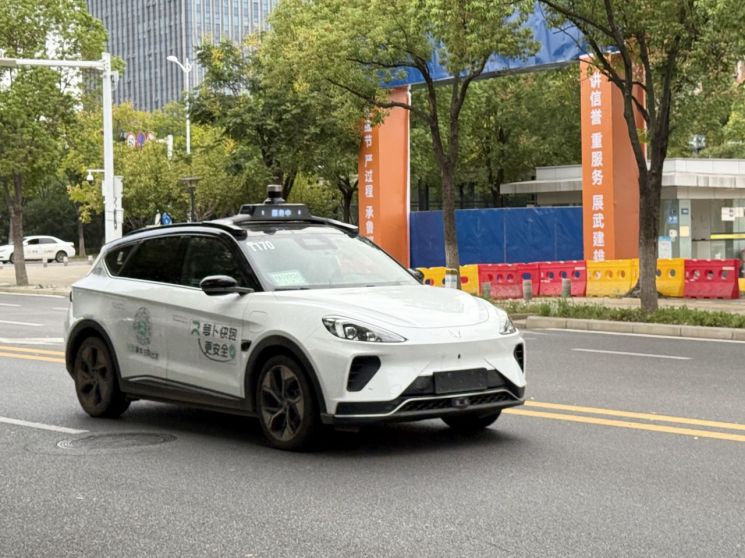
At L3, the vehicle handles driving in certain sections such as highways, but the driver must intervene whenever requested by the system. In contrast, at L4, even if the driver does not respond, the vehicle can independently execute a Minimum Risk Maneuver (MRM) and come to a safe stop.
The core of this draft is that it requires vehicles at the L3 level to handle risks on their own. If a situation arises in which the driver cannot control the vehicle or fails to respond, the system must automatically execute an MRM. The vehicle must be able to change lanes and stop at a location that does not impede traffic flow, while minimizing risks to road users such as passengers and pedestrians.
Additional safety requirements are also included, such as mandatory installation of an autonomous driving data storage system for automated driving (DSSAD), which functions like a black box.
This regulation is China's first mandatory national standard for L3 and L4 autonomous driving systems. It will replace the recommended standard (effective September 2024) that is currently in force. While companies may choose whether to follow a recommended standard, failure to meet a mandatory standard results in a ban on production, sales, and imports within China.
The regulation will take effect on July 1, 2027. Vehicles that have already been approved will also be subject to the new standards starting 13 months after implementation.
China has been expanding autonomous driving pilot projects, mainly in certain local regions. However, after a robo-taxi accident resulting in casualties in Zhuzhou, Hunan Province, in December last year, safety controversies have continued, and analysts say the authorities are now moving quickly to tighten standards.
© The Asia Business Daily(www.asiae.co.kr). All rights reserved.

















