Threat to Existing Business Models
Pressure on Private Credit and Leveraged Loans
As concerns grow that the disruptive innovation of artificial intelligence (AI) could threaten not only the software sector but also traditional industries such as finance, logistics, and real estate, investor anxiety is shaking the New York stock market.
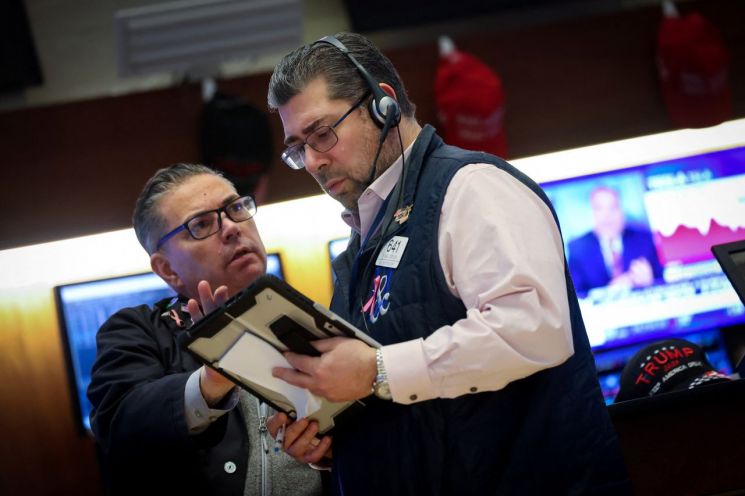 Traders are working on the trading floor of the New York Stock Exchange (NYSE) in New York City, United States. Reuters Yonhap News
On the 13th (local time), CNBC reported, citing a UBS report, that the risk of corporate loan defaults driven by AI could become a reality.
In the report, Matthew Mish, head of credit strategy at UBS, assessed that "as software and data service companies backed by private equity funds come under pressure from the AI threat, at least tens of billions of dollars in corporate loan defaults could occur this year." Mish presented as his base-case scenario the possibility that between 75 billion and 120 billion dollars in leveraged loans and private credit could go bad within this year.
Mish stressed that "the disruptive innovation brought by AI is not a problem for 2027-2028, but a reality that is already under way," and said investors need to reassess credit risk.
Fears that AI tools will replace the functions of specialized enterprise software are already starting to materialize in the market. Following the launch of new technologies such as Anthropic's "Claude Co-Work," software stocks fell across the board. Subsequently, in data services, asset management, real estate, and logistics, investor sentiment weakened and share prices plunged on expectations that AI could transform existing business models.
For example, logistics company C.H. Robinson Worldwide plunged 14.54 percent that day, while real estate services firms CBRE and Jones Lang LaSalle fell 8.84 percent and 7.57 percent, respectively. In finance, Morgan Stanley dropped 4.88 percent, illustrating how the AI shock is spreading across sectors.
Market experts interpret this correction not as mere volatility but as a signal of an impending restructuring of industrial structures. Given the rapid spread of AI, how quickly companies absorb or respond to AI is expected to be the key factor determining the future direction of their share prices. Emmanuel Cau, an analyst at Barclays, noted that "the list of companies that will be affected by AI is growing every day, and the gap between the new and old parts of the economy is widening."
Keith Buchanan, portfolio manager at Globalt Investments, said, "It is difficult for investors to respond to the impact AI will have across the entire economy. The speed of companies' strategic responses will determine future market confidence."
© The Asia Business Daily(www.asiae.co.kr). All rights reserved.
![Clutching a Stolen Dior Bag, Saying "I Hate Being Poor but Real"... The Grotesque Con of a "Human Knockoff" [Slate]](https://cwcontent.asiae.co.kr/asiaresize/183/2026021902243444107_1771435474.jpg)
















