A new image sensor has been developed that maintains accurate color separation even when the angle of incoming light changes. It is being hailed as a structural innovation that goes beyond the physical limits of conventional cameras. Once commercialized, this technology is expected to make it possible to capture clear and natural colors (photos) even in low-light environments.
KAIST announced on the 14th that a research team led by Professor Jang Minseok in the Department of Electrical and Electronic Engineering at KAIST and a team led by Professor Jung Haejoon at Hanyang University have developed a metamaterial technology for image sensors that can stably separate colors even when the angle of incidence of light varies.
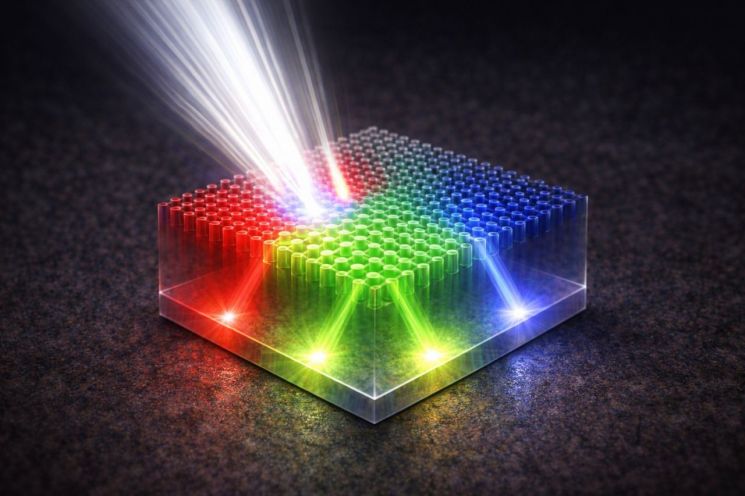 Nanophotonic color router technology (AI-generated image). Korea Advanced Institute of Science and Technology (KAIST)
Conventional smartphone cameras use very small lenses to focus light onto a single point to take pictures. As pixels inside the camera become smaller, however, this approach has the drawback that the lens alone struggles to collect enough light.
The Nanophotonic Color Router compensates for this drawback by using an extremely small, invisible structure to separate light by color instead of focusing it with a lens. This structure is a metamaterial-based technology that precisely routes light along designed paths and separates it into red (R), green (G), and blue (B).
Samsung Electronics has already demonstrated the commercial potential of this technology by applying it to an actual image sensor under the name "Nano Prism." Theoretically, it is known that stacking multiple layers of extremely fine nanostructures allows more light to be collected and colors to be separated with higher accuracy.
However, existing nanophotonic color routers work properly only when light enters from directly in front, and show limitations (the oblique incidence problem) in situations where light comes in at an angle, as in smartphone cameras, causing color mixing or severe performance degradation. This is a challenge that must be solved before nanophotonic color routers can be applied to real products.
Before addressing the challenge, the joint research team first identified its root cause. They found that existing designs were overly optimized for conditions where light enters perpendicularly, so even a slight change in the angle of incidence led to a sharp drop in performance.
Because smartphone cameras receive light from a wide range of angles, it is crucial to maintain performance even at different angles.
To achieve this, instead of having humans design the structure directly, the joint research team adopted an inverse design approach, in which a computer autonomously searches for the optimal structure. Using this method, they derived a color router structure that can stably separate colors even when the angle of incoming light changes.
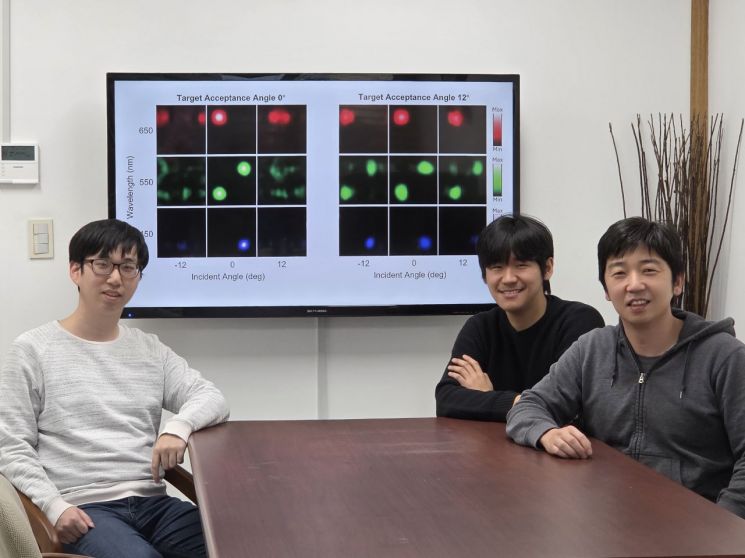 (from left) Park Chanhyung, PhD candidate in the Department of Electrical and Electronic Engineering; Jeon Jaehyun, undergraduate student in the Department of Physics; Jang Minseok, professor in the Department of Electrical and Electronic Engineering. KAIST
The color router structure maintained about 78% optical efficiency and stable color separation performance even when the light had a tilt of up to ±12 degrees. This level of performance is sufficient for smartphone usage environments and stands in stark contrast to existing structures, which were almost nonfunctional within the same angular range.
In particular, the joint research team systematically analyzed performance variations and limits by taking into account the number of metamaterial layers, design conditions, and possible fabrication errors, and by evaluating how robust the structure is to changes in the angle of incidence. This study is significant in that it presents design criteria for color routers that reflect realistic image sensor operating conditions.
Professor Jang Minseok of KAIST said, "This study is meaningful in that it systematically analyzed the incidence-angle issue that has hindered the commercialization of color router technology and proposed a direction for resolving it," adding, "The design method proposed by the joint research team can be applied not only to color routers but also to a wide range of metamaterial-based nanophotonic devices."
Meanwhile, KAIST undergraduate student Jeon Jaehyun and PhD candidate Park Chanhyung participated in this research as co-first authors. The research results (paper) were recently published in the international journal Advanced Optical Materials.
© The Asia Business Daily(www.asiae.co.kr). All rights reserved.


















