A Daring Comeback Written by Teen Spirit, Transforming the Team's Mood
Gen Z Performances Raise Expectations for the Remaining Schedule
Some See It as the Starting Signal of a Generational Shift in Winter Sports
At the 2026 Milan-Cortina d'Ampezzo Winter Olympics, the athletes leading South Korea's medal race are not familiar veteran faces but teenage rookies. So far, 3 out of the 4 medals (75%) that South Korea has won have come from teenage athletes. With an average age of 17.7 (Choi Gaon 17, Lim Jongeon 18, Yoo Seungeun 18), this de facto "high school squad" is opening a new era for Korean winter sports.
On the 13th, Yonhap News Agency highlighted the performances of these teenage Taegeuk Warriors, reporting that 3 out of the 4 medals that the South Korean delegation has won so far at the 2026 Milan-Cortina d'Ampezzo Winter Olympics were earned by athletes in their teens.
 On the 13th, at Livigno Snowpark in Italy, Korea's Choi Gaon scored 90.25 points in the ski and snowboard women's halfpipe final at the 2026 Milan-Cortina d'Ampezzo Winter Olympics to win the gold medal and is celebrating after the medal ceremony. Yonhap News
Among the teenage athletes, the most striking name is Choi Gaon in the women's snowboard halfpipe. Born in 2008, she scored 90.25 points in her third run of the final, overtaking Chloe Kim (88.00 points), who was aiming for a "third straight title," to claim the gold medal. This marks the first-ever Winter Olympic gold medal in the history of Korean skiing. At the same time, at 17 years and 3 months old, she also broke the record as the youngest gold medalist in the event. She shed tears after consecutive mistakes in her first and second runs, but her flawless final run created a "come-from-behind drama" that has been the most memorable moment of the Games so far.
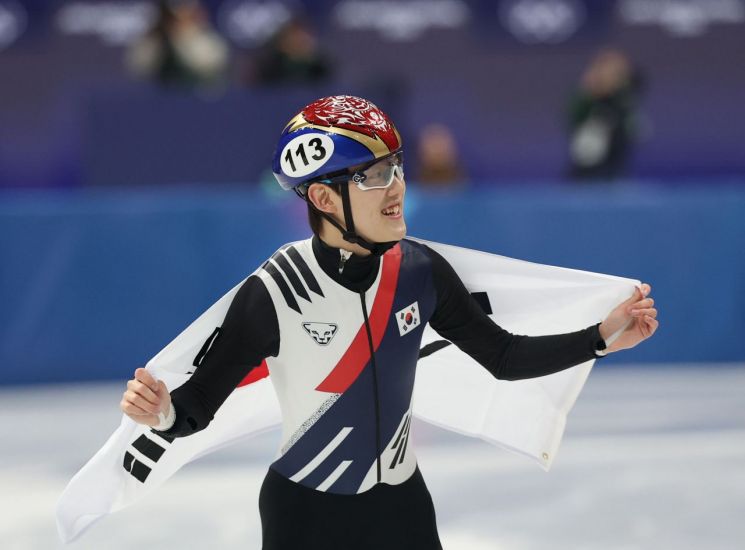 Lim Jongeon of South Korea, who won the bronze medal in the men's 1000m short track final at the 2026 Milan-Cortina d'Ampezzo Winter Olympics held on the 13th at the Ice Skating Arena in Milan, Italy, is wrapped in the South Korean flag and celebrating. Yonhap News
On the ice, the youngest member of the short track national team, 18-year-old Lim Jongeon of the Goyang City Hall team, made a strong impression. In the men's 1000m final, he had stayed at the back of the pack for most of the race, but unleashed an explosive sprint on the final lap to cross the finish line in third place. From the quarterfinals through to the final, he pulled off a "last-minute comeback" in every race, and his race management signaled the emergence of a next-generation ace.
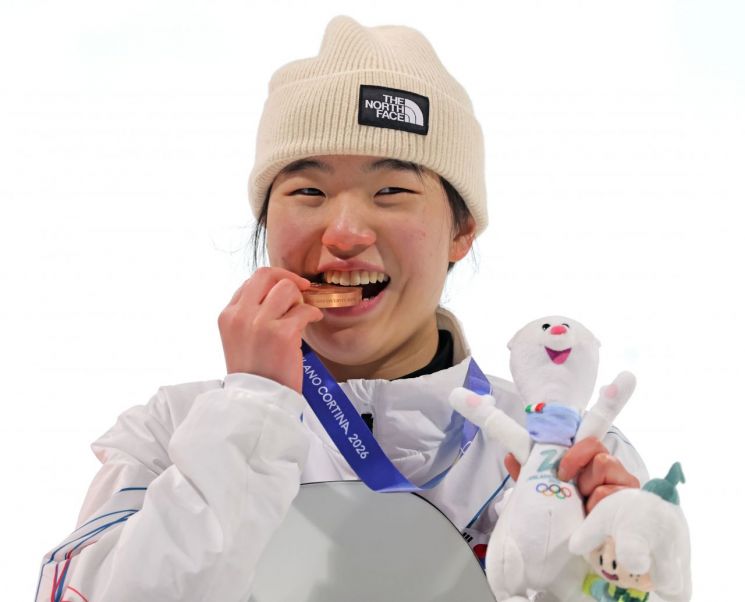 On the 10th at Livigno Snowpark in Italy, Yoo Seungeun, who won the bronze medal in the women's snowboard big air at the 2026 Milan-Cortina d'Ampezzo Winter Olympics, is biting her medal. Photo by Yonhap News
In the women's snowboard big air, 18-year-old Yoo Seungeun of Seongbok High School won the bronze medal. By perfectly landing the highly difficult "backside triple cork 1440," which involves four and a half rotations backward, she set a new milestone as the first Olympic medalist in a women's snow event for South Korea. "I had never landed it perfectly in practice, but all I had in mind was that I would do it in the competition," she said. The fearless boldness characteristic of teenagers bore fruit.
At the Summer Olympics, the "teenage sensation" had already lifted the overall mood of the national team when shooters Oh Yejin (19) and Ban Hyojin (16) won gold medals at the 2024 Paris Games. However, it is rare for teenagers to account for 75% of the medals, as they have at these Milan Games. That is why this is being interpreted not just as a passing sensation, but as the starting signal of a "generational shift." The positive energy generated by medalists with an average age of 17.7 is providing a powerful boost for the remaining events. The challenges they are mounting on ice and snow go beyond a simple medal race and are shaping into a trend that could reshape the future landscape of Korean winter sports.
© The Asia Business Daily(www.asiae.co.kr). All rights reserved.
![Clutching a Stolen Dior Bag, Saying "I Hate Being Poor but Real"... The Grotesque Con of a "Human Knockoff" [Slate]](https://cwcontent.asiae.co.kr/asiaresize/183/2026021902243444107_1771435474.jpg)


















