Dow Jones and Nasdaq Indexes Decline
S&P 500 Falls for Third Straight Session
Caution Deepens on Wall Street
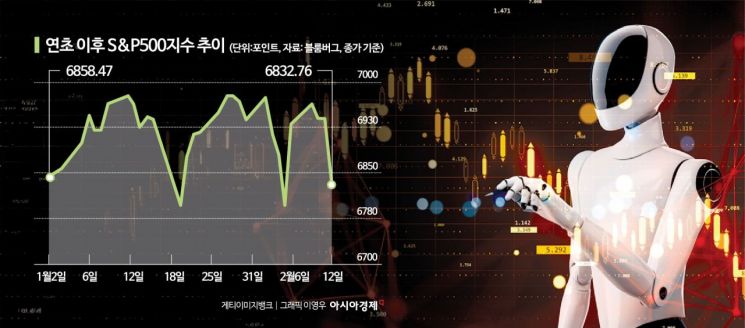
The artificial intelligence (AI) that has driven the rise in the U.S. stock market has returned as a "double-edged sword." The three major New York stock indexes fell by between 1% and 2% as panic selling continued on fears that AI will disrupt industries. On Wall Street, warnings are emerging that while AI technology momentum may remain valid in the short term, investors need to diversify their portfolios over the medium to long term.
On the 12th (Eastern Time), at the New York Stock Exchange (NYSE), the Dow Jones Industrial Average closed at 49,451.98, down 1.34% from the previous session. The large-cap-focused S&P 500 Index fell 1.57% to 6,832.76, and the tech-heavy Nasdaq Composite Index dropped 2.04% to 22,597.15. As a result, the S&P 500 has now extended its losing streak to three consecutive trading days.
Rotation out of a small number of big tech (large information technology) stocks into various other sectors, along with uncertainty over returns on big tech's massive AI infrastructure investments, weighed on the market. The combined capital expenditure (CAPEX) forecast for this year for four companies — Amazon, Meta, Google, and Microsoft (MS) — reaches 660 billion dollars (about 958 trillion won).
On top of this, concerns have taken root on Wall Street that an AI tool unveiled last month by AI startup Anthropic could rapidly erode the existing profit structures of specific industries such as software, finance, transportation, and logistics. Palantir Technologies alone fell 4.8% on the day. Since the beginning of the year, it has declined 23%.
This has translated into deteriorating profitability for the private equity fund (PEF) industry that has invested in software-related stocks. The real estate sector also saw share prices fall as forecasts gained traction that advances in AI will replace white-collar jobs and thereby reduce demand for commercial real estate such as offices. Real estate services firms CBRE and SL Green Realty each recorded single-day declines of more than 8% and 4%, respectively.
Excessive earnings expectations among investors are another burden. While the earnings of large technology stocks are generally solid, they are being immediately corrected when they fail to meet elevated expectations. Cisco Systems, a network equipment manufacturer, reported second-quarter (fiscal quarter) revenue and earnings per share (EPS) that beat market forecasts this year. However, weakness in its gross margin came to the fore, and its share price plunged 12.32%.
Wall Street's sense of caution has also grown. Capital Economics (CE) predicted in a "client memo" sent on the 9th that the S&P 500 could climb to the 8,000 level this year and then revert to around the 7,000 level by 2027. This implies a decline of about 13%. The firm expects investors will come to feel that technology stock valuations have become excessively high. In a worst-case scenario, a 30% correction cannot be ruled out, added CE economists Jennifer McKeown and William Jackson.
By contrast, Swiss investment bank (IB) UBS projected in a recent report that the S&P 500 Index could reach the 7,700 level by year-end. This would represent an additional gain of about 12% from current levels. As grounds for its optimistic view, UBS cited the U.S. Federal Reserve (Fed)'s dovish stance, the robust growth of the U.S. economy, and the continued AI momentum.
However, UBS also noted that, following the strong rally at the start of the year, the possibility of heightened short-term volatility cannot be ruled out. It further analyzed that investors should reduce their concentration in the "Magnificent 7 (M7)" and diversify across sectors such as financials, healthcare, and utilities.
© The Asia Business Daily(www.asiae.co.kr). All rights reserved.

















