Reaffirming Commitment to Implementing the Tariff Agreement, Selecting Candidate Projects Ahead of the Special Act
Semiconductors, Energy, and Critical Minerals Cited as Strong Candidates for Advanced Industry Cooperation
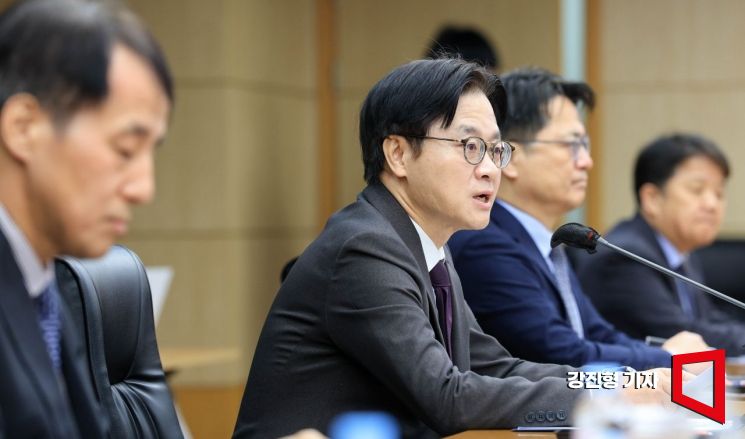 Kim Jeonggwan, Minister of Trade, Industry and Energy, is delivering remarks at the "Korea-U.S. Strategic Investment MOU Implementation Committee" held at the Korea Trade Insurance Corporation in Jongno-gu, Seoul on Feb. 13, 2026. Photo by Kang Jinhyung
The government has begun full operation of a unified government-level single window overseeing Korea-U.S. strategic investment projects, moving to manage trade risks related to the United States. While reaffirming its commitment to implementing the tariff agreement, it also announced a plan to select and review candidate projects even before the enactment of a special act for managing Korea-U.S. strategic investments (Special Act on Investment in the United States).
The Ministry of Trade, Industry and Energy announced on the 13th that it had held the first meeting of the "Korea-U.S. Strategic Investment Memorandum of Understanding (MOU) Implementation Committee." This meeting is the first official session to fully activate the interim implementation framework the government set up after U.S. President Donald Trump hinted late last month on social media (SNS) at the possibility of raising tariffs on Korean products. Vice ministers from relevant ministries, as well as the heads of the Korea Trade Insurance Corporation, the Export-Import Bank of Korea, and the Korea Development Bank, attended the meeting.
Minister of Trade, Industry and Energy Kim Jeonggwan said in his opening remarks, "Immediately after President Trump’s SNS post about tariff hikes late last month, I visited the United States and met with U.S. Secretary of Commerce Howard Lutnick, where I reaffirmed our government’s commitment to implementing the Korea-U.S. tariff agreement," adding, "I also shared with the U.S. side our legislative plan for the Korea-U.S. Strategic Investment Special Act." He went on to explain, "Even before the special act comes into force, we have established an interim implementation framework through this week’s Meeting of Ministers on External Economic Affairs so that we can review candidate projects to the maximum extent possible within the scope of administrative authority."
The Implementation Committee launched on this day will serve as a "single window" that will henceforth oversee consultations related to Korea-U.S. strategic investments. The aim is to verify the commercial viability of strategic projects and to unify the consultation channel with the United States in order to accelerate decision-making. Under the committee, a "Preliminary Project Review Team" will be established to allow public-private experts to conduct advance assessments of each project’s economic feasibility, strategic value, and contribution to the national interest.
The government intends to use investment projects in the United States not as simple capital outflows, but as opportunities to expand exports and enhance technological cooperation. Minister Kim stressed, "We will create opportunities for our companies to secure references in the U.S. market and to increase exports of equipment and materials," and added, "We will also build a foundation for acquiring advanced strategic assets overseas and for combining U.S. cutting-edge technologies with domestic manufacturing capabilities."
During the meeting, participants discussed recent developments in the implementation of the Korea-U.S. tariff agreement, the review direction for candidate strategic investment projects, and future implementation procedures. It was reported that participants reached a consensus on the need for close cooperation among relevant ministries and policy finance institutions to ensure that investment projects in the United States align with the national interest.
Based on the strategic investment framework agreed upon by Korea and the United States and discussions within related industries, key candidate projects are expected to focus on strengthening local manufacturing and production bases in the United States and on cooperation in advanced industries. In particular, semiconductors and advanced manufacturing are cited as key pillars of bilateral cooperation. Expansion of semiconductor production lines, establishment of advanced packaging facilities, and reinforcement of equipment and parts supply chains are being mentioned as candidate projects, with investments under review to link research and development (R&D) centers or to expand local production.
Energy and new materials-related investments are also major targets. Projects associated with future industrial technologies are being discussed, including energy infrastructure, core minerals and battery supply chains, and renewable energy facilities. Given that the United States is striving to diversify supply chains and secure strategic materials, analysts say there is a high likelihood that investments in electricity, batteries, rare metal processing, and advanced materials will be included as strategic cooperation projects.
Minister Kim stated, "All future projects will be reviewed with professionalism and transparency under the principle of putting the national interest first and the standard of commercial rationality," and added, "We will fully convey our efforts to implement the tariff agreement to the U.S. side so that unnecessary misunderstandings between Korea and the United States do not recur."
© The Asia Business Daily(www.asiae.co.kr). All rights reserved.

















