Lead Proposal by Assemblyman Lee Jaegab
Call to Overhaul Legal Framework Hindering the Hemp Special Zone
The legislative call to expand the proven results accumulated in the Gyeongbuk Industrial Hemp Regulation-Free Special Zone into an industrial ecosystem has been formalized through a resolution passed by the local council.
On the 12th, the city council held the 4th plenary session of its 264th extraordinary meeting and adopted the "Resolution Urging Amendment of the Narcotics Control Act to Industrialize the Demonstration Outcomes of the Industrial Hemp Regulation-Free Special Zone," calling on the government and the National Assembly to improve the system.
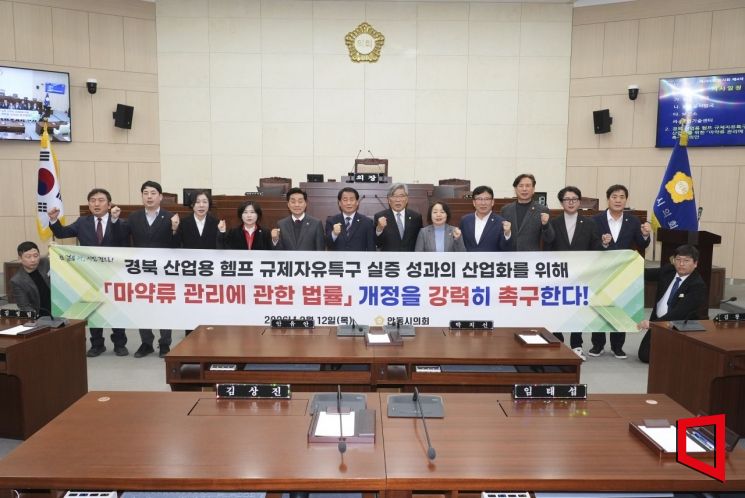
The resolution assessed that, despite having produced meaningful outcomes in the special zone such as high-purity CBD extraction, use as pharmaceutical and bio raw materials, and verification of export potential, the current law broadly regulates even areas unrelated to psychoactive components, thereby blocking corporate investment and the expansion of research.
It also made clear that, given the global trend in which countries manage hemp by distinguishing industrial and medical uses based on THC content and foster the market as a strategic industry, Korea likewise needs to revise its laws in line with scientific judgment and global standards.
The council presented as key tasks: a rational classification and management focused on psychoactive components; allowing research, manufacturing, and import/export of low-THC products and introducing a full-cycle tracking system; linking the special zone’s demonstration outcomes to commercialization; strengthening penalties for illegal cannabis distribution and clearly separating it from the legal industry; and establishing a phased legislative timetable by the government and the National Assembly.
Assemblyman Lee, who sponsored the resolution, said in his proposal explanation, "If state-approved demonstrations cannot break through the wall of the law, policy credibility will inevitably be shaken," adding, "Now we need a legislative decision that opens the door to industrialization based on the verification that has been carried out."
The city council plans to deliver the adopted resolution to the Presidential Office, the National Assembly, and relevant central government ministries, and to continue responding so that the needs from the field can be reflected in the subsequent discussion process.
Deregulation is not neglect, but something that is only possible on the basis of sophisticated management. If the contours of both risk and potential have already been revealed through testing, the next step is the time for institutionalization. Whether the special zone’s achievements will lead to future regional industries ultimately depends on the speed of legislation.
© The Asia Business Daily(www.asiae.co.kr). All rights reserved.

















