Samsung formalizes first mass production and shipment of HBM4
Passes Nvidia qualification, "customers are satisfied"
SK Hynix, Micron "already mass-producing HBM4"
Mass-production viability such as yield is key as supply race begins
Samsung Electronics has officially announced the first mass production and shipment of its sixth-generation high bandwidth memory (HBM4), moving in earnest to preempt the market. The industry had initially expected deliveries to major customers such as Nvidia to begin in the third week of this month, but the schedule appears to have been moved up as early-delivery requests from customers wanting supply before the Lunar New Year holiday coincided with Samsung Electronics securing stable yield. With Samsung firing the opening shot, supply competition among memory makers such as SK Hynix and Micron is expected to intensify further.
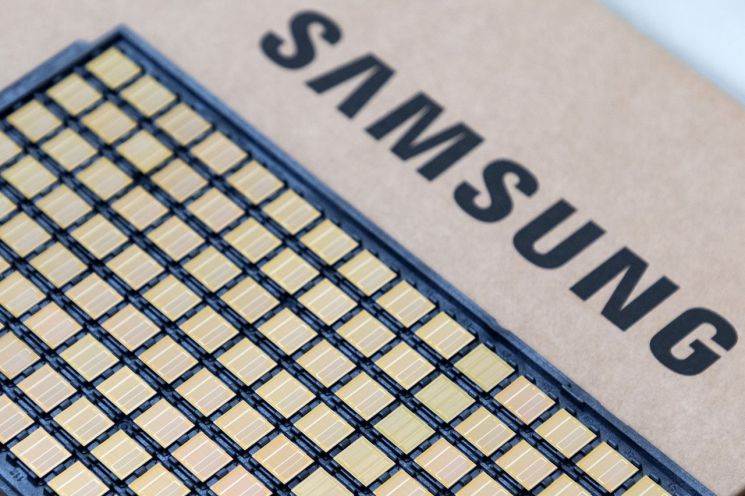
According to the semiconductor industry on the 13th, Hwang Sangjoon, Executive Vice President in charge of memory development at Samsung Electronics, stated in a press release the previous day, "Samsung Electronics' HBM4 broke with the precedent of applying already-validated processes and instead adopted the most advanced processes such as 1c DRAM and 4 nm (1 nm = one-billionth of a meter) foundry," adding, "By fully securing headroom for performance scaling through process competitiveness and design improvements, we were able to meet customers' demands for higher performance in a timely manner."
This indicates that the product has entered production after meeting the technical performance requirements set by Nvidia and passing its qualification tests. HBM4 is scheduled to be mounted on Nvidia's next-generation artificial intelligence (AI) chip "Vera Rubin." Jae-hyeok Song, President and Chief Technology Officer (CTO) of the Device Solutions (DS) Division at Samsung Electronics, also commented on the news of HBM4 shipments at the "Semicon Korea 2026" event on the 11th, saying, "We are now showing you our true capabilities," and described customer feedback as "very satisfactory."
Samsung HBM4 delivers speeds of up to 13 Gbps
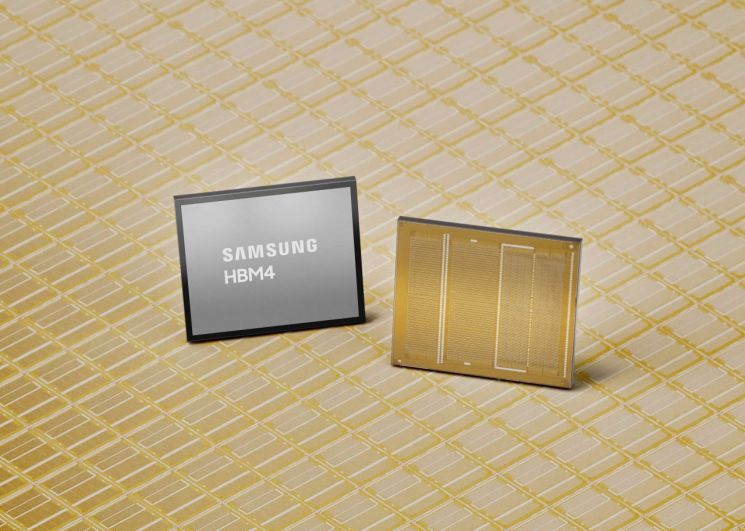
Samsung Electronics highlighted its use of the most advanced process technology and high operating speed as the key strengths. The company said it applied 1c DRAM and a 4 nm base die to this HBM4, securing stable yield and performance from the initial stage of mass production without the need for redesign. It also achieved a pin speed performance of 11.7 Gbps (gigabits per second). This is about 46% higher than the JEDEC (Joint Electron Device Engineering Council) standard of 8 Gbps, and the company explained that it can be scaled up to a maximum of 13 Gbps.
Samsung Electronics further emphasized that, on a single-stack basis, memory bandwidth reaches up to 3.3 TB/s (terabytes per second), exceeding the 3.0 TB/s level required by customers. For a 12-high stack, it offers a capacity range of 24 GB to 36 GB, and the company plans to scale up to a maximum of 48 GB when a 16-high stack is applied.
As the number of data-transfer I/O (input/output) pins has doubled from 1,024 to 2,048, Samsung Electronics applied low-power design technology to the core die to address the resulting power consumption and thermal concentration issues. It also adopted a low-voltage design for data transmission and reception via through-silicon vias (TSVs) and optimized the power distribution network (PDN), improving energy efficiency by about 40% compared with the previous generation, while enhancing thermal resistance characteristics by about 10% and heat dissipation characteristics by about 30%.
Samsung plants its flag first, intensifying the three-way battle
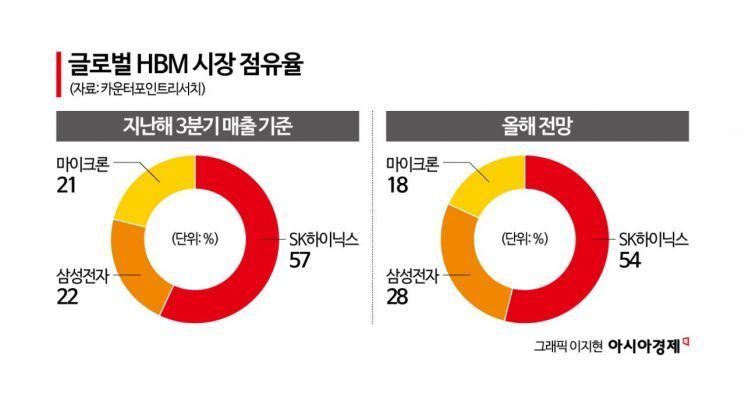
With Samsung Electronics officially confirming shipments of HBM4 for Nvidia, competition for supply among major memory makers has heated up. Micron, which had previously been seen as having dropped out of the race to supply HBM4 to Nvidia, also stated, "We have already started mass production of HBM4 and begun shipping to customers," raising the possibility that it could re-enter the supply chain. Mark Murphy, Chief Financial Officer (CFO) of Micron, said at a U.S. semiconductor conference on the 11th (local time), "Micron's HBM4 products provide speeds above 11 Gbps, and we are very confident in the performance, quality, and reliability of the products," stressing that "this year's HBM supply volume is sold out."
Rival SK Hynix likewise says it is mass-producing the volumes requested by customers. Hyunjong Song, President of SK Hynix, said at an earnings briefing on the 29th of last month, "HBM4 is also proceeding as scheduled through the same process, in line with the timeline agreed with customers," adding, "After establishing a mass production system for HBM4 in September last year, we have been mass-producing the volumes requested by customers." According to the industry, SK Hynix has also passed Nvidia's qualification tests and plans to begin large-scale shipments of HBM4 products within this month.
Jonghwan Lee, Professor in the Department of System Semiconductor Engineering at Sangmyung University, said, "For Samsung Electronics, which has been lagging behind SK Hynix in HBM, this has created an opportunity to turn the tables," but added, "However, if yields are not good, it will not be able to increase volume."

© The Asia Business Daily(www.asiae.co.kr). All rights reserved.



















