China Ranks First with 624 Phase 3 Cancer Trials
Large-Hospital Investments Enable Simultaneous Multiple Trials
Korea Lacks Mechanisms to Integrate Clinical Capabilities
China is rapidly catching up with the United States in clinical trial infrastructure, which is directly linked to new drug development capabilities. China has already surpassed the United States in the number of single-center Phase 3 cancer clinical trials conducted. This is the result of nationwide investment that has strengthened the basic clinical infrastructure centered on large hospitals. With the National Medical Products Administration (NMPA) having approved a record number of innovative new drugs last year, analysts say that the enhancement of clinical trial execution capabilities is translating into an increase in the volume of new drugs.
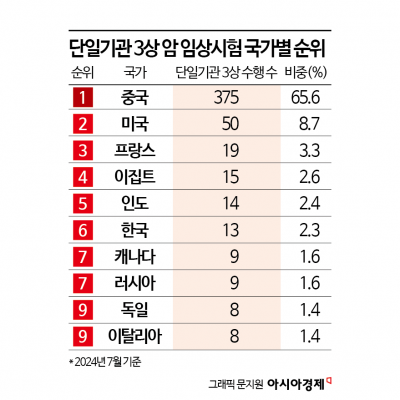
According to the pharmaceutical and biotech industry on February 13, an international joint research team that included the United States analyzed 1,237 Phase 3 cancer clinical trials registered in the National Institutes of Health (NIH) clinical trial registry system "ClinicalTrials.gov," and pre-released the study results on February 10 (local time) on the preprint server "medRxiv."
The analysis showed that 624 Phase 3 cancer trials were being conducted in China, accounting for 48.5% of the total and ranking first by country. However, in terms of the number of research institutions, the United States ranked first, with 2,626 institutions, or 39.6% of the total. China had 464 institutions, accounting for only 7%. In other words, the United States leads in the number of institutions, while China leads in the number of trials.
The most notable feature of clinical trials in China is the high proportion of "single-center Phase 3" studies, in which a single large hospital independently handles everything from patient enrollment to trial operations. Of the 572 single-center Phase 3 cancer trials worldwide, 398 were conducted in China, accounting for 70%. Unlike the United States and Europe, which recruit patients in a decentralized manner through multi-center and multi-country collaboration, China concentrates clinical trials in large tertiary hospitals with a large patient pool.
The research team interpreted this as the result of strategic investment in large research institutions. They explained that this structure accelerates clinical trial timelines and enables multiple Phase 3 trials to be conducted simultaneously, which in turn is linked to an increase in the number of new drug approvals.
China is building its biotech capabilities at the national level. Since the 2015 reform of the drug review system, it has significantly shortened clinical trial approval procedures and expanded the number of nationally designated clinical trial hospitals to more than 1,000. As a healthcare system that concentrates patients in large tertiary hospitals has combined with national research and development (R&D) support, it is believed that an ultra-large infrastructure capable of conducting single-center Phase 3 trials has been established.
The results of this investment are also visible in the numbers. In 2024, the total number of clinical trials registered in ClinicalTrials.gov from China exceeded 7,000, surpassing the United States. According to global consulting firm McKinsey, China’s share in the global innovative new drug pipeline has also risen to around 30%. Last year, the value of technology exports exceeded 40 billion dollars, marking a successful transition to a country that exports pipelines.
In this study, Korea accounted for 2.3% of the total, with 13 single-center Phase 3 cancer trials. Seven Korean institutions were included among the top 100 large research institutions, indicating that the competitiveness of individual hospitals is high. However, because trials are structurally dispersed across multiple institutions, the proportion of single-center trials is relatively low. Experts point out that, to supplement single-center trial capabilities, it is necessary to build hub-type platforms that link clinical data and patient resources across hospitals.
Currently, the Korea National Enterprise for Clinical Trials and the Korea Drug Development Fund respectively handle infrastructure support and project-based R&D functions, but the country is viewed as lacking a permanent network that integrates and manages hospital clinical capabilities. There have been collaborative cases such as the COVID-19 infectious disease clinical consortium, but these remained limited to specific diseases and project units and did not develop into a structure for jointly conducting large-scale clinical trials.
© The Asia Business Daily(www.asiae.co.kr). All rights reserved.
![Clutching a Stolen Dior Bag, Saying "I Hate Being Poor but Real"... The Grotesque Con of a "Human Knockoff" [Slate]](https://cwcontent.asiae.co.kr/asiaresize/183/2026021902243444107_1771435474.jpg)
















