Meeting to Discuss Korea-U.S. Trade Issues
"Doing Our Best to Ensure Passage of the Special Act on Investment in the United States"
"Close Consultations with the United States on Non-Tariff Areas"
On the 12th, Yeo Hangu, Director-General for Trade Negotiations at the Ministry of Trade, Industry and Energy, met with James Kim, Chairman of the American Chamber of Commerce in Korea (AMCHAM), and stated that "the Korean government is faithfully implementing the tariff agreements between the two countries in order to stabilize the Korea-U.S. trade environment."
On this morning, AMCHAM invited Director-General Yeo to a closed-door meeting at the Grand Hyatt Hotel in Yongsan-gu, Seoul. As recent Korea-U.S. trade frictions have expanded beyond tariff issues to non-tariff barriers, the meeting was arranged for the public and private sectors to discuss policy directions to stabilize the Korea-U.S. trade environment and to explore ways to enhance economic cooperation between the two countries.
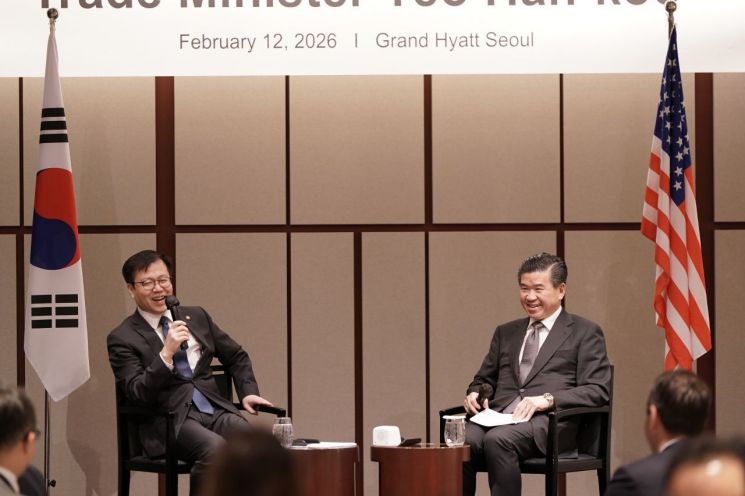 Yeo Hangu, Director-General for Trade Negotiations at the Ministry of Trade, Industry and Energy, and Kim James, chairman of the American Chamber of Commerce in Korea, were talking at a special luncheon hosted by the American Chamber of Commerce in Korea at the Grand Hyatt Hotel in Yongsan-gu, Seoul, on the 12th. Yonhap News Agency
In his opening remarks, Director-General Yeo said, "The fact that Korean companies' investments in the United States and U.S. companies' investments in Korea are expanding together proves that investment cooperation between the two countries is developing on a mutually beneficial basis," adding, "If, based on the tariff negotiations concluded last year and the Korea-U.S. strategic investment work MOU, the two countries jointly identify and support promising investment projects, I have no doubt that this year will be a year in which Korea-U.S. economic cooperation takes a leap forward."
Director-General Yeo stressed that he is working hard to ensure passage of the Special Act on Investment in the United States, which was introduced in November last year. He said, "A special committee of the National Assembly for handling the Special Act was launched on the 9th, and we are doing our utmost to secure the bill's passage," adding, "We will make sure that the Special Act is passed so that economic and industrial cooperation between the two countries can continue in a stable manner."
He continued, "As a follow-up task to the Korea-U.S. joint fact sheet, we are faithfully implementing measures related to non-tariff areas in close consultation with the U.S. side," adding, "We will actively share future progress with the U.S. administration and businesses." Director-General Yeo held discussions on non-tariff issues the previous day with Rick Switzer, Deputy U.S. Trade Representative at the Office of the United States Trade Representative (USTR), who visited Korea.
Regarding the progress of the Korea-U.S. tariff negotiations, Chairman Kim commented, "Although detailed adjustments are underway, Director-General Yeo has the capacity to enable the Korean government to bring the negotiations to an appropriate conclusion."
He also said, "Two weeks ago, President Lee Jaemyung said that during his term he hopes to see the number of global companies' (Asia) headquarters in Korea increase from fewer than 100 to 1,000," adding, "Companies such as Qualcomm, whose Asia headquarters are located in Korea, are serving as important role models." Chairman Kim and other heads of foreign chambers of commerce in Korea recently visited the Presidential Office and shared their views with President Lee on enhancing labor flexibility.
In the subsequent closed-door discussion, the participants addressed major pending issues, including the government's policy direction in response to recent changes in the trade environment, investment cooperation between Korea and the United States, and measures to improve the environment for foreign direct investment. Director-General Yeo conveyed the government's position that it will continue to fully gather opinions from stakeholders, including foreign-invested companies, during the process of introducing relevant policies.
During the closed-door discussion, which lasted about 30 minutes, Director-General Yeo and Chairman Kim were reported to have reached a consensus in particular on increasing the number of global companies' Asia headquarters in Korea to 1,000.
© The Asia Business Daily(www.asiae.co.kr). All rights reserved.

















