Supreme Court: "SK Hynix Bonuses Not Included in Ordinary Wage"
Lower Court Ruling Against Plaintiffs Upheld
First Instance: "Not a Regular or Continuous Wage"
Second Instance: "No Explicit Basis for Payment"
In Contrast to Samsung Electronics
In a lawsuit filed by former SK Hynix employees demanding that management performance bonuses be included in their average wages for the purpose of recalculating severance pay, the Supreme Court has sided with the company. With the Supreme Court finally confirming that performance bonuses are difficult to regard as wages paid in return for work, legal proceedings that lasted more than seven years have come to an end.
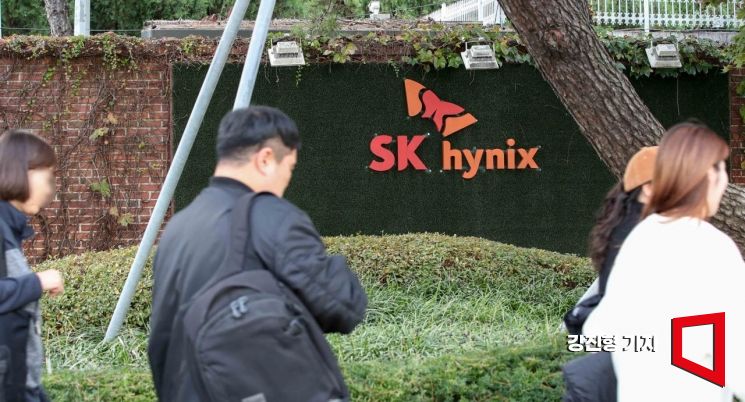 As SK Hynix posted record-high revenue, operating profit and net profit for Q3 2024 thanks to high-bandwidth memory (HBM), employees were leaving the SK Hynix headquarters in Icheon, Gyeonggi Province on the 25th. Photo by Kang Jinhyung
On the 12th, the First Division of the Supreme Court (Presiding Justice Ma Yongju) upheld the lower court ruling that found for the defendant in the appeal of a severance pay claim filed by former SK Hynix employees, identified as A and B, against the company.
A and B joined SK Hynix in 1997 and 1994, respectively, and left the company in 2016. After productivity incentives (PI) and profit sharing (PS) that they had received while employed were excluded from the average wage used as the basis for calculating severance pay, they filed suit in 2019 seeking payment of the difference that would arise if those amounts were included.
The average wage is the amount calculated by converting the total wages received during the three months prior to retirement into a daily amount, and it is the key standard that determines the size of severance pay. SK Hynix has been paying management performance bonuses since 1999 and, under labor-management agreements, has paid them each year to its employees, except for certain years.
The court of first instance ruled against the plaintiffs, finding that PI and PS do not constitute average wages. The first-instance court stated, "Management performance bonuses are not wages that can be viewed as being paid to employees on a regular and continuous basis, because the payment conditions are set each year through labor-management agreements, and whether they are paid and at what rate varies depending on business performance."
The appellate court took the same view, stating, "SK Hynix's PI and PS do not have any payment basis explicitly stipulated in collective agreements or salary regulations," and adding, "In light of the actual payment practices and relative weight of these bonuses, they lack a direct or close connection with the provision of labor, making it difficult to definitively regard them as wages," as it dismissed the retirees' appeal.
The Supreme Court reached the same conclusion. The bench held, "It is difficult to see SK Hynix as being under an obligation to pay the management performance bonuses at issue in this case on the basis of work rules, collective agreements, or labor practices," and further found, "In particular, among the management performance bonuses at issue, those linked to operating profit are also difficult to regard as being directly or closely related to the employees' provision of labor."
This reaffirmed the existing legal principle that, under the Labor Standards Act, wages that serve as the basis for calculating the average wage must be amounts that the employer is obligated to pay and that are directly or closely related to the provision of labor.
This ruling stands in contrast to a similar case brought by former Samsung Electronics employees, in which the Supreme Court late last month recognized the wage nature of "target incentives."
At that time, the Second Division of the Supreme Court (Presiding Justice Oh Kyungmi) held that Samsung Electronics' target incentives constitute wages, noting that the payment criteria were predetermined in the work rules and that the amount was fixed as a "fixed sum of money" based on each employee's base salary.
Observers attribute the difference in outcome to differences in the specific factual circumstances of the two companies' performance bonus schemes. While Samsung Electronics' target incentives were closer to "ex post settlement of work performance," SK Hynix's PI and PS were seen as having a stronger character as "ex post distribution of management performance," with the very fact of payment being uncertain depending on the company's business results. As a result of the Supreme Court's final ruling in this case, SK Hynix has been relieved of the burden of paying additional severance benefits.
© The Asia Business Daily(www.asiae.co.kr). All rights reserved.
![Clutching a Stolen Dior Bag, Saying "I Hate Being Poor but Real"... The Grotesque Con of a "Human Knockoff" [Slate]](https://cwcontent.asiae.co.kr/asiaresize/183/2026021902243444107_1771435474.jpg)












