FSC Announces "Delisting Reform Plan"
Strengthening Delisting Criteria Including Penny Stocks and Streamlining Review Procedures
Cleanup of Distressed Firms Accelerated Following President Lee’s Call to "Clear Out the Merchandise First"
Up to 220
Starting in July, the financial authorities will begin delisting so-called "penny stocks" whose share price is below 1,000 won. Even if a company formally boosts its share price through a reverse stock split, it will still be subject to delisting if the post-split price falls below par value. At the same time, they will move up the timing for raising the minimum market capitalization requirement and tighten the criteria related to capital impairment and disclosure violations, thereby overhauling the four major delisting standards across the board to accelerate the cleanup of insolvent companies. If this reform is implemented, it is estimated that up to 220 companies on the KOSDAQ market alone could fall within the scope of delisting this year.
"Shift to a High-Birth, High-Death Structure" KOSDAQ Delisting Intensive Management Period Starts Today
On the 11th, the Financial Services Commission and the Korea Exchange announced the "Delisting Reform Plan for Swift and Strict Exit of Insolvent Companies." The key points are: ▲operation of an intensive management period for KOSDAQ delistings ▲strengthening of the four major delisting criteria, including penny stocks ▲and streamlining of procedures.
Vice Chairman Kwon Dae-young of the Financial Services Commission said, "To make a major leap forward into a market trusted by investors, we need faster and more rigorous removal of insolvent companies," adding that "(this reform plan is) intended to accelerate a full-scale shift to a 'high-birth, high-death' market structure that supports the smooth listing of innovative companies while promptly and strictly delisting insolvent ones." He believes that, to secure additional upside momentum following the KOSPI’s move toward 5,000 points and the KOSDAQ’s move toward 1,000 points, it is urgent to expel insolvent companies, which are cited as a key factor in the overall market discount. Earlier, President Lee Jaemyung also likened the domestic stock market to a "department store," pointing out that "you must first clean up the merchandise."
Accordingly, the financial authorities will establish a KOSDAQ Intensive Management Unit within the exchange and operate a "delisting intensive management period" through June 2027. Effective immediately from this day, the unit will be headed by the Deputy CEO in charge of the KOSDAQ Division at the exchange, and will consist of a total of four teams (20 people) by adding one newly established team to the existing three delisting review teams. In particular, in the 2026 management evaluation of the exchange, they decided to assign a high provisional weighting of 20% to the KOSDAQ Division’s delisting performance when assessing results. Previously, delisting-related performance indicators were not included in the evaluation.
Early Hike in Market Cap Threshold, Penny Stocks... Four Major Delisting Criteria to Be Strengthened Across the Board
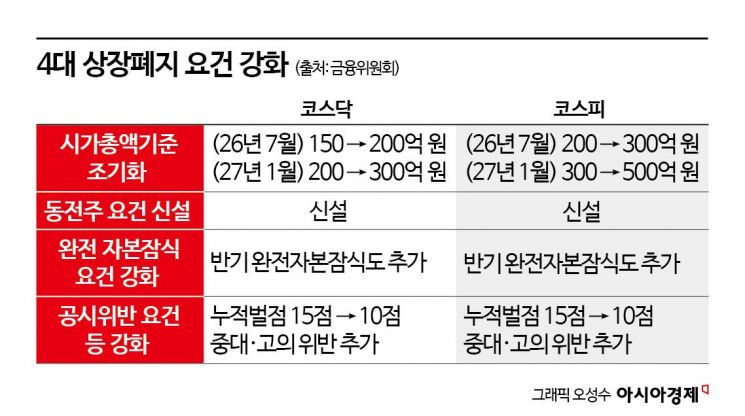
The core of this reform plan is the strengthening of the four major delisting criteria to be applied from July: market capitalization, penny stocks, complete capital impairment, and disclosure violations. First, the financial authorities decided to move up the timing of the previously announced hike in the market cap threshold for delisting. For KOSDAQ, the threshold was originally scheduled to rise to 20 billion won in January 2027 and 30 billion won in January 2028, but this will now be implemented earlier: 20 billion won in July 2026 and 30 billion won in January 2027.
To prevent companies from avoiding delisting through temporary share-price boosting, the maintenance requirements after designation as an issue under management will also be tightened. Previously, once a company was designated as an issue under management after failing to meet the market cap standard for 30 consecutive trading days, it could avoid delisting if it met the standard for 10 consecutive trading days and 30 cumulative trading days within a 90-trading-day period. Going forward, if it fails to meet the standard for 45 consecutive trading days within 90 trading days after being designated as an issue under management, it will be delisted immediately.
Similar to the U.S. Nasdaq, which enforces delisting criteria for "penny stocks" trading below 1 dollar, the authorities will introduce penny stock criteria as well. Vice Chairman Kwon said, "Penny stocks are characterized by high price volatility and low market capitalization, and they are easily targeted for stock-price manipulation," explaining that "starting July 1, stocks trading below 1,000 won will be newly introduced as a delisting criterion." If the share price remains below 1,000 won for 30 consecutive trading days, the stock will be designated as an issue under management, and if it fails to recover to at least 1,000 won for 45 consecutive trading days within the following 90 trading days, it will be delisted.
In particular, to block any detour through reverse stock splits, cases where the post-split share price falls below par value are also included in the delisting criteria. For example, if a company with a par value of 500 won and a share price of 300 won carries out a reverse split to raise par value to 2,000 won and its share price to 1,200 won in order to avoid the penny stock delisting criteria, it will still be subject to delisting. According to the exchange, as of the previous day, penny stocks listed on the KOSDAQ market accounted for nearly 10% of all listed issues. Vice Chairman Kwon stressed the background of introducing the penny stock criteria, saying, "This should have been done long ago. It is late in the sense that we are only now adopting international standards," and "At this point, it is better for the distant future to clean up the market thoroughly and move forward."
Along with this, the criteria for complete capital impairment will also be tightened. Previously, only complete capital impairment at the end of the fiscal year constituted a delisting criterion, but going forward, complete capital impairment at the half-year mark will be added as well. However, for the half-year basis, the listing status will be determined after a substantive review that considers the company’s going concern. In addition, the delisting criterion for disclosure violations will be eased in terms of the numerical threshold: the current standard of "15 cumulative penalty points from disclosure violations over the past year" will be lowered to 10 cumulative points. In particular, a single serious or intentional disclosure violation will be enough to trigger delisting. Vice Chairman Kwon explained, "These strengthened four criteria will be applied in the same way to the KOSPI market."
Delisting Reviews to Speed Up as Well..."Around 150 KOSDAQ Firms This Year"
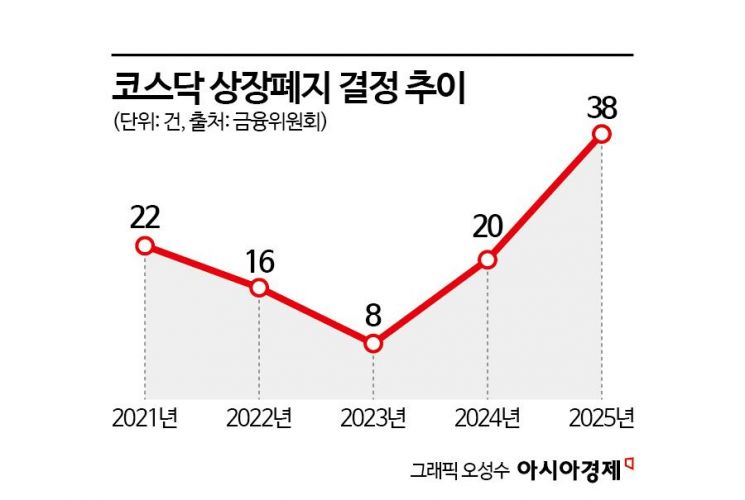
The reform plan also includes measures to streamline procedures in delisting reviews. Accordingly, the maximum improvement period in KOSDAQ substantive reviews will be shortened from the current 1 year and 6 months to 1 year. The maximum improvement period at the second-instance review will be cut from 1 year to 6 months, reducing the combined maximum period for the first and second instances to 1 year. The exchange also plans to consult with the courts to ensure swift handling of applications for injunctions against delisting. Over the past five years, only 2 out of 85 applications for injunctions against delisting were granted, but the average time to decision increased from 103 days in 2022 to 202 days in 2024.
If the reform plan is implemented, it is estimated that 100 to 220 companies on the KOSDAQ market alone could become subject to delisting this year. Vice Chairman Kwon said, "According to a simple simulation by the exchange, the number of KOSDAQ companies subject to delisting this year will be around 150, about 100 more than the previously expected 50," adding, "We will activate the intensive management period immediately from today. We will not tolerate any unfair practices, including accounting fraud and stock-price manipulation." Measures to streamline procedures that require follow-up steps such as rule amendments will take effect from April 1, and the strengthened four criteria will be implemented from July 1.

When asked how much the KOSDAQ index might rise if insolvent companies are delisted under the reform plan, he replied, "It would be inappropriate to mention a specific figure, as it could mislead investors," but added, "It will rise significantly from where it is now." The authorities also plan to simultaneously improve the listing system so that promising innovative companies can fill the void left by insolvent firms. He went on to say, "Furthermore, we will work to ensure that the domestic exchange innovates to global standards and is reborn as a hub for growth and innovation companies and as a key Asian exchange," adding, "We will swiftly prepare fundamental innovation measures that amount to a complete redesign of the exchange."
© The Asia Business Daily(www.asiae.co.kr). All rights reserved.



















