Chinese Historical Drama "Taepyeongnyeon" Draws Attention for Its Anti-War Message
Viewed by Some as a Metaphor for Today's Cross-Strait Relations
"A Symbol of Peaceful Cross-Strait Relations," "A Source of Controversy"
As a historical drama set during the Five Dynasties and Ten Kingdoms period has recently gained popularity in China, some observers interpret the anti-war ideology embedded in the series as being connected to today's cross-strait relations between China and Taiwan.
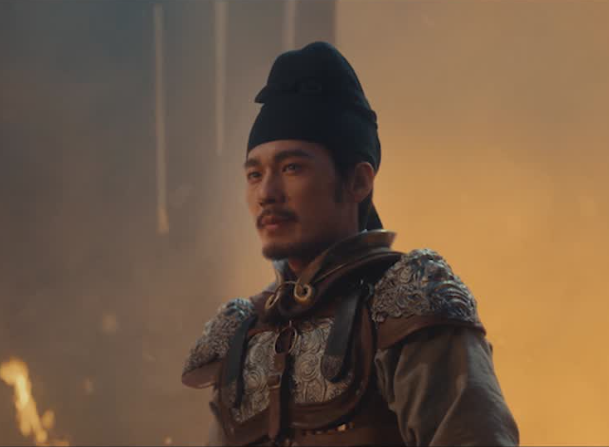
On the 11th, Yonhap News, citing Chinese-language media such as the Global Times and Chengdu Daily, reported that "since January 23, China Central (CC) TV and other outlets have been airing the 50-episode historical drama Taepyeongnyeon (Taipingnian), which depicts the fragmentation and turmoil of the Five Dynasties and Ten Kingdoms (907-979) and the Northern Song (960-1127) periods." It is a large-scale production that cost 350 million yuan (about 73.5 billion won).
The work tells the story of Qian Hongchu, the ruler of the Wuyue Kingdom, who gives up his royal authority to protect his people, voluntarily submits to the Song dynasty through "naptogwisong" (offering territory and returning allegiance), and thereby helps unify the realm. In other words, it conveys an anti-war ideology under the theme that "ending war is true peace." Dong Zhe, who wrote the script, said in an interview with the People's Daily, "Anyone living in a time of chaos desperately longs for peace," adding, "Peace is the greatest common denominator in people's hearts."
According to Yonhap News, despite its complex historical setting and cast of characters, and despite including brutal scenes such as cannibalism, the series has become so popular that it has sparked a boom in studying the history of the Five Dynasties and Ten Kingdoms period. On Chinese social networking services (SNS), posts about this historical drama have reportedly garnered more than 1.8 billion views.
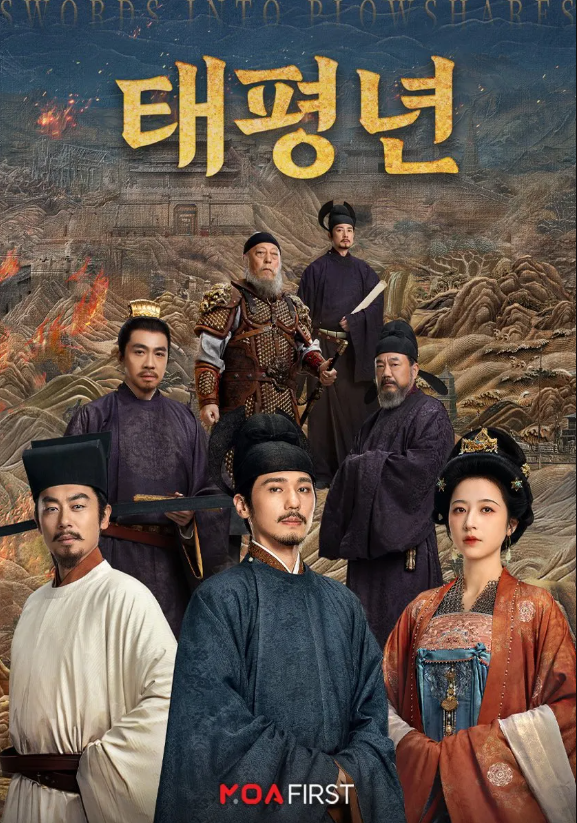 Poster for the 50-episode historical drama Taepyeongnyeon, depicting the fragmentation and turmoil of the Five Dynasties and Ten Kingdoms (907-979) and the Northern Song (960-1127) periods. MOA
The Chinese state-run Global Times wrote, "A drama about the unification achieved by the Song dynasty is also drawing interest in Taiwan," evaluating it as "a metaphor for a peaceful cross-strait future." The Global Times' Chinese-language sister outlet, Huanqiu Shibao, also reported, "The drama has become a symbol of peaceful cross-strait relations," and "It shows that achieving unification is in the fundamental interests of the Chinese nation and is an inevitable requirement for the great rejuvenation of the Chinese nation."
Taiwan's United Daily News reported that "the drama is triggering heated debate in Taiwan," adding, "In recent years, dramas that metaphorically depict the unification of Taiwan by mainland China have been produced one after another." Taehocheonjeon (Battle of Penghu) and The Glory of Silence, which were released last year, are examples. Taehocheonjeon portrays Emperor Kangxi of the Qing dynasty suppressing the forces of Zheng Chenggong, who led multinational pirates, including former Ming loyalists and Japanese pirates, and used Taiwan as their base of operations. The Glory of Silence depicts the life of Wu Shi, a Communist spy who infiltrated Taiwan in 1949, rose to the position of deputy chief of staff at the Ministry of National Defense of the Republic of China, and was eventually executed. China aired these works last year while declaring the "80th anniversary of Taiwan's return."
However, while Taehocheonjeon and The Glory of Silence contain metaphors in which "Taiwan independence forces" are portrayed as enemies to be punished, Taepyeongnyeon differs in that it emphasizes peaceful incorporation.
Li Guochang, vice president of the Chinese Academy of History, said in an interview with the Chinese media outlet Southern Window, "Under the current geopolitical situation, 'winning without fighting' is important," adding that the drama "raises awareness of the inevitable historical trend toward the unification of the Chinese nation, and conveys to Taiwanese society the message that unification is not 'surrender and annexation' but 'return,' and that it is 'not an end but a new beginning.'"
© The Asia Business Daily(www.asiae.co.kr). All rights reserved.
![User Who Sold Erroneously Deposited Bitcoins to Repay Debt and Fund Entertainment... What Did the Supreme Court Decide in 2021? [Legal Issue Check]](https://cwcontent.asiae.co.kr/asiaresize/183/2026020910431234020_1770601391.png)

















