National Police Agency Launches Pilot Operation of Driving Ability Diagnostic System
First Quantitative Assessment of Driving Ability for Seniors Aged 75 and Over
Data to Be Collected for Introduction of a "Conditional License System"
"Oh dear, I even served as a KATUSA driver in the army... How did I end up with 58 points?"
On the morning of the 11th, sighs of disappointment repeatedly filled the senior education room on the third floor of the Gangseo Driver's License Test Center in Gangseo-gu, Seoul. The Driver Ability Assessment System was unsparing even toward veteran grandfathers who used to be praised as "good drivers back in the day." Na (84) held in his hand an assessment sheet marked "Insufficient" and gave a hollow laugh, saying, "I've gone my whole life without an accident, but when I recently scratched my car while parking, I thought, 'Uh-oh'."
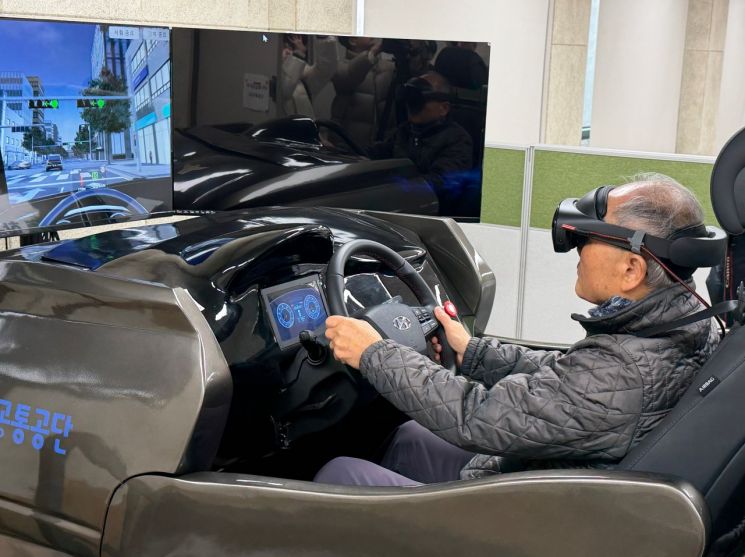 On the 11th, at the Gangseo Driver's License Test Center in Seoul, an elderly driver is undergoing a virtual driving assessment while wearing a VR headset. Photo by Park Hosu
The National Police Agency and the Korea Road Traffic Authority have begun pilot operation of the "Driver Ability Assessment System," which evaluates the actual driving ability of drivers aged 75 and older through virtual reality (VR) and on-road driving. Starting with the Gangseo Test Center, the program will be expanded to 19 test centers nationwide, including Seobu and Dobong. Instead of the existing two-hour classroom-only theoretical education, the core is to have drivers actually take the wheel and quantify their ability to cope with unexpected situations.
The seven seniors who visited the site that day were required to complete the "Traffic Safety Education for Elderly Drivers" in order to renew their driver's licenses. They chose one of two options for the test: "on-road driving" in a real vehicle or "virtual driving" using a VR device. The driver's 7-8 minute drive is transmitted in real time to the main control room inside the skills test course, where the system comprehensively evaluates factors such as forward attention and lane departure and assigns a score.
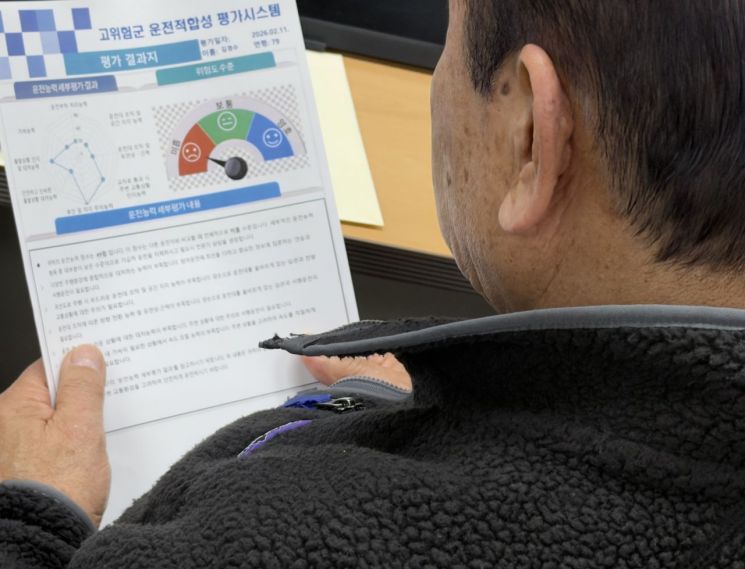 As the pilot operation of the 'Driver Ability Assessment System' for drivers aged 75 and older begins, a senior checks the on-road driving evaluation result sheet. Photo by Park Hosu
The on-road assessment consisted of eight tasks, including curve driving and arithmetic problems. The focus was on evaluating factors such as centerline violations that can lead to real accidents, response speed to signals and unexpected situations, and cognitive ability.
Once the test began, complaints could be heard here and there: "I thought I turned on the blinker in time, but it says I didn't," "I keep speeding up without realizing it." Even Kim Kyungsoo (79), who prided himself on "40 years without an accident," scored only 49 points due to slow responses to sudden situations. Among the four seniors who took the on-road test that day, three received an "Insufficient" rating, and the remaining one was so nervous that he deviated from the route, making it impossible to measure his score at all.
Three seniors chose VR, but their reactions were mixed. While the VR assessment allows drivers to safely experience various environments, it is less realistic. Kim Younghwan (84) waved his hand dismissively, saying, "I'm healthy enough that the hospital assessed my physical age as 68, but the VR screen makes me dizzy and feels awkward."
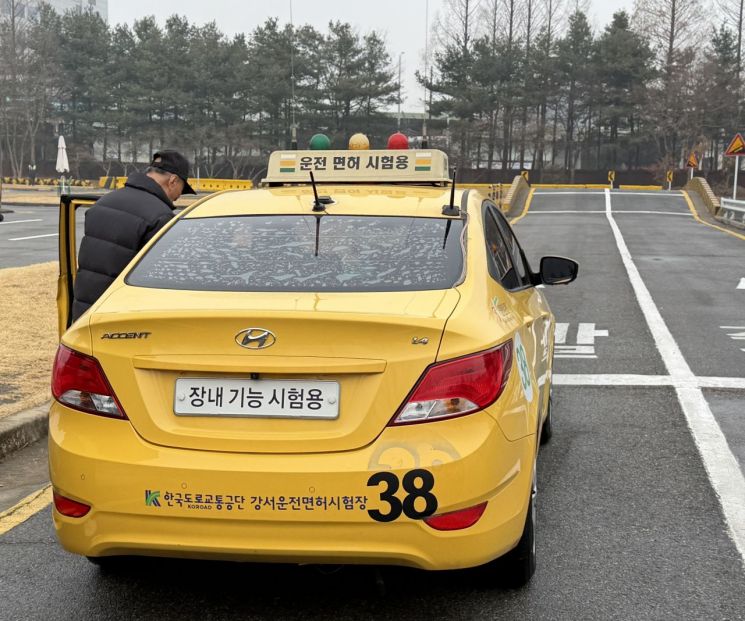 An elderly driver is seated in a test vehicle at the Gangseo Driver's License Examination Office in Seoul for an on-road driving assessment. Photo by Park Hosu
The newly introduced Driver Ability Assessment System classifies results into three levels: Insufficient, Average, and Good. Receiving an "Insufficient" rating does not mean an immediate return of one's license, but the police plan to use data from this system to prepare for the introduction of a "conditional license system." The idea is to guarantee mobility for drivers with reduced cognitive abilities by attaching conditions such as bans on night driving, restrictions on highway driving, or mandatory installation of safety devices.
Kim Dongjoo, driver’s license section chief at the National Police Agency, said, "We are implementing policies such as customized taxis and demand-responsive buses to guarantee mobility rights, but in reality they cannot keep up with actual demand in rural and fishing communities," adding, "Through this year's pilot operation, we will objectify and standardize the data. For those who absolutely cannot continue driving, license revocation will be unavoidable, but we will seek ways to allow as many as possible to drive in environments where safety is sufficiently ensured."
© The Asia Business Daily(www.asiae.co.kr). All rights reserved.



















