Expectations for earnings improvement of domestic demand stocks amid export and stock market boom
Asset price gains expected to spur consumption through the 'wealth effect'
As Korea's exports, led by semiconductors, improve sharply and the stock market rebounds, expectations are growing that the wealth effect will begin to appear in the domestic market, including department stores, large discount stores, and hotels.
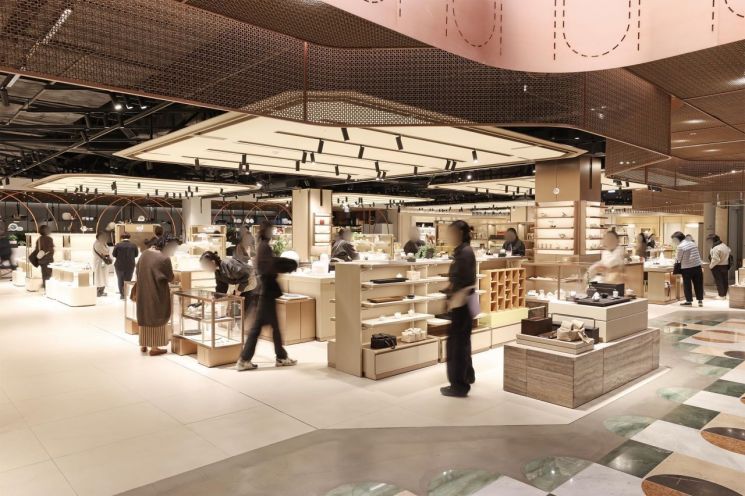
Expectations grow for earnings improvement in domestic demand stocks on stronger exports and bullish stock market
According to the Korea Exchange and KB Securities on February 12, the sector that has recorded the highest return in the Korean stock market so far in February is distribution stocks, with an average gain of 18%. Since the beginning of February, share price gains of major distribution stocks such as department stores and large discount stores have far outpaced the Kospi average.
Lotte Shopping's share price has risen by 37% in February, while Emart is up 35%, Shinsegae 17%, and Hyundai Department Store 16%. The rise in distribution stocks has far exceeded the Kospi return, which has gained only about 1-2% this month.
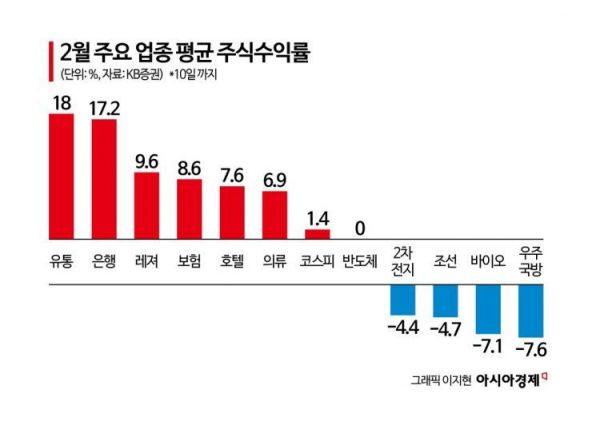
Hotel-related stocks, a representative domestic demand sector, have also delivered strong returns. GS P&L, which has Parnas Hotel as a subsidiary, has seen its share price jump by about 20% this month alone, and Seobu T&D, which owns Seoul Dragon City Hotel, has gained 39% so far this year, both far outperforming the Kospi.
Apparel-related stocks have also surged. Handsome, which reported a positive earnings surprise in the fourth quarter of last year, has seen its share price climb by about 20% this month alone, while LF has also gained more than 14% this month.
Rising asset prices expected to spur consumption through the 'wealth effect'
Market participants expect domestic consumption to begin a full-fledged recovery this year, supported by booming exports in key industries such as semiconductors, shipbuilding, defense, and power equipment, as well as a buoyant stock market. In particular, they see the sharp rise in equities fattening consumers' wallets and generating a positive effect that could lead to an improvement in domestic economic conditions.
Yoo Junghyun, researcher at Daishin Securities, said, "From the fourth quarter of last year, it has become evident across most distribution channels that consumption is entering a recovery phase," adding, "The steep rise in the stock market is likely to generate a wealth effect."

The recent rebound in the consumer sentiment index is also heightening expectations for an improvement in domestic economic conditions. The Bank of Korea's Composite Consumer Sentiment Index (CCSI) for last month came in at 110.8, up 1 point from 109.8 in December last year. A reading above 100 indicates that consumer sentiment is optimistic compared with the long-term average (2003-2024).
Last month, the Bank of Korea's News Sentiment Index reached 117.48, its highest level in four years and six months since July 2021 (117.71). The News Sentiment Index quantifies economic sentiment as reflected in economic news articles. With the Kospi surpassing 5,000 points this year and the stock market boom continuing, overall consumer sentiment is assessed to have improved.
Lee Euntaek, researcher at KB Securities, explained, "As the stock market surges, there is a strong possibility that it will stimulate Korea's gross domestic product (GDP) and consumer sentiment this year," adding, "A sharp rise in the stock market usually affects the economy with about a one-year lag, and given that our market jumped 76% last year, it is likely to have an impact this year."
© The Asia Business Daily(www.asiae.co.kr). All rights reserved.



















