Telephone Survey of 7,000 People Nationwide
Conflicts Ranked by Perceived Severity: Ideology, Income Class, Generation, Region, Gender
70% of Respondents "Willing to Talk with People Who Have Different Opinions"
It was found that 9 out of 10 people answered that "political conflict between conservatives and progressives is serious." However, more than 70% also responded that they are "willing to talk with people who have different opinions," indicating that the willingness for social communication is being maintained regardless of the perception of conflict.
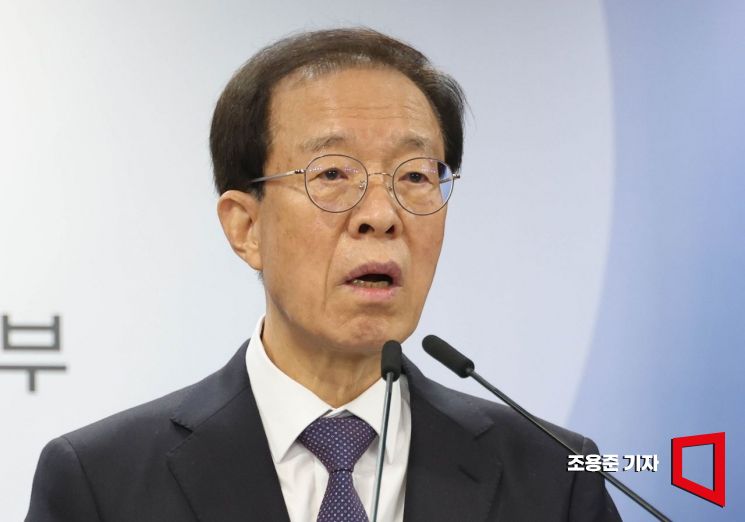 Lee Seokyeon, Chairperson of the Presidential Commission on National Unity, is announcing the results of a national perception survey on five major social conflicts for national unity at the Government Complex Seoul in Jongno-gu, Seoul on 2026.2.11. Photo by Cho Yongjun
On Feb. 11, the Presidential Committee for National Unity announced the results of a "national perception survey on five major social conflicts for national unity." The survey was commissioned by the committee to Gallup Korea and conducted via telephone interviews with 7,000 men and women aged 18 or older nationwide from Nov. 28 to Dec. 24, 2025.
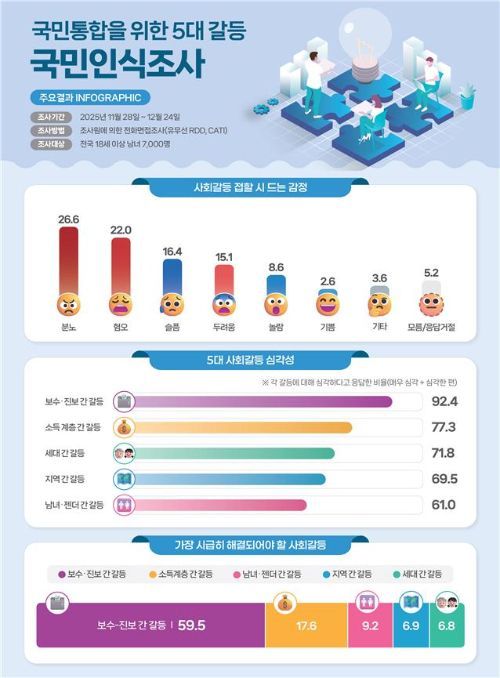
According to the survey, among the five major social conflicts (political/ideological, polarization, generational, gender, and regional), the share of respondents who perceived "conflict between conservatives and progressives" as "serious" was the highest at 92.4%. This was followed by conflict between income classes (77.3%), generational conflict (71.8%), regional conflict (69.5%), and conflict between men and women/gender conflict (61.0%).
When asked which conflict needs to be resolved most urgently, "conflict between conservatives and progressives" again ranked first at 59.5%. It was followed by conflict between income classes (17.6%), conflict between men and women/gender conflict (9.2%), regional conflict (6.9%), and generational conflict (6.8%).
As for the emotions people feel when encountering social conflict, anger (26.6%) was the most common, followed by disgust (22.0%), sadness (16.4%), and fear (15.1%). The Presidential Committee for National Unity explained, "Among women, 'fear' was the second most frequent response after 'anger,' and among those in their 40s and younger, disgust was relatively stronger, while among those in their 50s and older, anger was more pronounced."
Political conflict also ranked highest in the indicators of "perception, emotion, and behavior (experience)." Negative perception of political conflict was reported by 90.6% of respondents, negative emotions by 81.3%, and negative behavior (experience) by 71.1%. Overall, it was confirmed that negative perception, emotion, and experience tended to be stronger among female respondents.
However, 70.4% answered that they are "willing to talk" when asked about their "willingness to talk with people who have different opinions." The Presidential Committee for National Unity said that the willingness to talk was higher among men (76.1%) than among women (64.9%), and relatively higher among younger age groups.
As for the role that the Presidential Committee for National Unity should prioritize in order to ease social conflict, the most frequently cited answer was "creating public forums and spaces for communication with the public" (38.0%). This was followed by "research and studies for conflict resolution" (20.1%), "public participation-based conflict mitigation campaigns and public contests" (17.1%), and "advising the government on conflict-related policies" (15.7%).
Lee Seokyeon, Chairman of the Presidential Committee for National Unity, said, "Although conflict between conservatives and progressives is still perceived as the most serious, we were also able to confirm that a majority of the people are willing to talk about differing opinions," adding, "The people did not ask for conflicts to simply be covered up. What they are asking for is the creation of venues and structures where conflicts can be spoken about." He went on to say that the committee will "fulfill its role and mission as a 'national dialogue body' that gathers the voices of the people and designs social dialogue."
© The Asia Business Daily(www.asiae.co.kr). All rights reserved.
![Clutching a Stolen Dior Bag, Saying "I Hate Being Poor but Real"... The Grotesque Con of a "Human Knockoff" [Slate]](https://cwcontent.asiae.co.kr/asiaresize/183/2026021902243444107_1771435474.jpg)

















