Export and Facility Investment Get a Boost from Explosive Semiconductor Demand
Consumption on a Stable Upward Trend, Construction Still Sluggish
The Korea Development Institute (KDI), a state-run think tank, has revised up its forecast for this year’s economic growth rate for Korea to 1.9%, an increase of 0.1 percentage point from its previous projection. While exports led by semiconductors are performing far better than expected and are driving the overall economy, construction investment is experiencing a near-contraction due to sluggish new project starts, deepening polarization across sectors.
"Semiconductors did all the work"... Export outlook jumps 0.8 percentage point
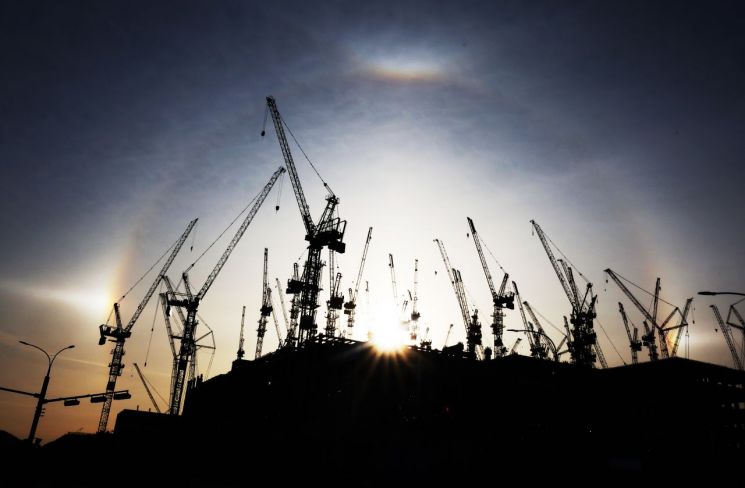 Semiconductors are expected to significantly raise this year’s economic growth by serving as a driving force in exports and capital investment. The photo shows the SK Hynix Yongin Cluster construction site in Cheoin-gu, Yongin, Gyeonggi Province. Photo by Yonhap News
In its report titled "Revised Economic Outlook for 2026" released on February 11, KDI projected that this year’s real gross domestic product (GDP) will grow by 1.9%. This is 0.1 percentage point higher than the 1.8% forecast it announced in November last year in its "Economic Outlook for the Second Half of 2025."
Jung Kyuchul, Director of Economic Outlook at KDI, said, "Expectations for artificial intelligence (AI) have grown tremendously recently, and as a result, demand for semiconductors has increased significantly, with prices also rising sharply. This has had a direct and substantial impact on exports and has created room to expand capital investment." He added, "In addition, although not by a large margin, consumption has also been revised up somewhat, which is why the economic growth forecast has been raised compared with last November."
KDI revised up its forecast for total export growth (in volume terms) for this year to 2.1%, an increase of 0.8 percentage point from its previous projection. The decisive factor was the surge in demand for memory semiconductors driven by the global AI boom. The strong export performance is also expected to translate into increased corporate capital investment, with the outlook for facilities investment raised by 0.4 percentage point to 2.4%. In particular, thanks to improved terms of trade stemming from rising semiconductor prices and falling crude oil prices, the current account surplus is projected to reach an unprecedented 148.8 billion dollars.
Construction "ice age" continues... Strict response to safety accidents → longer construction periods → reduced project volume
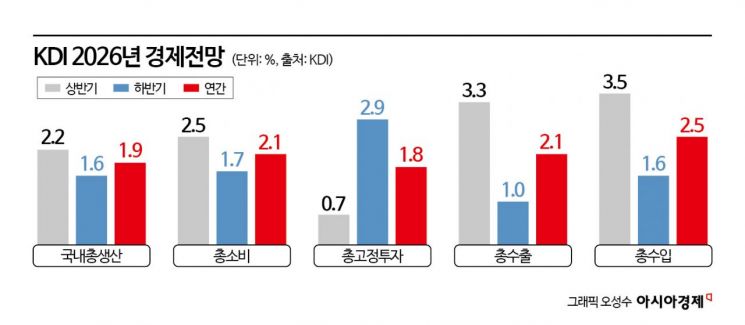
In contrast, construction investment, which dragged down the Korean economy last year with an annual contraction of -9.9%, is also unlikely to show a clear rebound this year. KDI sharply lowered its forecast for construction investment to 0.5%, a downward revision of 1.7 percentage points. Although orders have increased, they are not translating into actual groundbreaking due to factors such as sluggish real estate markets in regional areas, and KDI assessed that, as no signs suggesting a recovery have yet been observed, the rebound in construction investment will be further delayed.
Jung noted, "We are seeing signs that the pattern of construction investment is gradually changing compared with the past," adding, "In addition to delays in groundbreaking and the impact of population decline, construction periods are being extended significantly, and this is directly linked to a reduction in construction volumes." He further explained, "The lengthening of construction periods is closely related to heightened awareness of safety accidents at construction sites under the current administration."
Private consumption is expected to grow by 1.7%, up 0.1 percentage point from the previous forecast, supported by improvements in real income and the effects of interest rate cuts. KDI explained that, although consumption is showing a modest recovery, the economic gap between industries is pronounced, as weakness in the construction sector and in manufacturing excluding semiconductors is leading to job losses. The consumer price inflation rate is projected at 2.1%, 0.1 percentage point higher than the previous forecast, which is similar to the government’s inflation target of 2.0%. However, KDI analyzed that there is upward pressure on inflation if consumption improves further and the exchange rate rises.
© The Asia Business Daily(www.asiae.co.kr). All rights reserved.


















