Intergenerational transmission of both income and assets has intensified among recent cohorts
"Potential dragons to the river"...Need to expand region-based proportional admission systems
"From small streams to large rivers": Enhancing the education
The Bank of Korea and the Organisation for Economic Co-operation and Development (OECD) have confirmed through a joint study that the intergenerational mobility symbolized by the saying "a dragon rises from a small stream" has weakened further in recent years. The analysis suggests that, in order to mitigate the structure in which economic status is increasingly passed down in connection with one’s place of birth and residence, it is necessary not only to strengthen mobility so that "those with the potential to become dragons can reach the river," but also to transform local regions so that "small streams can become great rivers."
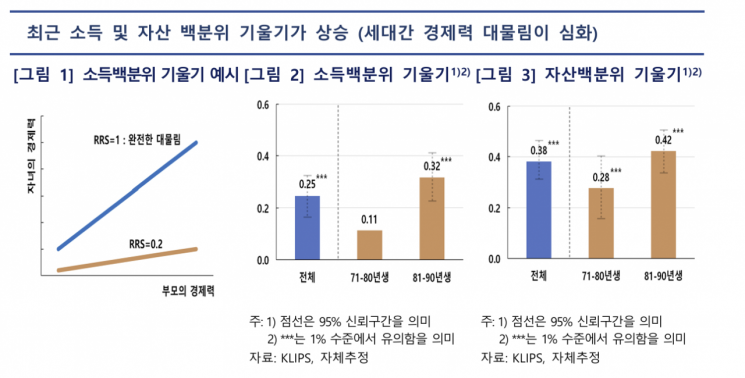
According to the "BOK Issue Note - Interregional Migration and Intergenerational Transmission of Economic Status (Jeong Minsoo, Lee Dahye, and Volker Ziemann)," published by the Bank of Korea on the 11th, the intergenerational transmission of economic status in Korea has recently intensified. Jeong Minsoo, head of the Regional Economic Survey Team in the Bank of Korea’s Economic Statistics Department, said, "The rank-rank slope (RRS), which is widely used to measure the degree of intergenerational transmission based on income, is estimated at 0.25. This means that if parents move up 10 places out of 100 in the income ranking, their children move up 2.5 places," adding, "The asset-based rank-rank slope, which is based on assets, is even higher at 0.38, indicating that the transmission of assets is stronger than that of income."
By generation, both income and assets show a pattern of stronger intergenerational transmission among more recent cohorts. For children born in the 1970s, the income RRS is 0.11 and the asset RRS is 0.28, whereas for children born in the 1980s, these figures rise to 0.32 and 0.42, respectively. Jeong pointed out, "This aligns with the widespread perception in society that the ladder of social mobility is weakening."
Jeong explained, "In general, when children leave their parents and move to another region, factors that affect economic outcomes such as the educational environment and workplace change together, which tends to improve their economic status and ease intergenerational transmission. Microdata analysis shows that the average income percentile of children who migrated was 6.5 percentage points higher than that of their parents, while the income percentile of non-migrant children actually fell by 2.6 percentage points." The income and asset RRS of the migrant group (0.13 and 0.26) were also significantly lower than those of the non-migrant group (0.33·0.46), indicating that intergenerational transmission is weaker among those who move.
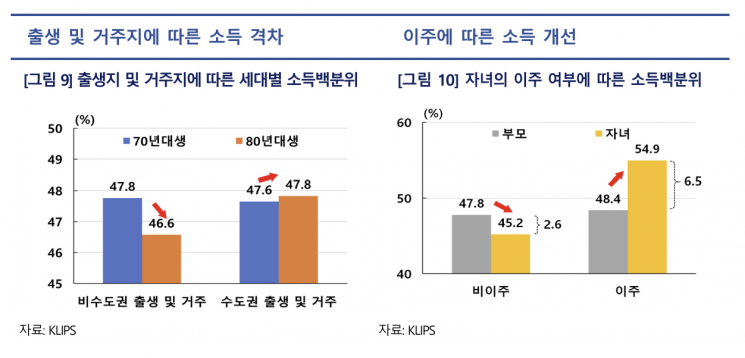
Notably, the upward shift in income class for the children’s generation due to migration (the migration effect) varies greatly depending on the place of birth and destination. Children born in the Seoul metropolitan area experienced upward mobility, particularly among low-income children, when they moved within the metropolitan region. In contrast, children born outside the metropolitan area saw a large improvement in economic status when they moved to the metropolitan area, but the effect of migration between provinces within the same wider region has shrunk considerably compared with the past. For example, in past generations (those now in their 50s), the average income percentile of those born outside the metropolitan area who graduated from a local hub-city university and those who went on to a metropolitan-area university was similar, at 61.7% and 62.3%, respectively. In contrast, among more recent cohorts (those now in their 30s), the average income percentile of graduates from metropolitan-area universities (61.8%) far exceeded that of graduates from regional hub-city universities (53.3%). Jeong interpreted this as "the combined result of weakening competitiveness at hub-city universities and structural conditions across non-metropolitan regions where there is a relative shortage of quality jobs."
The fact that migration within the same wider region outside the metropolitan area does not sufficiently lead to improvements in economic status is particularly disadvantageous for children from low-income households. This is because low-income families are more likely to forgo moving to Seoul or the metropolitan area due to the burden of housing costs and instead choose to move within the same region to nearby hub cities. Jeong noted, "Children whose parental assets are in the bottom 25% had a 43-percentage-point lower probability of moving to the metropolitan area than children in the top 25%," and judged that "this inequality of opportunity is likely to have contributed to the overall intensification of intergenerational transmission in Korea." At the same time, children born outside the metropolitan area who remain in their hometown are experiencing a "transmission of poverty." Among them, the share of children whose parents’ income is in the bottom 50% and whose own income also remains in the bottom 50% has risen from the high-50% range for earlier cohorts (those born between 1971 and 1985) to over 80% for more recent cohorts (those born between 1986 and 1990. Conversely, the share entering the top 25% income bracket has fallen from 13% to 4%.
From an individual standpoint, children born outside the metropolitan area have a strong incentive to move to the metropolitan area, and children born in the metropolitan area have a strong incentive to remain there. This has resulted in the one-sided concentration of young people in the Seoul metropolitan area. However, Jeong stressed that "in a situation where individually rational decisions are causing serious negative side effects at the national level, ranging from regional polarization and impediments to social cohesion to ultra-low fertility, public intervention to correct this is unavoidable." He emphasized, "To mitigate the structure in which economic status is increasingly passed down in connection with one’s place of birth and residence, it is necessary not only to strengthen mobility so that 'those with the potential to become dragons can reach the river,' but also to make efforts to transform local regions so that 'small streams can become great rivers.'"

In this process, the roles of the education system and public investment are particularly important. Jeong said, "We need to expand opportunities for low-income students from non-metropolitan regions to enter top-tier universities in Seoul through measures such as regional proportional admissions," adding, "Bold public investment is also needed to dramatically enhance the educational competitiveness of non-metropolitan hub universities." He explained that a "selection and concentration" strategy should be pursued so that a small number of hub universities can secure competitiveness in at least some fields comparable to that of top-tier universities in Seoul. This means that concentrated investment in hub cities is needed to improve the industrial base and jobs in non-metropolitan regions. He added, "Growth centered on hub cities can be a fundamental solution for both strengthening mobility within non-metropolitan regions and easing intergenerational transmission," and said, "Ongoing discussions on administrative district consolidation and reorganization of wide-area governance should also be pursued in a direction that enhances the status of hub cities."
© The Asia Business Daily(www.asiae.co.kr). All rights reserved.



















