Employment Trends in January 2026
Increase in Employed Slows to 108,000
Youth Employment Rate at 43.6%, Down for 21 Consecutive Months
Although the number of employed people in January continued to increase for the 13th consecutive month, the pace of growth slowed to the lowest level in about a year. While weak employment among young people has been prolonged, the slump in the construction and manufacturing sectors has continued, and the cold wave delayed the start of senior jobs programs, weakening the employment growth trend among older people as well.
According to the report "Employment Trends in January 2026" released by the National Data Office on the 11th, the number of employed people last month was 27,986,000, an increase of 108,000 from the same month a year earlier. The number of employed has increased for 13 consecutive months since January last year, but the upward trend has clearly weakened since peaking at 312,000 in September last year. The increase in the number of employed narrowed to 193,000 in October, 225,000 in November, 168,000 in December last year, and to the low-100,000 range in January this year. This is the smallest increase in 13 months since December 2024, when the number of employed people decreased by 52,000.
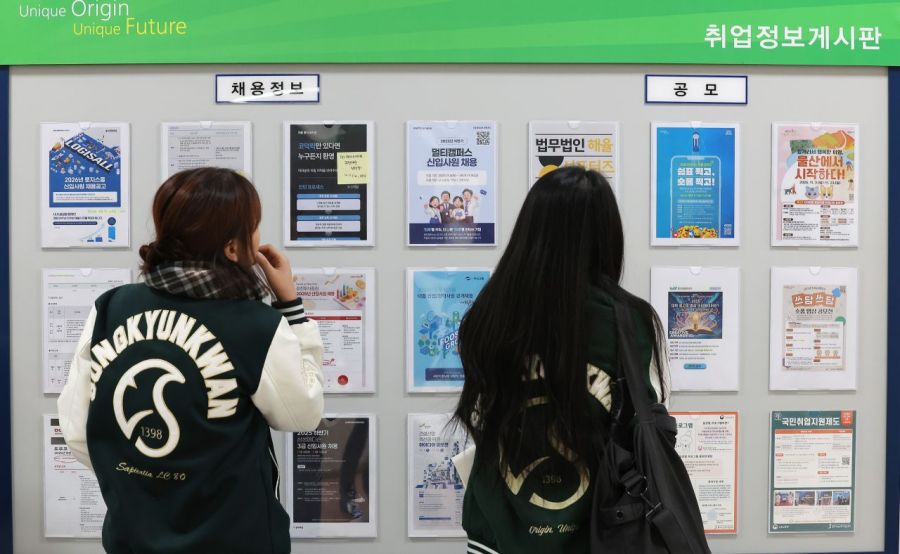
Prolonged slump in manufacturing and construction... Employment growth concentrated in services = By industry, weak employment continued in key sectors. The number of employed in the construction industry fell by 20,000, and in the manufacturing industry by 23,000. Employment in construction has declined for 21 consecutive months since May 2024, and in manufacturing for 19 consecutive months. The number of employed also decreased in agriculture, forestry and fishing (-107,000), professional, scientific and technical services (-98,000), and public administration (-41,000). Bin Hyunjun, Director General of Social Statistics at the National Data Office, analyzed, "The decline in professional, scientific and technical services appears to be driven by a combination of factors, including a contraction in architectural engineering orders and changes in industrial structure."
In contrast, employment continued to increase mainly in services such as health and social welfare services (185,000), transportation and storage (71,000), and arts, sports and leisure-related services (45,000). This is interpreted as reflecting rising demand for care services due to population aging and the recovery of face-to-face services.
By age group, employment increased among those aged 60 and over (141,000), those in their 30s (101,000), and those in their 50s (45,000). However, the increase among those aged 60 and over was the smallest in five years since January 2021, when the figure fell by 15,000. In particular, the number of employed young people (aged 15 to 29) decreased by 175,000, marking a decline for 39 consecutive months since November 2022, and the number of employed in their 40s also fell by 3,000. Director General Bin said, "The drop in temperatures and cold wave last month reduced activity among older people, and the delayed start of senior jobs programs by local governments also had an impact."
By employment status, among wage workers, the number of regular employees increased by 192,000 and the number of daily workers by 26,000, while temporary workers decreased by 97,000. Among non-wage workers, the number of self-employed with employees rose by 56,000, but the number of self-employed without employees (-11,000) and unpaid family workers (-58,000) declined. This shows that the recovery of vulnerable forms of employment remains sluggish.

Employment rate hits all-time high... Unemployment and youth indicators worsen = The overall employment rate for those aged 15 and over stood at 61.0%, the same level as a year earlier. However, the employment rate for those aged 15 to 64 (the Organisation for Economic Co-operation and Development (OECD) standard) was 69.2%, up 0.4 percentage points from the same month last year, marking the highest January figure since related statistics began. The labor force participation rate was 63.6%, up 0.2 percentage points from a year earlier, the highest January level since statistics began in 1999.
In contrast, the employment situation for young people showed a clear worsening trend. The youth employment rate was 43.6%, down 1.2 percentage points from a year earlier, extending its decline for 21 consecutive months, and marking the lowest January level in five years since 2021 (41.1%).
Unemployment indicators, which reflect the quality of employment and perceived economic conditions, also deteriorated. The number of unemployed last month was 1,211,000, an increase of 128,000 from a year earlier, and the unemployment rate rose 0.4 percentage points to 4.1%. This is the highest level in four years since January 2022. The number of unemployed is also the largest in five years since January 2021, when it reached 1,570,000. The youth unemployment rate was 6.8%, up 0.8 percentage points.
Among the economically inactive population, the number of people classified as "took a rest" was 2,784,000, up 110,000 from a year earlier. Of these, those aged 60 and over increased by 118,000, and young people also increased by 35,000. Director General Bin explained, "As the inclusion of older people in senior jobs programs was delayed, many in the older age group were classified as 'took a rest' instead of being employed," adding, "Among young people as well, the number of people taking a rest appears to have increased due to the overall deterioration in employment conditions." The Ministry of Economy and Finance stated, "We will strengthen the competitiveness of key industries and enhance job creation capacity by supporting future growth engines."
© The Asia Business Daily(www.asiae.co.kr). All rights reserved.
!["The Woman Who Threw Herself into the Water Clutching a Stolen Dior Bag"...A Grotesque Success Story That Shakes the Korean Psyche [Slate]](https://cwcontent.asiae.co.kr/asiaresize/183/2026021902243444107_1771435474.jpg)

















