U.S. January Jobs Data To Be Released Tonight
AI And Anti-Immigration Policies Weigh On Labor Demand
Job Growth Has Already Slowed
The global financial sector is on edge over the U.S. January employment report, which is scheduled to be released on the 11th (local time). The direction of the labor market could serve as a factor that changes the Federal Reserve (Fed)'s interest-rate path. The market expects the employment figures to deteriorate, and this could be used as material to increase the likelihood of interest-rate cuts.
Outlook for a Weaker Job Market in January
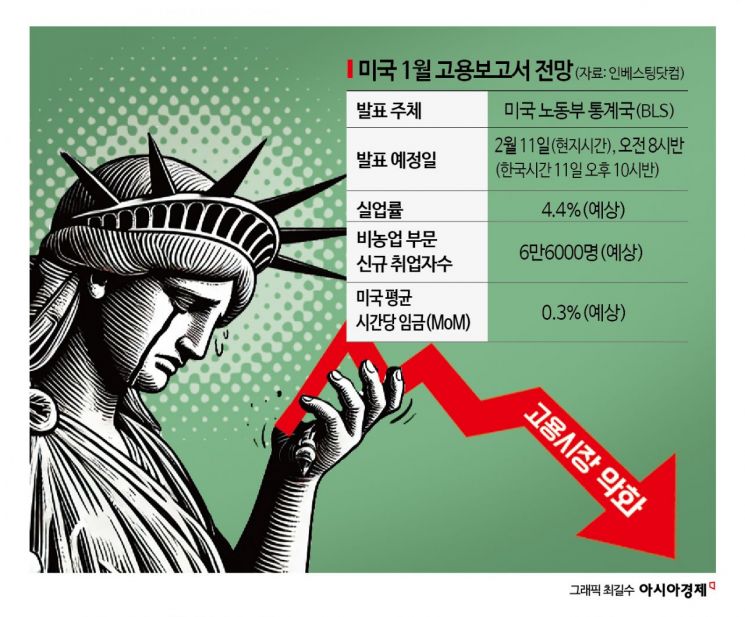
The U.S. Bureau of Labor Statistics (BLS) will release the January employment report at 8:30 a.m. on this day (10:30 p.m. on the 11th Korea time). The report will include nonfarm payrolls and the unemployment rate, among other data. The original release date was the 6th, but the schedule was pushed back due to the impact of the U.S. federal government shutdown (Shut Down, temporary work stoppage).
According to the market consensus (average of estimates), the number of new jobs in January is about 66,000, and the unemployment rate is 4.4%. In the December report last year, payrolls increased by only 50,000, far below expectations. However, the unemployment rate fell from 4.6% to 4.4%. This release will also include annual revisions to last year's employment figures, so the December numbers may be revised. Some analysts have pointed out that the increase in employment from last March through the past year could turn out to be significantly lower than previously estimated.
Recently released private-sector employment data have come in far below forecasts, lending support to this view. In a report released on the 4th, U.S. employment data firm Automatic Data Processing (ADP) said that private-sector employment in January increased by 22,000 from the previous month. This is far below the 45,000 increase expected by experts surveyed by Dow Jones.
Fed Officials Remain Cautious
The market is paying close attention to this indicator, which could influence the Fed's monetary policy. At the Federal Open Market Committee (FOMC) meeting in January, the Fed decided to keep the federal funds rate at its current range of 3.5% to 3.75%. Fed Chair Jerome Powell signaled his view that the U.S. labor market remains solid.
Key officials are taking a cautious stance on easing rates. However, they are keeping in mind the possibility that a confirmed deterioration in the labor market, or an easing of inflation, could act as variables.
Lorie Logan, President of the Federal Reserve Bank of Dallas, said at an event held in Austin, Texas, the previous day, "If inflation falls or we see a material further cooling in the labor market, additional rate cuts could become appropriate." Beth Hammack, President of the Federal Reserve Bank of Cleveland, also attended a regional banking event in Ohio on the same day and stated, "It is desirable to maintain rates at the current level and watch how conditions evolve."
The report is drawing particular attention as a key indicator that can reveal the impact of the second Trump administration's anti-immigration policies and the decline in labor demand caused by the spread of artificial intelligence (AI) technologies. Shruti Mishra, an economist at global investment bank Bank of America, predicted that this report will be "the Super Bowl of jobs reports." She added, "Job growth has already slowed due to labor supply shocks from tighter immigration policies and weaker (labor) demand caused by tariff uncertainty and artificial intelligence (AI)."
Markets Are Mixed
U.S. Treasury yields showed a modest overall decline. Investors appear to have moved to the sidelines. According to CNBC, as of 8:30 a.m. Korea time on the 11th, the benchmark 10-year Treasury yield stood at 4.141%, down 0.4 basis point (1 bp = 0.01 percentage point) from the previous session. The 30-year Treasury yield also fell by a similar margin to 4.783%, and the 2-year Treasury yield slipped to 3.452%, a decline of less than 0.2 basis point.
Risk assets were also mixed. On the New York Stock Exchange, the S&P 500 Index and the Nasdaq Composite fell 0.33% and 0.59%, respectively, from the previous session, while the Dow Jones Industrial Average alone closed up 0.1%. As of 9:30 a.m. Korea time on the 11th, gold prices were up 0.53%, while Bitcoin was moving sideways in the upper 69,000-dollar range, down about 1.3% from 24 hours earlier. It briefly fell below the upper 68,000-dollar range during intraday trading but soon rebounded on bargain hunting.
It appears that the sharp undershoot in U.S. December retail sales released overnight, combined with heightened caution ahead of the employment data, has weighed on sentiment. According to the U.S. Department of Commerce, U.S. retail sales in December last year were flat on a month-on-month basis, with a 0% increase. The forecast had been for a 0.4% increase. Core retail sales (the control group), which are used in calculating personal consumption expenditures (PCE) in gross domestic product (GDP), also fell 0.1% from the previous month.
Meanwhile, the Trump administration has moved preemptively to shape public opinion. The New York Times (NYT) reported that senior White House aides are sending external messages emphasizing that the domestic economy remains solid, even if the pace of job growth slows, ahead of the release of the January employment report.
Peter Navarro, White House adviser on trade and manufacturing, said in an interview with Fox Business, "The number of new jobs itself has declined due to the deportation of illegal immigrants," adding, "We need to lower expectations for monthly job growth figures." Kevin Hassett, White House National Economic Council (NEC) Director, also appeared on CNBC and said that tighter immigration controls, the spread of AI, and overall productivity gains could reduce the pace of job growth. Both aides stressed that there is no need for excessive concern even if job growth falls below 100,000.
© The Asia Business Daily(www.asiae.co.kr). All rights reserved.

















