Press Conference Marks 10 Years Since Kaesong Shutdown
Tenant Companies Appeal for Approval to Visit North Korea
Number of Suspended or Closed Firms Rises to 40... 30% of Total
Gap Between Government Damage Estimates and Actual Losses
Calls fo
"It has already been 10 years since I last visited our factory, which is practically just around the corner."
On the morning of the 10th, Yoo Dongok, CEO of Daehwa Fuel Pump, said this as he gazed at the faint outline of the Kaesong Industrial Complex beyond the Inter-Korean Entry Office in Paju, Gyeonggi Province. Daehwa Fuel Pump, which he operates, was the third among 15 companies to move into the pilot zone of the Kaesong Industrial Complex in 2004. The factory grew rapidly amid expectations for the first inter-Korean economic cooperation project and the excitement of a fresh start. The business, which began with 10 South Korean employees and 150 North Korean employees in a building with a total floor area of 4,000 square meters (about 1,200 pyeong), grew in just six years into a company with annual sales of 35 billion won and 350 employees by 2010.
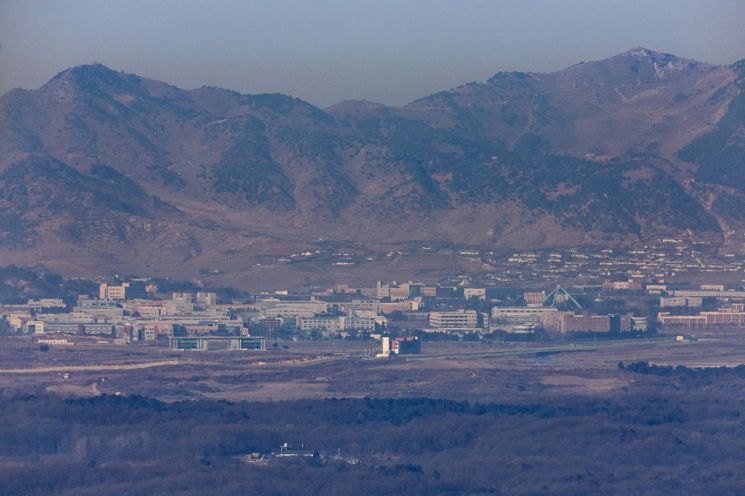 On the 9th, ahead of the 10th anniversary of the closure of the Kaesong Industrial Complex, the area around the complex appeared desolate when viewed from the border area of Paju, Gyeonggi Province. Yonhap News
The fate of CEO Yoo and Daehwa Fuel Pump was completely upended by the sudden decision of the Park Geunhye administration in February 2016 to fully suspend operations at the Kaesong Industrial Complex. Yoo said he only heard the news three hours before the closure became irrevocable and had to leave the factory and employees behind in the North as they were. He expected, as in the first suspension in 2013, that operations would soon return to normal, but news of a restart never came. He said, "Relatively speaking, our company is in a better situation because we have been able to continue our business at home and abroad," adding, "Regrettably, more than half of the companies that were based in the Kaesong Industrial Complex at that time have suspended operations or gone out of business."
On this day marking 10 years since the full suspension of the Kaesong Industrial Complex, entrepreneurs who had moved into the complex gathered at a press conference in front of the gate of the Inter-Korean Entry Office, where they each shared their painful stories and called for the normalization of the Kaesong Industrial Complex.
Park Yongman, CEO of Green Fiber, who moved into the Kaesong Industrial Complex in February 2007, said that the factory and workers from whom he had to part in haste still often come to mind. He recalled, "Before the factory was completed, we rented a warehouse from Hyundai Asan and produced the initial batch of products together with about 150 North Korean workers," and added, "There were many trials and errors and times when feelings were hurt, but now all I feel is an overwhelming longing for those people with whom we sweated together and shared the ups and downs of life."
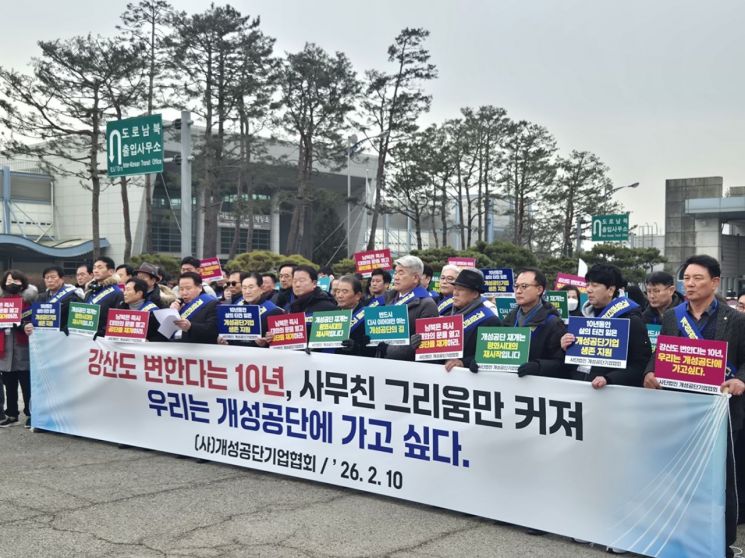 On the 10th, representatives of companies based in the Kaesong Industrial Complex are holding a press conference in front of the Inter-Korean Entry Office gate in Paju, Gyeonggi Province to mark the 10th anniversary of the suspension of the Kaesong Industrial Complex. Kaesong Industrial Complex Companies Association
Gap in perception of losses with the government... Full compensation still a distant prospect
The Kaesong Industrial Complex is regarded as a representative model of inter-Korean economic cooperation that utilizes North Korea's labor force and South Korea's technological capabilities. When the Park Geunhye administration decided on a full suspension in the name of responding to North Korea's fourth nuclear test and long-range missile launch, companies that had invested hundreds of billions of won to move into the complex were forced to shoulder enormous economic losses.
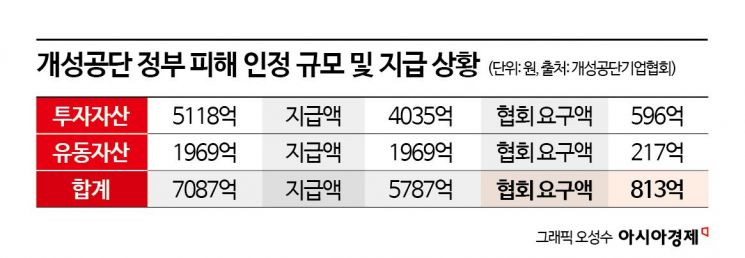
According to the Kaesong Industrial Complex Companies Association, the damages suffered by tenant companies are estimated at about 1.3 trillion won. The government recognizes only 708.7 billion won of this. The gap arises because substitute production costs to maintain clients and operating losses were excluded. Through four rounds of support, the government has paid 578.7 billion won to tenant companies. The companies are asking the government to promptly pay at least 81.3 billion won out of the unpaid amount of 130 billion won, which consists of 59.6 billion won in investment assets and 21.7 billion won in current assets.
Even this, however, is difficult to regard as genuine compensation, business owners argue, because it is in effect "insurance-type" support that companies must repay if the Kaesong Industrial Complex resumes operations. This is due to a clause in the inter-Korean economic cooperation insurance terms established under the Roh Moo-hyun administration, which stipulates that funds received must be repaid if the complex is reopened. Park stressed, "The public believes that we have already received sufficient compensation, but in reality we have never been compensated. This is because we will have to pay back every won we received once operations resume."
40 out of 124 companies have shut down
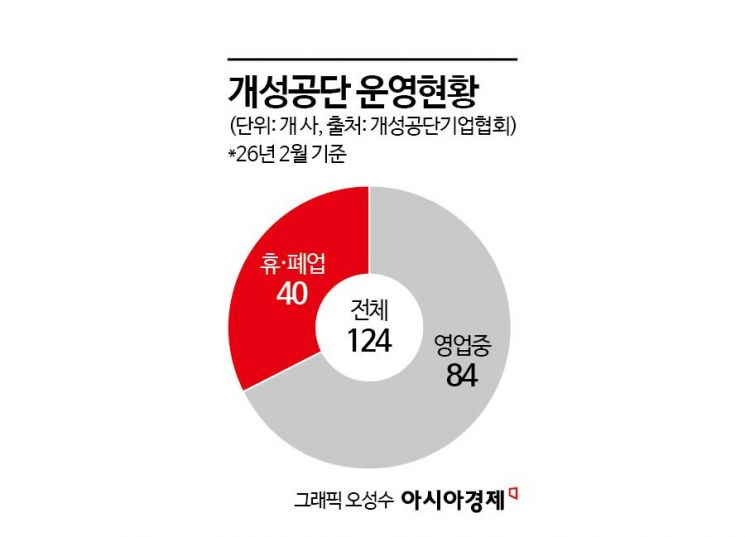
In the meantime, the number of companies that have failed to withstand severe management difficulties and have closed their doors has risen rapidly. The association has found that, of the 124 tenant companies, 40 companies (32%) are currently in a state of suspended operations or closure. In a 2021 survey by the Kaesong Industrial District Foundation of 121 tenant companies, 27 companies (22.3%) were found to have suspended operations or closed, meaning the number has increased significantly in just five years. If one includes cases that have not formally reported suspension or closure but in reality have almost no sales or are burdened with mounting arrears and debt, making them "companies in name only," the actual figure is estimated to be even higher.
A considerable number have relocated overseas in search of low-wage production bases and are continuing their business there. According to the association, after the closure of the complex, more than 30 tenant companies moved their operations to countries such as Vietnam (28 companies), Myanmar (2 companies), and China (1 company). An association official said, "Most of the tenant companies that had grown rapidly by utilizing North Korean labor moved to emerging countries as substitutes, but considering factors such as workforce, geographical accessibility, and similarities in language and culture, the advantages gained through inter-Korean economic cooperation are far greater."
"Government attention needed for reopening of Kaesong Industrial Complex"
Tenant companies are urging the government to take responsible action to restart operations at the Kaesong Industrial Complex. Kim Jinhyang, former chairman of the Kaesong Industrial District Foundation, said, "The tenant companies did nothing wrong; they simply entered the Kaesong Industrial Complex trusting the government's promises," and continued, "We want to clearly convey to the government that at the very least, it should lift the May 24 Measures, which are regarded as a symbol of sanctions against North Korea. We appeal to the Ministry of Unification and other relevant ministries not to forget the Kaesong Industrial Complex and to pay attention to its reopening."
Cho Kyungjoo, head of the Kaesong Industrial Complex Companies Association, said, "We have requested approval to visit North Korea multiple times, but our requests have been repeatedly rejected," and appealed, "We ask the government to step up its international diplomatic efforts, including in North Korea-U.S. relations, so that businesspeople can visit the North for the legitimate purpose of inspecting their assets."
© The Asia Business Daily(www.asiae.co.kr). All rights reserved.



















