Samsung to Begin HBM4 Mass Production and Shipment This Month
SK Hynix Expected to Start Supply from Next Month
SK Hynix Emphasizes Volume, Samsung Focuses on Technology
Securing High Performance and Stability Will Be Key Going Forward
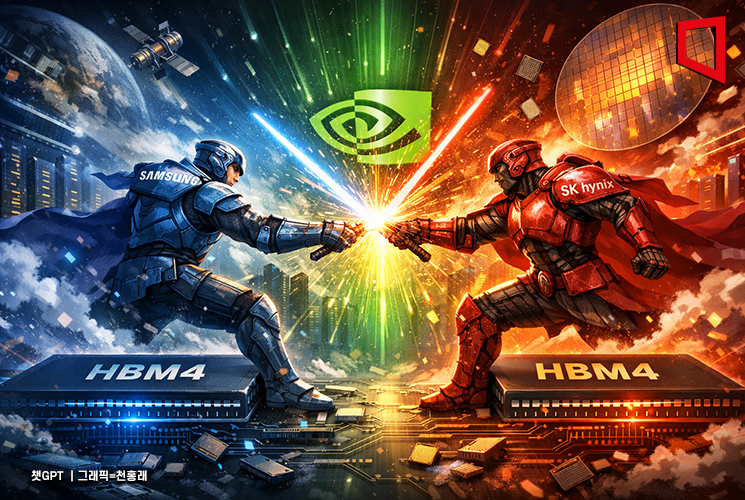
Samsung Electronics and SK Hynix are locked in fierce competition ahead of the mass production and shipment of sixth-generation high-bandwidth memory (HBM4). As Micron, which had been considered a strong candidate to join the supply chain, is now expected to face difficulties in supplying products to Nvidia, the battle between the two Korean companies for leadership over HBM4 supply is forecast to intensify. With Samsung Electronics highlighting its "technology" and SK Hynix stressing its "volume and stability," attention is now focused on which company will secure stable supply first.
According to the semiconductor industry on February 11, Samsung Electronics will begin mass production and shipment of HBM4, which will be mounted on Nvidia's next-generation artificial intelligence (AI) chip "Vera Rubin," as early as the third week of this month. During its conference call on last year's fourth-quarter earnings held on January 29, Samsung Electronics officially confirmed that HBM4 mass production and shipment would begin in February.
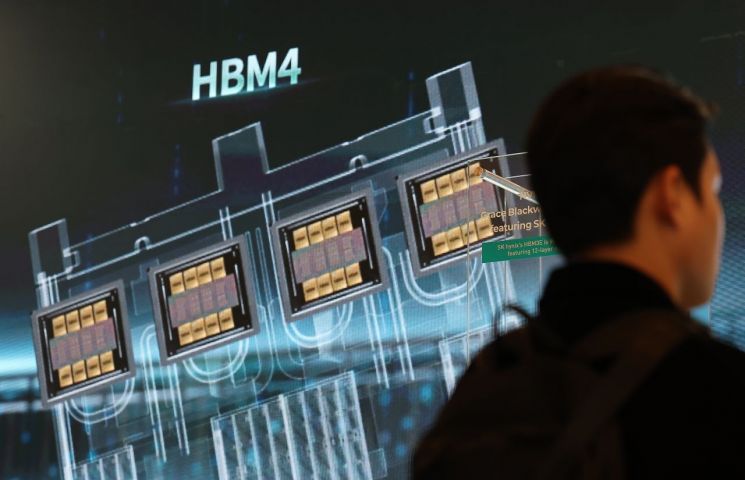 On the 8th of last month (local time), an HBM4 video was playing at the SK Hynix booth at CES 2026 at the Venetian Convention Center in Las Vegas, Nevada, USA. Photo by Yonhap News.
In contrast, SK Hynix is expected to begin supply from next month. SK Hynix established the world's first HBM4 mass production system in September last year and was the first to provide samples to customers such as Nvidia, but its supply schedule is reportedly being delayed somewhat as it moves to revise certain specifications to meet Nvidia's requirements. The company is currently not disclosing its HBM4 supply schedule.
Although Samsung Electronics is assessed to be slightly ahead in the pace of qualification testing (quality verification), the prevailing view is that SK Hynix will supply a larger total volume of HBM4 this year. Industry sources say SK Hynix has been tentatively allocated more than 50% of HBM4 volume, while Samsung Electronics has been allocated in the 20% range.
Samsung Electronics is seen as having achieved results in terms of technological competitiveness, having secured the title of first HBM4 supplier and being the first to meet Nvidia's performance requirements. To differentiate itself in the HBM4 market, Samsung Electronics has successfully developed its most advanced DRAM product based on the sixth-generation (1c) DRAM process, emphasizing its technological edge over competitors that are applying the existing 1b DRAM process.
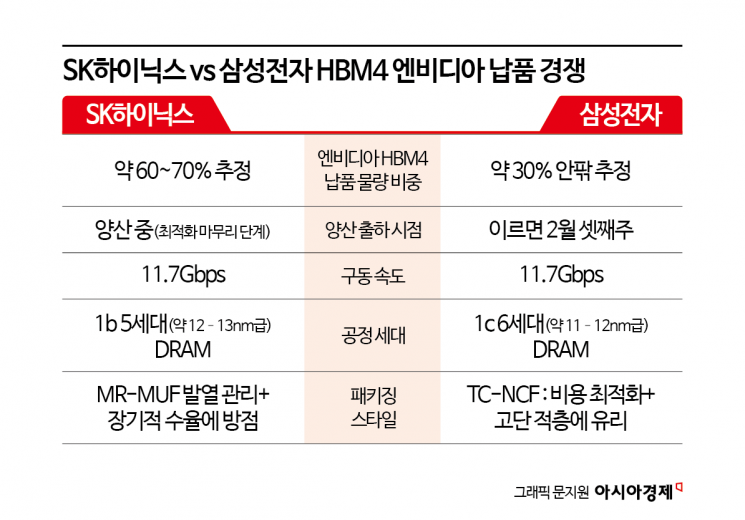
As the two companies are pursuing contrasting strategies, the key issue going forward is whether they can secure both high performance and mass production stability at the same time. Samsung Electronics has applied a logic base die built on Samsung Foundry's 4 nm (1 nm = one billionth of a meter) process, focusing on achieving performance through a cutting-edge node. In contrast, SK Hynix is understood to be pursuing a strategy that prioritizes initial mass production stability by using a base die built on TSMC's 12 nm process, a more mature node.
The difference in DRAM processes is also cited as a variable. Samsung Electronics' 1c DRAM process has a higher level of technical difficulty, but compared with existing processes it entails greater cost burdens and a relatively lower level of process maturity, raising concerns that initial yield could become a variable.
Lee Changhan, former vice chairman of the Korea Semiconductor Industry Association, said, "It is true that Samsung's product is somewhat more advanced. However, it appears that it will take time for that production line to stabilize," adding, "When a production plant begins initial production, yields are inevitably low. The key question is whether it can gradually improve yields and achieve stabilization."
© The Asia Business Daily(www.asiae.co.kr). All rights reserved.



















