"Minimum wage does not help revitalize the local economy"
On the 10th, Minister of Justice Jung Seongho stated at a Cabinet meeting that supplementary measures, such as the introduction of a "region-based living wage," are needed to ensure that the influx of foreign workers does not lead to a decline in wages for domestic workers.
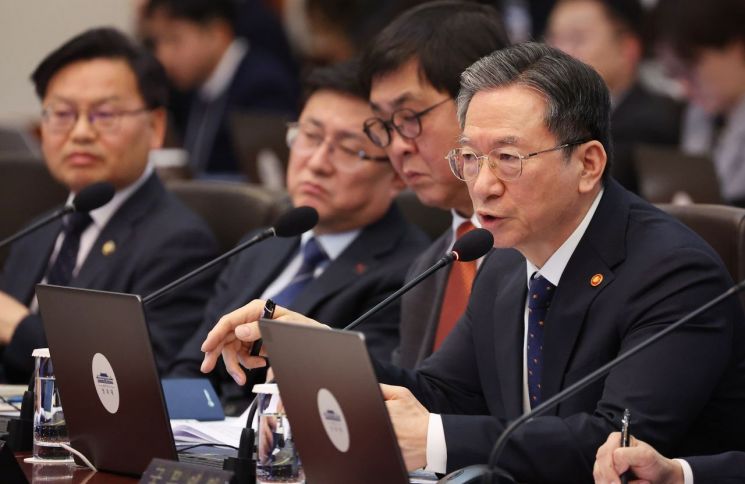 Jung Seongho, Minister of Justice, is speaking at a Cabinet meeting held at the Blue House on the 10th. Yonhap News
On this day, Minister Jung made these remarks while explaining the current situation regarding the surge of foreign workers in the shipbuilding industry, an issue raised by President Lee Jaemyung. Minister Jung said, "Currently, shipbuilding companies are allowed to hire foreign workers for up to 30% of their workforce," adding, "However, this does not apply to all processes, but is limited to three specific areas that Korean workers tend to avoid: welding, painting, and electrical work."
He went on to say, in relation to the pilot project for wide-area visas, "We understand that the number of people who have entered worksites such as Ulsan currently stands at around 700 to 800," and added that, regarding the figures mentioned by the President, the government is in the process of verifying accurate statistics and checking the actual hiring levels compared to the permitted quotas.
He also expressed concern about the side effects caused by the low wage structure of foreign workers. Minister Jung pointed out, "Initially, the wages of foreign workers were set at around 35 million won, which is about 80% of the gross national income (GNI), but they have now fallen to the level of the minimum wage."
In particular, he said, "If foreign workers receive only the minimum wage, it does nothing to revitalize the local economy and instead creates the problem of driving down the wages of domestic workers," adding, "We are discussing whether their pay should be set not at the minimum wage, but at about the level of a region-based living wage."
He also explained the distinction between bringing in workers through the existing Ministry of Trade, Industry and Energy framework and the "wide-area visa." Minister Jung said, "The wide-area visa is a system under which, in consultation with local governments, we provide Korean-language education and integration education locally before sending workers."
In response, President Lee said, "I have doubts as to whether granting visa issuance authority to specific regions is appropriate from the perspective of national control and management," and instructed, "Carefully evaluate the performance of the pilot project to decide whether to maintain it, and report back again next time."
© The Asia Business Daily(www.asiae.co.kr). All rights reserved.
![Clutching a Stolen Dior Bag, Saying "I Hate Being Poor but Real"... The Grotesque Con of a "Human Knockoff" [Slate]](https://cwcontent.asiae.co.kr/asiaresize/183/2026021902243444107_1771435474.jpg)
















