613 More Students in 2028-2029, 813 More in 2030-2031 in Phased Expansion
All Additional Slots Filled Through the "Regional Doctor Track" at 32 Medical Schools Outside Seoul
Enrollment Cap for National Universities with Fewer Than 50 Student
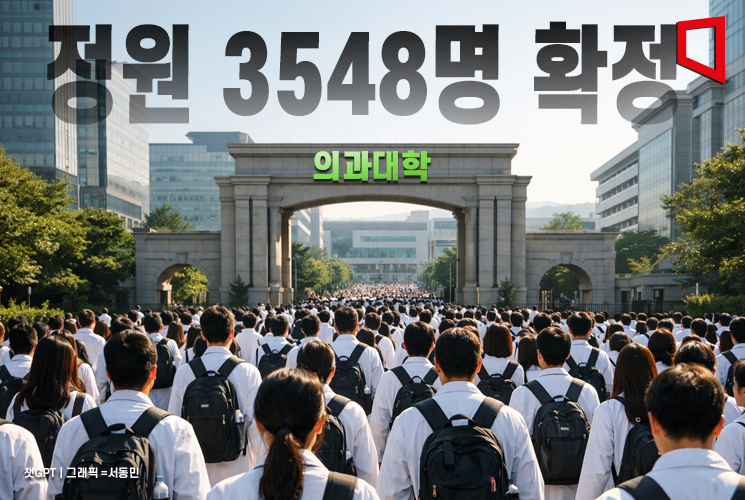
The government has finalized next year’s medical school enrollment quota at 3,548 students, an increase of 490 compared to before the conflict between the government and the medical community. For the two academic years starting in 2028, the quota will increase by 613 students each year, and for the two academic years starting in 2030, it will increase by 813 students each year. The additional students will be selected as regional doctors through a special regional admission track at 32 medical schools nationwide, excluding those in Seoul.
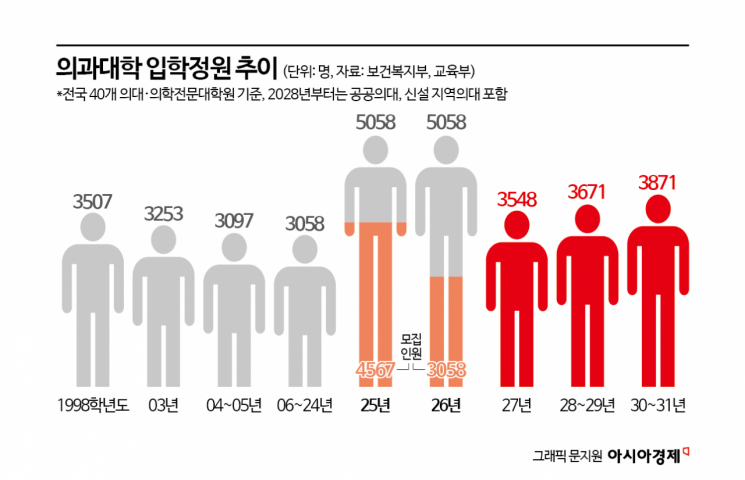
On the 10th, the Ministry of Health and Welfare held the 7th Health and Medical Policy Deliberative Committee (HMPDC) meeting at the Government Complex Seoul and decided to increase the annual average number of medical students to be trained at 32 medical schools outside Seoul by 668 students from 2027 to 2031.
Accordingly, based on the 2024 academic year quota of 3,058 students, the medical school enrollment quota will be 3,548 students in the 2027 academic year, and 3,671 students in both the 2028 and 2029 academic years. In addition, starting from the 2030 academic year, when a public medical school and a regional medical school are established and each recruits 100 new students, the total medical school enrollment quota after 2030 will reach 3,871 students. Taken together, this means that over the next five years, an additional 668 doctors will be trained annually on average. All additional students will be selected as regional doctors.
The Ministry of Health and Welfare has decided to apply upper limits on the increase in enrollment by type and size of university, taking into account the regional distribution of medical schools and the situation in which students in the 2024 and 2025 cohorts will be taking classes together.
Accordingly, for national university medical schools with an enrollment quota of 50 or more, the increase rate compared to the 2024 academic year enrollment quota will be capped at 30%. However, for small national university medical schools with fewer than 50 students, the upper limit will be set at 100% so that they can play a key role in training medical personnel within their respective regions. For private universities, the upper limit will be 20% for medical schools with 50 or more students and 30% for small medical schools with fewer than 50 students.
The increased quota will apply to 32 universities outside Seoul. The specific enrollment quota for each university will be finalized in April after deliberation by the Ministry of Education’s allocation committee and other procedures.
On the same day, the government also announced plans to expand medical education infrastructure along with the quota increase plan. It will provide support so that each university can secure personnel, facilities, and equipment appropriate to its enrollment size, and will promptly improve basic educational facilities such as lecture rooms and laboratories/practical training rooms. It will also gradually secure experimental and practical training equipment needed for basic medical experiments and practice, clinical performance, and clinical skills training.
Students selected through the regional doctor admission track, which will be introduced from the 2027 academic year, will study without the burden of tuition and other costs and will serve as regional doctors after graduation. The government will establish a Regional Doctor Support Center to assist students with academic support, career exploration, and post-graduation career development. Training institutions for medical students will be diversified beyond university hospitals to include regional medical centers and local hospitals and clinics.
Regional doctors will be selected from nine regions excluding Seoul: Daejeon-South Chungcheong, North Chungcheong, Gwangju, North Jeolla, Daegu-North Gyeongsang, Busan-Ulsan-South Gyeongsang, Gangwon, Jeju, and Gyeonggi-Incheon. New students will be selected by dividing recruitment into 44 medium-level medical service areas and 6 wide-area units, and after graduation, they will be required to serve for 10 years based on the location of their high school at the time of selection. Students admitted through the regional doctor track will receive support for tuition, textbook costs, practical training expenses, dormitory fees, or equivalent living expenses.
As university hospitals are responsible for clinical training of medical students and residency training, the government will expand support for strengthening hospitals’ educational infrastructure and research and development (R&D). The government is building clinical education and training centers equipped with advanced equipment at all 10 national university hospitals and plans to prepare a comprehensive development plan to strengthen the roles and capabilities of national university hospitals.
The government will also push for innovation in residency training. It will strengthen regional medical training programs led by regional tertiary general hospitals and provide residents with diverse training experiences across different types of medical institutions and levels of case severity through network-based collaborative training. The maximum continuous training time has been reduced from 36 hours to 24 hours, and starting in March, a pilot program will be implemented to determine an appropriate upper limit for weekly training hours.
Support will also be provided for the education of the 2024 and 2025 cohorts of medical students, whose numbers have increased more than other cohorts. Through the Ministry of Education’s monitoring team, the government will check once every quarter how each university is improving its educational conditions. In addition, the Ministry of Education’s Medical Education Advisory Group, which includes medical school professors, students, and medical education experts, will discuss the current situation and support needs of each university.
Health and Welfare Minister Jung Eun-kyeong stated, "The decision to increase the number of doctors is the result of consultation and communication based on a shared recognition that our health care system has reached an unavoidable crisis," adding, "This decision is an important starting point for reforming regional, essential, and public health care. In close cooperation with the Ministry of Education and other relevant ministries, we will faithfully implement the training of medical personnel and related measures."
Vice Minister of Education Choi Eun-ok said, "We will work to ensure that medical education, which is the first stage in training medical personnel, can be pursued in connection with regional, essential, and public health care systems from admission to graduation."
© The Asia Business Daily(www.asiae.co.kr). All rights reserved.


















