Expanding private investment targets from roads and railways to data centers and power grids
Introducing the "5% rule"... Government to shoulder 60% of cost increases in case of sharp construction cost fluctuations
The government is pushing ahead with measures to revitalize private investment that will attract private capital into new businesses such as artificial intelligence (AI) data centers and the national power grid. Recently emerging lifestyle social overhead capital (SOC) such as senior housing will also be newly included as targets for private investment. The government is also pursuing a model in which the general public shares in the returns from private investment projects through funds in which ordinary citizens participate. Through this, it plans to expand the scale of private investment projects to a total of 100 trillion won over the next five years.
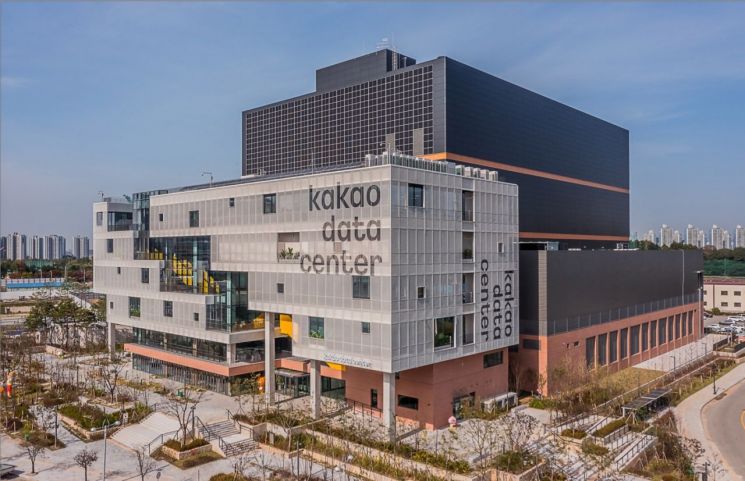 Kakao Data Center in Ansan. Going forward, such data centers will be included as projects under the private investment scheme and could become eligible investments for publicly offered infrastructure funds with citizen participation. The Asia Business Daily DB.
On the 11th, the Ministry of Planning and Budget reviewed and approved a revision to the Basic Plan for Private Investment Projects, which includes these measures, at the "Second Private Investment Project Review Committee Meeting for 2026," chaired by Vice Minister Lim Kigeun, who is acting as Minister of the Ministry.
Expanding into advanced infrastructure... ushering in the 100 trillion won era over the next five years
According to the revision, the scope of private investment, which had previously been limited to traditional SOC such as roads and railways, will be expanded to advanced economic infrastructure including AI data centers, energy storage systems (ESS), hydrogen power generation, and the national power grid. The government has set a goal of identifying new private investment projects worth 20 trillion won each year for five years, totaling 100 trillion won. This is intended to scale up the current annual average private investment volume of around 14 trillion won in order to respond to the rapidly increasing demand for future infrastructure.
A "publicly offered infrastructure fund with citizen participation," through which the general public will share in the fruits of private investment projects, will also be launched. This is similar to the "Seoul Subway Line 9 Citizen Fund," in which citizens invested and shared profits during the second-phase construction of Seoul Subway Line 9 in 2013. That fund, which was launched at a total size of 100 billion won and sold out in just two days, recorded a stable annual rate of return in the 4% range and was successfully liquidated in 2021.
The citizen-participation infrastructure fund will be broadly utilized, ranging from traditional SOC to lifestyle SOC such as data centers, power grids, and elderly medical and welfare facilities (senior housing). In particular, the number of lifestyle SOC categories has increased from the existing seven to a total of ten, with the addition of three new categories: elderly welfare facilities, care facilities, and urban parks. Popular senior housing complexes that have recently been in vogue are now also included as targets for private investment projects.
Kim Myungjung, Director-General for Fiscal Investment Review at the Ministry, explained, "The fund assets will be composed of senior bonds and guaranteed by the Infrastructure Credit Guarantee Fund so that the risk burden will be eliminated," adding, "The rate of return is expected to be offered at around 5-6%, higher than time deposits at commercial banks."
Introducing the '5% rule' to share risks... preventing midstream project abandonment
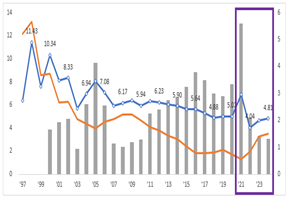 Rate of return for Build-Transfer-Operate private investment projects, 1997-2024. Planning Office.
Measures to share risk in order to prevent private operators from abandoning projects midway due to factors such as high inflation and high interest rates will also be strengthened. The government will introduce the so-called "5% rule," under which, if a cost difference of 5% or more arises between construction costs calculated using the GDP deflator and those calculated using the consumer price index during the construction period, the competent authority’s 60% share of that difference will be reflected in the total project cost. Compared with the previous rule of "50% sharing when the difference reaches 7%," this lowers the threshold while increasing the public sector’s responsibility, with the aim of preventing projects from being derailed. The Ministry of Planning and Budget expects that up to 20% of all projects will benefit from this measure. In addition, the equity ratio requirement for Build-Transfer-Operate (BTO) private investment projects has been lowered from 15% to 10%, reducing entry barriers.
Vice Minister Lim stated, "By innovating the paradigm of private investment, we will not only support economic growth but also contribute in various ways, including improving people’s quality of life," adding, "We will mobilize all our capabilities over the next five years to usher in the '100 trillion won era of private investment.'"
© The Asia Business Daily(www.asiae.co.kr). All rights reserved.

















