At Noon on the 10th, a Visit to Major University Cafeterias
Student Meals in the 6,000-Won Range Amid High Prices...Even Office Workers Join In
Soaring Prices Push Student Loans Past 1 Trillion Won
On the afternoon of the 10th, the student cafeteria on the first floor of the Student Union Building at Yonsei University in Seodaemun-gu, Seoul, quickly saw a line of students debating their menu choices at the kiosk stretch to more than 10 meters. In contrast to the quiet campus during the winter break, notification buzzers announcing that orders were ready rang nonstop in the cafeteria. The spacious seating area was packed with people grabbing an inexpensive meal before or after their part-time shifts, as well as students living alone in Seoul who stayed in the city over the break.
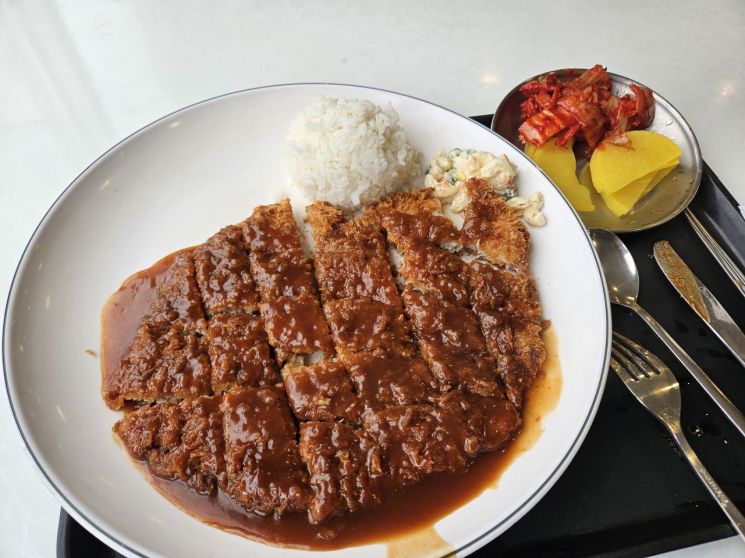 Sejong Daewang Donkkaseu ordered at the student cafeteria on B1 of the Student Union Building at Sejong University in Gwangjin-gu, Seoul, around noon on the 10th. Priced at 6,500 won, it was inexpensive but larger than typical pork cutlets sold commercially. Reporter Park Jaehyun
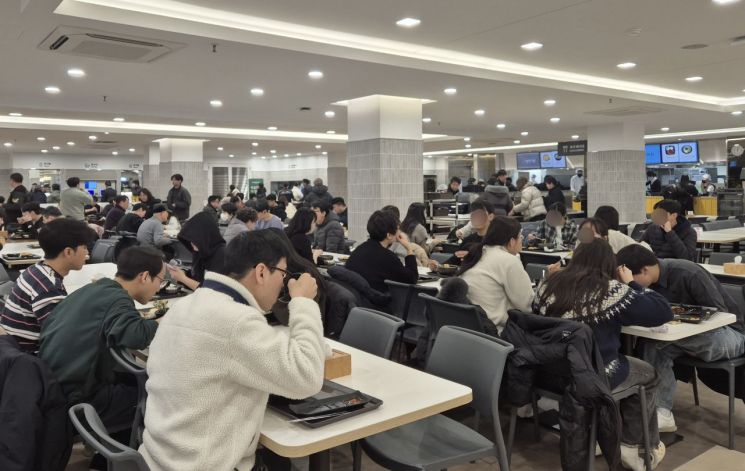 On the afternoon of the 10th, the first-floor student cafeteria in the Student Union Building at Yonsei University in Seodaemun-gu, Seoul, was bustling with students who had come to campus for a meal. Photo by Oh Jieun
Students who came to the cafeteria during the break all cited the same reason: the burden of rising prices. A 22-year-old university student surnamed Kim from Busan said, "I try to use the student cafeteria as much as possible during the break to cut down on expenses," adding with a smile, "I also think it's probably healthier than delivery food." Graduate student Kim Youngmin (29), who is in a master’s program, said, "As a graduate student, I still go to the lab during the break, and since the prices here are cheaper than outside restaurants, I use the student cafeteria often."
At Yonsei University, the most popular item on the menu that day was chicken gomtang with thin wheat noodles, priced at 5,300 won. Considering that chicken gomtang at restaurants near the school costs 10,000 won, it is about half the price. Other options, such as grilled skewered meat and wasabi mayo rice bowl (5,500 won) and Jeju-style pork boiled meat hangover soup (6,000 won), were also generally offered at affordable prices.
The student cafeteria explained, "Because the prices are low but the meals are well put together, many students are coming even during the break."
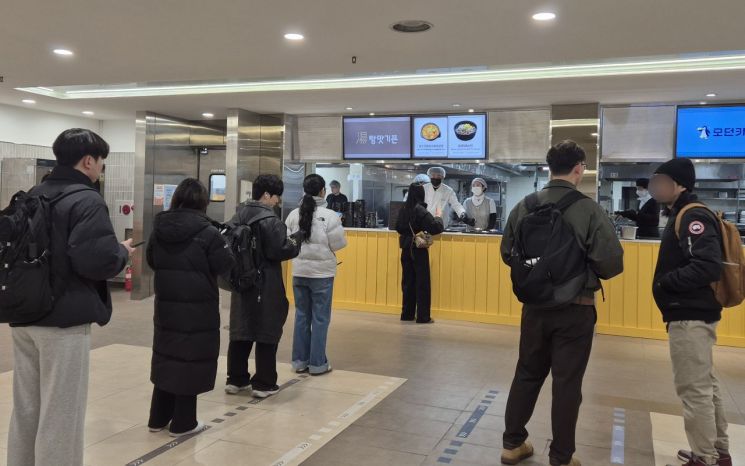 On the afternoon of the 10th, the student cafeteria on the first floor of Yonsei University Student Union in Seodaemun-gu, Seoul is crowded with students who came to campus to eat. Photo by Oh Jieun
The same day, the student cafeteria on B1 of the Student Union Building at Sejong University in Gwangjin-gu, Seoul, was also crowded. Sejong University likewise offered menus that allowed students to have a meal without much financial burden, such as beef brisket doenjang stew (6,000 won), Sejong Daewang pork cutlet (6,500 won), and Spam cheese soft tofu stew (5,800 won). After ordering the Sejong Daewang pork cutlet myself, I found that it was not smaller than pork cutlets sold in ordinary restaurants, making it an excellent value for money.
A 20-year-old student surnamed Shin, whom we met at Sejong University, said, "I ordered yukhoe bibimbap for 6,000 won, and I was surprised at how generous the portion was and how good it tasted," and then asked rhetorically, "With prices these days, where else can you get yukhoe bibimbap for this price?"
With restaurant prices soaring, more and more university students are turning to student cafeterias. As demand grows for inexpensive meals, student cafeterias remain crowded even during the break, when campuses usually become quiet.
According to the National Data Office on the 13th, last year’s overall consumer price inflation rate was 2.1%, while both restaurant prices and food prices rose by 3.2%. The fact that dining-out costs have risen more than overall prices is seen as one of the reasons why students feeling the squeeze on their living expenses are turning to the relatively cheaper student cafeterias.
The increased demand for student cafeterias is visible in the numbers. Korea University’s student cafeterias served 11,919 people last month. This means that even during the break, usage exceeded 60% of the level seen during the semester. At Sookmyung Women’s University, about 500 people use the student cafeteria per day during the semester, and even during this winter break, the utilization rate remained above 40%.
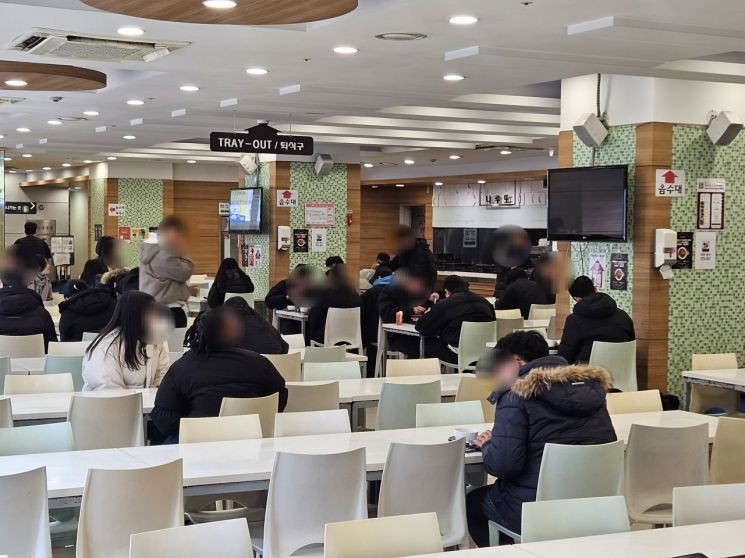 Around noon on the 10th, students were eating at the student cafeteria on B1 of the Student Union Building at Sejong University in Gwangjin District, Seoul. Even during the school break, the cafeteria was crowded with people. Photo by Park Jaehyun
The tight financial situation of students is also evident in the record-high reliance on student loans. According to the Ministry of Education and the Korea Student Aid Foundation, student loans for the second semester of last year totaled 1.0337 trillion won, up 3.0% from the same period a year earlier. In particular, living-expense loans increased by 2.8%, continuing their upward trend over the past five years.
The number of borrowers in the last semester exceeded 310,000, indicating that many young people are maintaining their studies through debt.
Companies that operate student cafeterias consult with universities when setting menu prices in order to minimize the financial burden on students.
Lee Jonghyuk, department head at Sandeul Food, which operates the student cafeteria at Sejong University, said, "We set the price range in consultation with the university and the student council, taking into account students’ financial situations," adding, "Recently, our low prices have become well known, and now even nearby office workers and local residents are coming to eat here."
Lee Eunhee, a professor in the Department of Consumer Science at Inha University, said, "Student cafeterias are often subsidized by universities, so there is a perception that you can get a proper meal at a low price," and added, "In this era of high prices, just as office workers have turned to in-house cafeterias to save on food costs, their footsteps are now extending to universities and student cafeterias as well."
© The Asia Business Daily(www.asiae.co.kr). All rights reserved.



















