"Doll parenting" trend among China's Generation Z
Raising dolls like real children...market size also expanding
As analyses emerge that China's low birth rate problem has already entered a more serious phase than Korea's, attention is focusing on the spread of "doll parenting" as a new culture among young people.
The Hong Kong-based South China Morning Post (SCMP) on February 10 (local time) reported on the rise of the "doll parenting" cultural phenomenon that is gaining popularity among China's Generation Z (people in their teens and twenties).
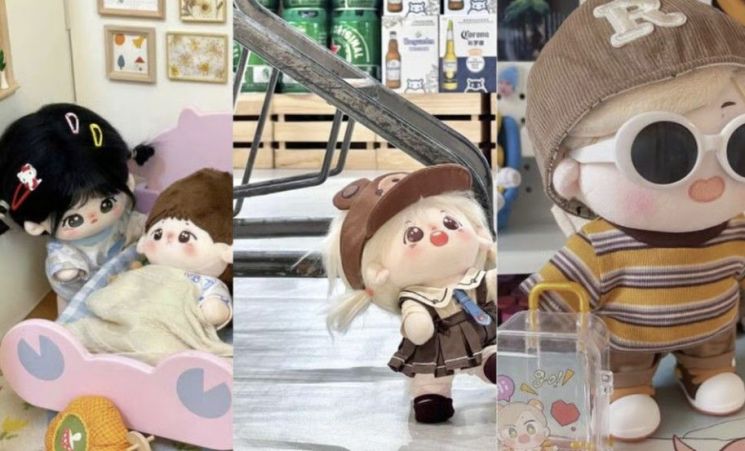 Plush dolls used for doll parenting. Sold for 40 to 100 yuan each. Screenshot from the South China Morning Post.
The outlet wrote that "young women in China are raising stuffed dolls as if they were their own children," analyzing it as "a new parenting trend that seeks motherhood without pain." Doll parenting goes beyond a simple collecting hobby or playing with dolls. Young people who "raise" dolls book expensive restaurants to celebrate the dolls' birthdays and willingly purchase costly clothes made of high-end fabrics. Some even travel to resort destinations together with their dolls.
According to SCMP, doll parenting in China began in 2023 with a post on a social networking service (SNS). The post described how a woman, who visited Haidilao, a Chinese hot pot restaurant, carrying a doll, asked for a baby chair to seat the doll but was refused. She said, "Haidilao is usually famous for its top-notch service, but they refused to refill water for my doll or sing a birthday song for it," and lamented, "Are they rejecting stuffed-doll enthusiasts?"
The post sparked fierce controversy online. Since then, the number of doll enthusiasts carrying stuffed dolls around in China has surged, and recently they have come to be called "doll moms." Doll moms refer to the waiting period until their ordered doll arrives as "pregnancy," and they dress the dolls, put makeup on them, change their hairstyles with wigs, and take them out on excursions.
The dolls popular among doll moms are known to cost around 40 to 100 yuan (approximately 8,000 to 20,000 won). However, most of the spending does not go to the doll itself but to accessories. The money spent on clothes, shoes, wigs, and props is known to easily exceed several hundred thousand won. According to SCMP, China's doll market already surpassed 1.4 billion dollars (about 2.0417 trillion won) in 2023 and recorded a high average annual growth rate of 11% from 2016 to 2023.
Meanwhile, China's low birth rate problem has already reached a serious level, according to surveys. Renowned Chinese demographer Liang Zhongtang said in an interview with Taiwan's Central News Agency on January 21 that "China's total fertility rate likely already fell to around 0.7 in 2024," claiming that this is "lower than Japan (1.15) or Korea (0.75)." According to China's National Bureau of Statistics, the country's total population last year was 1,404.89 million, down by 3.39 million from the previous year. This was the largest decline since 2022.
© The Asia Business Daily(www.asiae.co.kr). All rights reserved.
![Clutching a Stolen Dior Bag, Saying "I Hate Being Poor but Real"... The Grotesque Con of a "Human Knockoff" [Slate]](https://cwcontent.asiae.co.kr/asiaresize/183/2026021902243444107_1771435474.jpg)











