Introduction of Autonomous Operations Platform "AION"
24/7 Monitoring with AI Agents
Unveiling of AI Robot "U-BOT"... "Humanoids Also Under Consideration"
LG Uplus is ramping up its "Autonomous Operations Network" (Autonomous Network) strategy, which aims to automate overall network operations using technologies such as AI agents and digital twins. The company also plans to deploy AI robots at switching centers (central offices) to address potential safety issues that may arise at worksites.
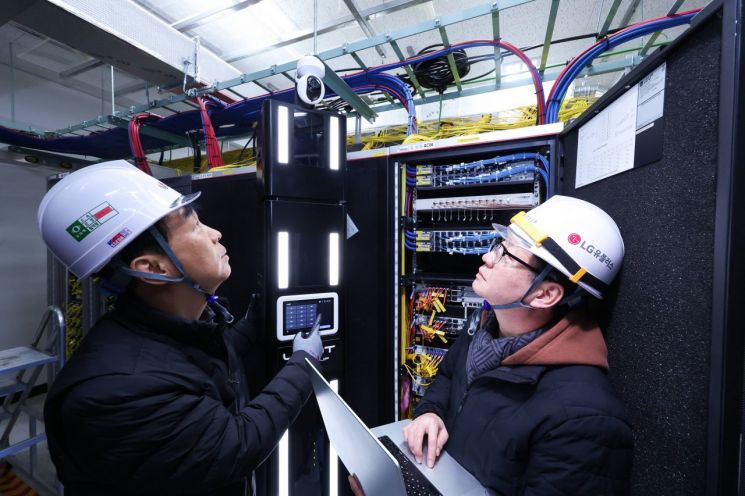 LG Uplus announced on the 10th that it will accelerate its 'Autonomous Operation Network' strategy, applying AI agents and digital twin-based technologies to its commercial network to automate overall network operations. An LG Uplus employee is introducing the AI autonomous driving robot 'U-BOT'. Photo provided by LG Uplus.
At a press briefing held at 10 a.m. on the 10th at LG Science Park in Gangseo-gu, Seoul, LG Uplus proposed a strategic shift toward an AI-based Autonomous Operations Network that applies automation technologies, previously used only for limited functions, across the entire network operations process, including fault management, traffic management, wireless network optimization, and central office management. The company plans to overcome the limitations of labor-dependent network operations and provide customers with a more convenient communications experience.
The company also introduced AION (Artificial Intelligence Orchestration Nexus), the core platform of the Autonomous Operations Network. Through this platform, it is sequentially introducing automation of repetitive work and AI-based preemptive response systems. LG Uplus stated that after the introduction of AION, the number of customer quality complaint cases decreased by 70%, while home customer quality complaint cases fell by 56%. Park Sungwoo, Head of Network AX at LG Uplus, said at the briefing, "As networks become increasingly complex and the number of devices continues to grow, these are results that could not have been achieved with traditional industrial operation methods." He added that the Autonomous Operations Network could be completed as early as 2028.
LG Uplus said it is currently conducting 24-hour real-time monitoring through AI agents. Instead of humans checking alarms and responding, AI detects abnormal signs, determines the scope of impact and response measures, and then either handles issues remotely or requests on-site dispatch. In addition, in the area of central office management, where various telecommunications facilities are installed, the company is expanding autonomous operations by combining digital twins with AI. A digital twin is a technology that reproduces the physical real world in a virtual space to analyze data. AI agents continuously analyze environmental changes such as temperature and humidity inside central offices, detect abnormal signs, and automatically take necessary actions.
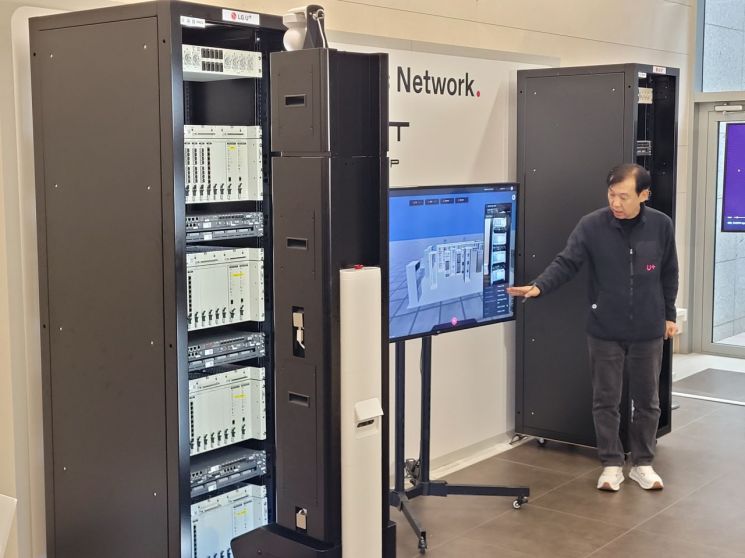 LG Uplus held a press briefing at 10 a.m. on the 10th at LG Science Park in Gangseo-gu, Seoul, and announced plans to transition to an AI-based autonomous operations network. A researcher is demonstrating LG Uplus's AI autonomous driving robot "U-BOT". Photo by Gong Byungseon
The company also unveiled a plan to deploy robots at central offices. Using EXAONE, an AI model from LG AI Research, the AI autonomous driving robot U-BOT will collect information on equipment status, temperature, and surrounding environmental conditions inside central offices and feed this data into the digital twin model. Park said, "People cannot be stationed at central offices, but if robots are stationed there, they can provide information in advance," adding, "We are considering the deployment of robots that can take actions, and we are also considering humanoids as the next step." He further explained, "Robot deployment at central offices is still in the testing stage," and added, "Batteries are a risk factor in central offices, and we believe it would be better if robots or humanoids manage such issues instead of humans."
Regarding robot development, the company said it is working in collaboration with other LG Group affiliates. Lee Sangheon, who is in charge of advanced network development at LG Uplus, said, "The U-BOT currently on display is the result of the combined capabilities of many LG Group affiliates," adding, "We utilized EXAONE and developed it in cooperation with our subsidiary Bear Robotics." He continued, "Rather than simply showcasing robots, we are focusing on how effectively they can be applied in the field," and added, "We are considering evolution to the next model once stability is secured, and we also plan to collaborate with LG Group affiliates on this as well."
© The Asia Business Daily(www.asiae.co.kr). All rights reserved.


















