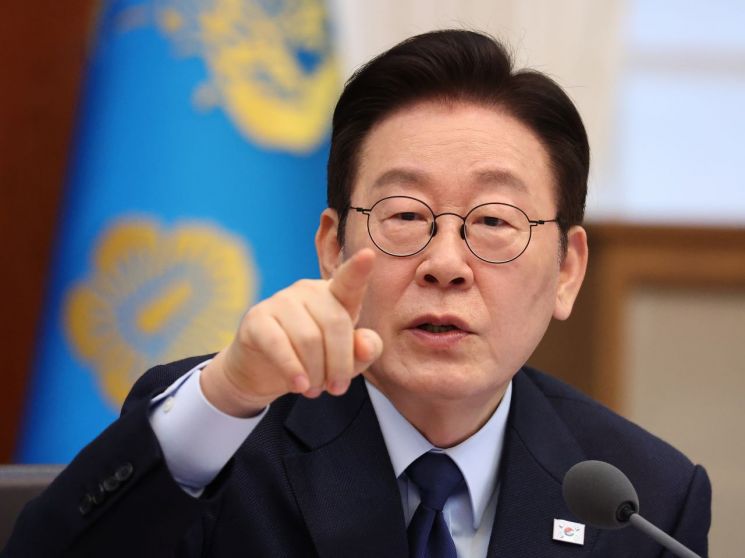
President Lee Jaemyung presides over Cabinet meeting on the 10th
Heavy capital gains tax deferred by 3 or 4 months depending on region
Owner-occupation requirement deferred until the end of tenant contracts
Toward the National Assembly: "The curr
The government will end the temporary suspension of heavier capital gains tax on owners of multiple homes on May 9, but has prepared a mechanism that allows for a deferral of up to two years. If there is a tenant and the owner is inevitably unable to sell the house, the obligation to reside in the property will be deferred until the end of the lease term so that the owner is not subject to the heavier capital gains tax. For registered acquisition-and-lease homes, owners will be exempted from heavier taxation only if they sell the house within a specified period after the mandatory eight-year lease term has elapsed.
4- to 6-month deferral of heavier capital gains tax...until lease expiry if there is a tenant
On the 10th, President Lee Jaemyung presided over a Cabinet meeting at the Blue House and received this report from Koo Yooncheol, Deputy Prime Minister for Economic Affairs and Minister of Finance and Economy. According to Deputy Prime Minister Koo, owners of multiple homes who wish to avoid heavier capital gains tax must complete their sales contracts by May 9. However, in the existing land transaction permit zones such as the three Gangnam districts and Yongsan, heavier capital gains tax will be deferred even after the end date, provided that the final payment or registration is completed within up to four months. In all other areas, a grace period of up to six months will be granted.
In addition, for owners of multiple homes who cannot sell because they have tenants, the government has decided to defer the obligation to reside in the property until the end of the existing tenant’s lease period. However, in the case of a new tenant, the owner must move in and actually reside in the property once the lease term ends, and must complete actual occupancy within two years from the policy announcement date. If an owner of multiple homes decides to sell, the buyer must be someone who does not own a home. This measure is scheduled to be released through an amendment to the Enforcement Decree this week.
Regarding registered acquisition-and-lease homes, President Lee said, "For apartments with high demand, the system itself has already been in place for eight years," and criticized, "If the mandatory lease period has ended, but there is no specified period and heavier capital gains tax is not applied indefinitely, then they could sell even 20 years later. That is a problem." He added, "We must set a period (from the end of the lease to the sale). After an appropriate period, we will apply the tax system in exactly the same way as for ordinary homes."
Before the Cabinet meeting, President Lee wrote on social media, "The 42,500 apartment units in Seoul are by no means a small volume," and stated that applying heavier capital gains tax on registered rental homes owned by multiple-home landlords could be expected to have a stabilizing effect on the real estate market to some extent. On this day, President Lee attached a media article titled, "Rental housing operators are in turmoil over President Lee’s remarks putting the rental housing system on the chopping block," and made these comments.
The article stated that, as of 2024, among 1,349,121 private rental housing units nationwide, only about half, or 717,466 units, are acquisition-and-lease homes, and that among these, apartments in Seoul account for only about 42,500 units. The point was that most acquisition-and-lease homes are small-sized housing, so even if they are put up for sale, the effect on price stabilization would be limited. This is the third consecutive day that President Lee has raised issues with the acquisition-and-lease system. On the 8th, he remarked, "It is strange that as long as you register as a rental business operator, you can buy as many homes as you want." On the 9th, he hinted at a reform of the system by criticizing the preferential treatment of exempting registered rental business operators from heavier capital gains tax on multiple homes, saying, "All kinds of tax systems should be the same as those for general rental housing in order to be fair, right?"
Lee admonishes the National Assembly: "At the current legislative pace, it is hard to cope"
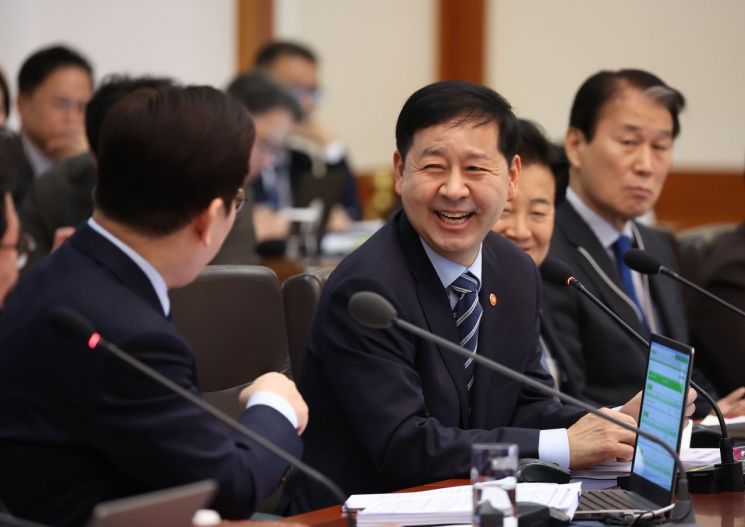 Koo Yooncheol, Deputy Prime Minister and Minister of Finance and Economy, is talking with President Lee Jaemyung at a Cabinet meeting held at the Blue House on the 10th. Photo by Yonhap News
Furthermore, at the Cabinet meeting, President Lee pointed out, "With the current legislative pace, it is very difficult to respond proactively to changes in the international community." After prefacing his remarks by saying, "I was trying not to say this to the National Assembly if I could help it, but I must," President Lee analyzed, "Instability in the international community is extremely high, and competition between nations is so fierce that even the order itself is collapsing."
He went on to stress, "In such a situation, domestic unity and reform measures are extremely important," adding, "No matter how hard we run, if we do not run faster than other countries, we will immediately fall behind in the competition. That is the grave reality we face."
In particular, President Lee emphasized, "To achieve goals such as backing trade negotiations with foreign countries, innovating administrative regulations, and securing momentum for a great transition, various legislation to strengthen the Republic of Korea’s competitiveness is truly urgent," and appealed, "Regardless of party affiliation, I ask for politics that put the national interest first, in which you, as public servants representing the sovereign people, exert unified strength. This is especially true in external relations."
Addressing Cabinet members as well, President Lee said, "For urgent legislation, please persuade the National Assembly more actively and appeal to them," and added, "As I previously told the Minister of Employment and Labor, people are dying in the field; even if you have to go and beg, I hope you will ensure that legislation can be passed swiftly."
Having designated this year as the "first year of a great leap forward," President Lee has repeatedly criticized the ruling party’s slow legislative pace. At a senior secretaries’ meeting on January 29, he said, "I wish the legislative pace could be further increased." In the middle of his remarks, he even voiced frustration, saying, "It is frustrating." At the Cabinet meeting on the 27th, he rebuked National Tax Service Commissioner Lim Gwanghyun, saying, "The current legislative pace of the National Assembly is far too slow. Nearly eight months have passed, yet even legislation on the government’s basic policy directions stands at less than 20%. The National Assembly is so slow that we are unable to work."
President Lee also said, "This past January reportedly had the driest weather, with the lowest relative humidity, since statistics began 73 years ago," and instructed, "The likelihood of wildfires is much higher, and once they break out, they are harder to extinguish. As this situation is likely to continue, I ask you to make greater efforts to prevent wildfires." He also appealed to the public, saying, "When entering mountains or conducting burning work near mountains, please take special care to ensure that it does not lead to wildfires."
© The Asia Business Daily(www.asiae.co.kr). All rights reserved.


















