Operation of Autonomous Material-Transport Robots at Siheung Rolling Stock Depot
Korea Railroad Corporation (Korail) has reported the first results of its artificial intelligence (AI) and 5G-based new technology demonstration projects carried out at railway sites such as Seoul Station and the Siheung Rolling Stock Maintenance Depot. Korail announced on the 10th that it successfully completed the demonstration conducted as part of the Open RAN demonstration project of the National Information Society Agency (NIA).
This demonstration was part of the Open RAN project promoted jointly with NIA, based on LG Electronics' Open RAN 5G private network solution. A 5G private network using Open RAN refers to a mobile communication network built exclusively for a specific organization or workplace, configured with a "standardized open interface (Open RAN)." It offers flexible scalability and, with ultra-low latency, ultra-high speed, and ultra-connectivity performance, can reliably transmit large volumes of data.
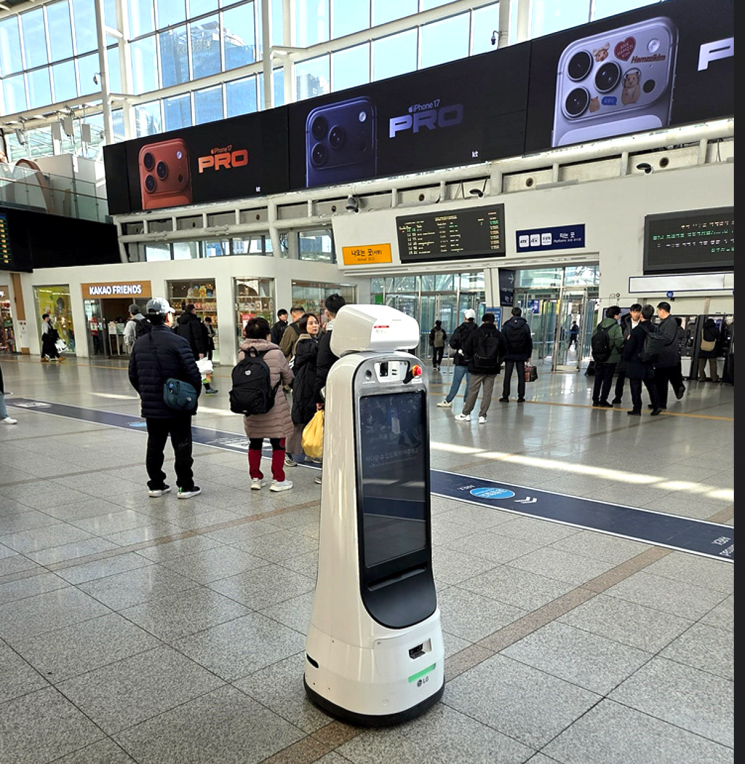 A robot deployed at Seoul Station. Using artificial intelligence (AI), it analyzes congestion and guides customers to disperse. Korail
At Seoul Station, a service that combines an AI-based congestion management system with an information robot is in trial operation. Artificial intelligence analyzes in real time the CCTV footage installed in the concourse passageways and on the platforms, and transmits the results to the robot. The robot then moves directly to congested spots and disperses passenger flows through voice guidance such as "Please move to the west plaza." This is intended to reduce congestion and collision risks caused by overlapping movement directions of disembarking passengers at Seoul Station, which has multiple exits, and it serves to assist station staff in on-site guidance. By linking train arrival and departure times with platform congestion data, safety personnel are also pre-deployed during time periods when crowds are expected to surge.
A radar sensor-based vital sign detection system has also been installed in the restrooms at Seoul Station. Without using cameras, it detects vital movements such as falls or breathing with radar, enabling a swift response to emergencies while avoiding concerns about invasion of privacy.
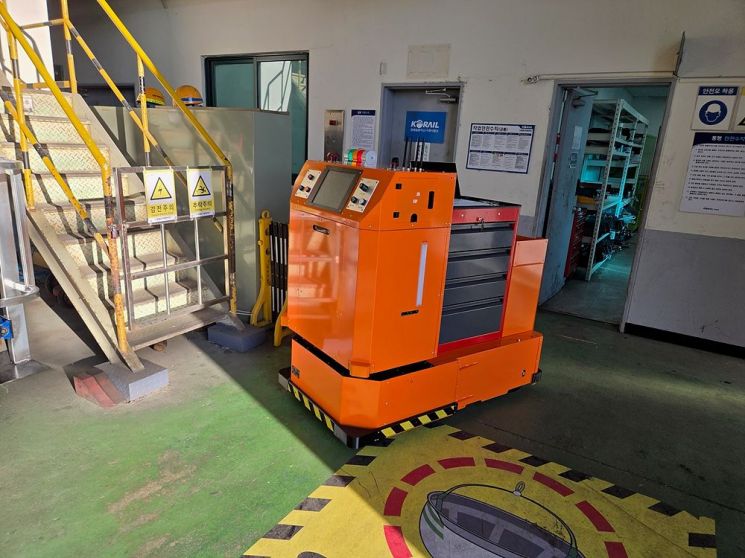
At the Siheung Rolling Stock Depot, which services metropolitan commuter trains, an autonomous material-transport robot has been deployed. This robot carries heavy materials and follows workers autonomously by detecting their movements, thereby reducing the risk of injury at maintenance sites. The data transmission system for rolling stock maintenance has also been improved. Previously, data had to be downloaded via a secure USB over a wired connection, but it has now been changed to wireless transmission over the 5G private network, enabling 7GB of data to be processed in 2 minutes and 30 seconds.
Although the NIA-funded demonstration project has been completed, Korail's own demonstration projects will continue until November this year. Korail plans to keep the current equipment deployed at Seoul Station and the Siheung Rolling Stock Depot and to continue making improvements to enhance operational efficiency.
Yoon Jaehun, Head of AI Strategy at Korail, said, "We will accelerate the AI transformation (AX) of railway services by fully launching the introduction of advanced technologies such as artificial intelligence and 5G private networks."
© The Asia Business Daily(www.asiae.co.kr). All rights reserved.
![Clutching a Stolen Dior Bag, Saying "I Hate Being Poor but Real"... The Grotesque Con of a "Human Knockoff" [Slate]](https://cwcontent.asiae.co.kr/asiaresize/183/2026021902243444107_1771435474.jpg)

















