A new technology has been developed that enables artificial intelligence (AI) to complete "molecular design" rapidly and accurately. Molecular design is crucial for ensuring that the atoms forming a material substance bond in a stable way. The stability of a molecule depends on how countless atoms are arranged. Until now, this process has been as complex as searching for the lowest valley in a vast mountain range, requiring enormous time and cost. In contrast, the newly developed technology is meaningful in that AI can learn and understand the laws of physics and thereby find the optimal path quickly and accurately.
On February 10, KAIST announced that a research team led by Professor Kim Wooyeon of the Department of Chemistry has developed an AI model called the "Riemann Diffusion Model (R-DM)," which autonomously learns the physical laws that determine molecular stability and uses them to predict molecular structures.
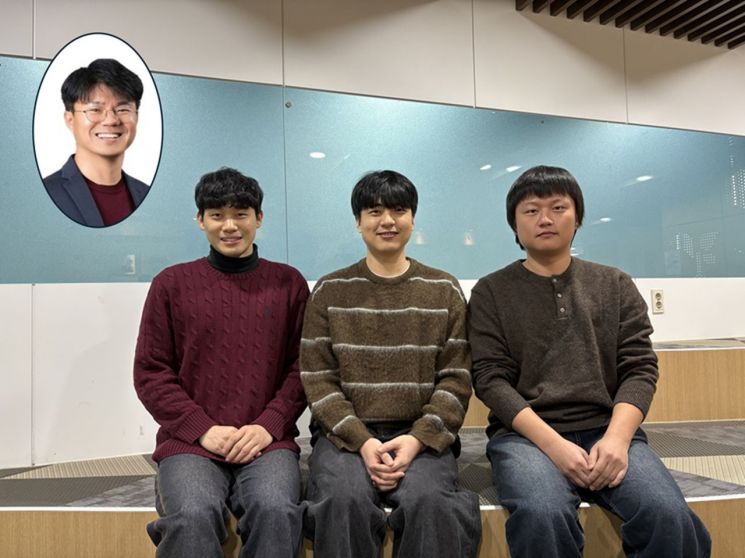 (From the top left) KAIST Professor Kim Wooyeon, KISTI Dr. Woo Jaeheon, KAIST Dr. Kim Seonghwan, KAIST Ph.D. candidate Kim Junhyung. KAIST
The most notable feature of this model is that it directly takes into account the "energy" of a molecule. Whereas conventional AI models simply mimicked the shape of a molecule, R-DM refines the structure on its own by considering what kinds of forces act within the molecule.
The research team first created a molecular structure map in which higher energy levels are represented as hills and lower energy levels as valleys, and then designed the AI so that it can move toward and find the lowest valley (the lowest energy state).
On this energy landscape, R-DM completes molecules by avoiding unstable structures and finding the most stable state. This was made possible by applying the mathematical theory of "Riemannian geometry," which allowed the AI to autonomously learn the fundamental chemical principle that "matter prefers the state of lowest energy."
Experimental results showed that R-DM achieved up to more than 20 times higher accuracy than existing AI models. Its prediction error was reduced to a level almost indistinguishable from that of high-precision quantum mechanical calculations. This represents a world-class level among AI-based molecular structure prediction technologies.
This technology can be applied in a wide range of areas, including new drug development, next-generation battery materials, and high-performance catalyst design. The research team expects it to serve as an "AI simulator" that can dramatically accelerate research and development in molecular design processes that previously required a great deal of time.
It is also expected to have significant potential in the environmental and safety sectors, as it can rapidly predict chemical reaction pathways even in situations where experiments are difficult to conduct, such as chemical accidents or the spread of hazardous substances.
Professor Kim said, "R-DM is the first case in which AI understands the basic principles of chemistry and autonomously assesses molecular stability," adding, "This technology will act as a catalyst that fundamentally changes how new materials are developed in the future."
Meanwhile, this research was co-led by Dr. Woo Jeheon of the KISTI Supercomputing Center and Dr. Kim Seonghwan of the KAIST Innovative New Drug Discovery Center as co-first authors. The research findings (paper) were recently published in the international journal "Nature Computational Science."
© The Asia Business Daily(www.asiae.co.kr). All rights reserved.

















