S&P 500 Rebounds After Opening Lower
U.S. Jobs Data Jitters...Caution Ahead of BLS Release on the 11th
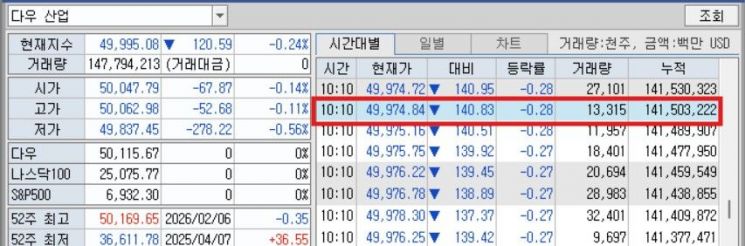
The three major U.S. stock indexes in New York were all on a downward trend on the 9th (local time). With the U.S. labor market showing unstable signals, caution has increased ahead of the January Employment Situation report from the Bureau of Labor Statistics (BLS) to be released on the 11th and the Consumer Price Index (CPI).
As of 10:10 a.m. that day on the New York Stock Exchange, the blue-chip Dow Jones Industrial Average was down 140.83 points (-0.28%) from the previous session at 49,974.84. The large-cap S&P 500 Index opened at 6,917.26, down 15.04 points (-0.22%), but soon rebounded and was trading at 6,936.96, up 4.66 points (+0.06%). The tech-heavy Nasdaq Composite was at 23,100.06, up 68.84 points (+0.29%).
At this time, the biggest decliners on the Dow include Amazon.com (-3.05%), IBM (-2.15%), Merck (-1.64%), and Apple (-1.35%). On the S&P 500, Oracle (+9.55%), Robinhood (+4.71%), Palantir Technologies (+3.98%), Apollo Global Management (+3.25%), and Nvidia (+3.24%) ranked among the top gainers. On the Nasdaq, Focus Universal (+70.85%) and Humacyte (+24.16%) were sharply higher, and most issues were generally on the rise.
The U.S. employment data are cited as the reason for the volatility, with the three major indexes falling at the open and then rebounding. Employment indicators released last week showed a slowing trend in hiring. According to the ADP private employment report, private payrolls in January increased by only 22,000, about half of market expectations.
According to the layoff report released by U.S. employment information firm Challenger, Gray & Christmas (CG&C), U.S. companies announced plans to cut 108,435 jobs in January. This is down 205% from the previous month and down 118% from a year earlier, and is the largest figure since 2009, right after the financial crisis.
In the market, expectations for the BLS employment data to be released on the 11th are that nonfarm payrolls in January will increase by 70,000 and the unemployment rate will remain at 4.4%. If the unemployment rate comes in higher than expected, concerns about the labor market could materialize. Attention is focused on whether the January payroll figure will fall below the market's lowest estimate of 70,000.
On the 13th, the January CPI will also be released. The market expects January CPI to rise 0.3% month-on-month and 2.5% year-on-year. On a year-on-year basis, this would be lower than December of last year (2.7%), but still above the Federal Reserve (Fed)'s 2% target.
With Fed chair nominee Kevin Warsh stressing "artificial intelligence (AI) productivity" and supporting interest rate cuts, market attention is also focused on this week's CPI data. He has argued that if AI-driven productivity significantly boosts supply, the Fed can lower its policy rate without triggering inflation problems. If the CPI reading comes in higher than expected, Warsh's "AI productivity" thesis will be put to the test.
© The Asia Business Daily(www.asiae.co.kr). All rights reserved.

















