China's agile offensive exploiting the "production cliff"
Over 1,300 units sold in January alone...older models remain a variable
Expansion accelerates with launch of 20-million-won-range "Dolphin"
Chinese brands like Zeekr and Chery continue to
Since entering the Korean market last year and selling more than 6,000 units, BYD has successfully established itself and has been further increasing its market share since the beginning of this year. While domestic automakers are suffering from severe delivery delays due to shortages in production volume for competing models, Chinese brands are rapidly moving into this gap with an aggressive "low-price strategy."
According to the Korea Automobile Importers & Distributors Association on the 10th, BYD sold 1,347 vehicles in the Korean market in January alone. This means it achieved 22% of last year’s total annual sales within just one month. In the monthly registration rankings by imported car brand, it ranked fifth, overtaking Volvo and Audi.
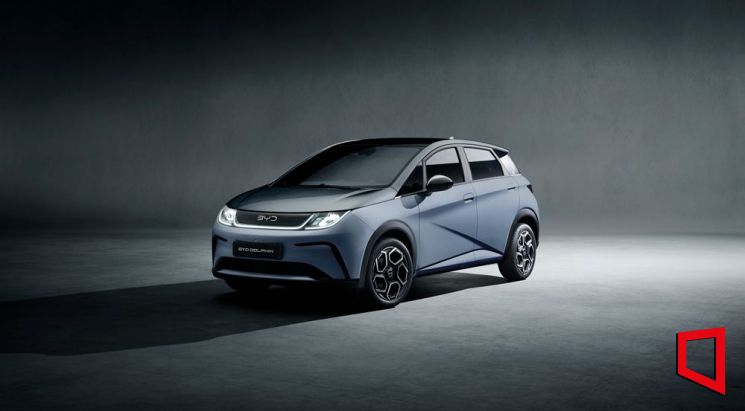
The driving force behind this success is its agile new model launch strategy. On February 2, BYD launched the Seal (RWD), an electric sedan priced in the 30 million won range, and on February 11 it is set to officially launch the Dolphin, a small electric hatchback in the 20 million won range.
The newly launched Dolphin is expected to compete directly with models such as Hyundai Motor’s Casper Electric and Kia’s EV3. Despite its relatively low price, it is evaluated as offering strong value because it includes a wide range of options, such as 15 advanced driver-assistance systems (ADAS), including Intelligent Cruise Control and Lane Keeping Assist.
The key point to watch is the delivery timing. Despite its strong popularity, the Casper Electric currently requires customers to wait more than 22 months to receive their vehicles due to insufficient production volume. BYD, on the other hand, appears able to deliver vehicles in a significantly shorter period.
Its price competitiveness is also threatening. Although the competing Kia EV3 belongs to a larger vehicle segment and offers a longer driving range, its price is set more than 10 million won higher than the Dolphin, leading to expectations that value-conscious consumers will defect to BYD.
The onslaught of Chinese cars does not stop there. Zeekr, the premium electric vehicle brand of China’s Geely Automobile Group, will officially enter the Korean market this year, led by its mid-size electric SUV, the 7X.
Some brands are entering the market indirectly by forming "strategic alliances" with domestic companies. Chery Automobile, China’s No. 1 exporter, is working with KGM on a joint development project for a mid-to-large SUV called the SE-10. The project involves integrating Chery’s dedicated platform and autonomous driving technology into KGM’s new vehicles.
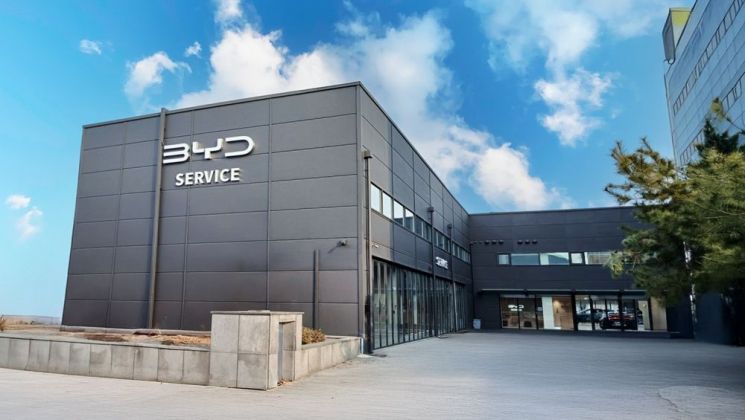
BYD has set this year’s sales target at 10,000 units and is also accelerating the expansion of its after-sales service (AS) infrastructure. Having recently opened its 17th service center, the company plans to increase its service network to 26 locations nationwide by the end of the year.
However, there are also risk factors. Some consumers point out that certain BYD models sold in Korea are already classified as older-generation models in overseas markets. Similar criticism arose last year when BYD launched the Atto 3 and Seal models, but BYD explained at the time that these were not inventory clearance models, but products tailored specifically to the Korean market.
Experts analyze that BYD, having made a soft landing in the Korean market, will achieve annual sales of more than 10,000 units this year, supported by the launch of even more affordable models. Lee Hanggu, a research fellow at the Korea Automotive Technology Institute, said, “Some imported brands sell only a few hundred units a year, but BYD has successfully entered the Korean market.”
Lee Hogun, a professor in the Department of Automotive Engineering at Daedeok University, said, “We need to distinguish between B2B (business-to-business) and B2C (business-to-consumer), but since BYD entered the Korean market there have been no cases where its quality has become an issue,” emphasizing, “BYD’s strategy of securing quality stability first and then launching low-priced models is likely to succeed.”
© The Asia Business Daily(www.asiae.co.kr). All rights reserved.


















