SpaceX-xAI merger brings space data center plans into focus
Lower cooling costs and 24-hour solar power supply
HJT solar cells optimized for extreme space environments draw attention
Share prices of related companies such as Daejoo Electronic Mat
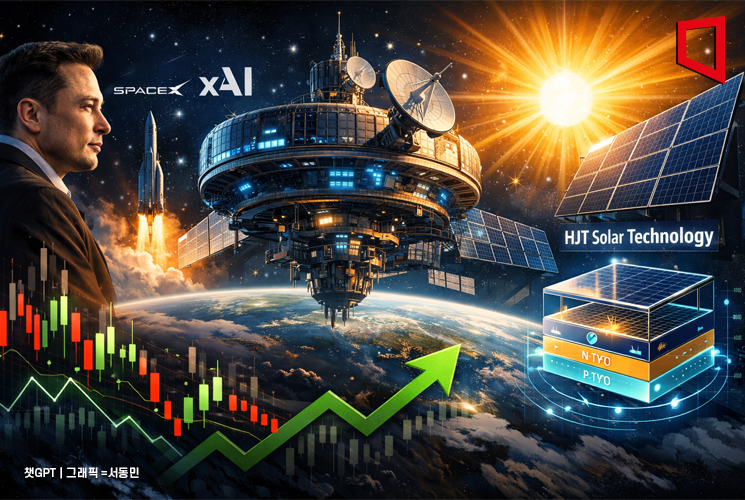
As Elon Musk announced the merger of SpaceX and xAI and unveiled his plan to build space-based data centers, share prices of domestic solar-related companies have been soaring. This is because the energy needed for space data centers is expected to be supplied by solar cells. In particular, interest is surging in heterojunction (HJT; Heterojunction Technology) solar cell technology, which maintains high efficiency even in extreme space environments.
On February 10, U.S. business media outlet Business Insider reported that SpaceX is hiring key engineers to develop a space data center. This is being interpreted as Musk taking concrete action toward the construction of space data centers.
Previously, SpaceX recently submitted to the U.S. Federal Communications Commission (FCC) a plan to launch 1 million satellites into Earth orbit and use solar panels attached to those satellites to supply power to an AI data center with a capacity of 100 gigawatts (GW).
Musk also emphasized the need for space data centers at the World Economic Forum (WEF) held in Davos, Switzerland, in January. At the time, he said, "Building AI data centers in space is such an obvious choice," adding, "Space will be the place where it is cheapest to host AI, and this will be realized within two years, three at the longest."
Building data centers in space offers several advantages. In the vacuum of space, heat can be dissipated without additional energy consumption, which can reduce cooling costs that account for a significant portion of data center operating expenses. It is also possible to shorten construction time because there is no need to build power grids and new power plants, and there are no issues such as local opposition.
Above all, if space-based solar power is synchronized with the Sun's orbit, it can generate electricity 24 hours a day, day and night. Because electricity can be produced regardless of weather or atmospheric conditions, power generation efficiency can be maximized. The solar industry expects that, in space, solar panels of the same area could generate electricity with about 5 to 8 times higher efficiency than on the ground. Unlike terrestrial solar power, there would be no need to install large-scale energy storage systems (ESS) to compensate for intermittency, and data centers could be operated stably around the clock using only solar power.
Among space solar technologies, HJT solar cells are drawing particular attention. According to local Chinese media, Musk's side recently looked into Chinese solar companies to assess the maturity of China's HJT technology. It is reported that Musk's team focused on HJT and perovskite technologies.
HJT is a solar cell in which different types of solar cells are stacked like a sandwich. By depositing amorphous silicon thin films on both the front and back surfaces of a monocrystalline silicon substrate, efficiency has been maximized. HJT solar cells can maintain stable performance even in the space environment, where they are exposed to radiation, and they also have the advantage of excellent mass producibility based on silicon wafers.
In addition, they suffer little power degradation even under extreme temperature changes ranging from minus 150 degrees Celsius to plus 120 degrees Celsius, enabling stable power generation in harsh space environments. Musk's team is said to have examined Chinese HJT solar cell companies because of these advantages.
Amid this trend, Daejoo Electronic Materials, which is developing paste materials used in HJT solar cells, is attracting attention among domestic companies. Paste refers to a conductive material that acts as an electrode to transfer electricity generated on the surface of a solar cell to the outside. Daejoo Electronic Materials is developing low-temperature firing silver (Ag) paste materials that are essential for HJT cell processes.
A representative of Daejoo Electronic Materials explained, "We have already secured HJT solar cell quality with excellent characteristics through close cooperation with one of the top five solar cell manufacturers in North America."
On February 9, Kiwoom Securities researcher Kwon Joonsu stated regarding Daejoo Electronic Materials, "It appears that inquiries have recently begun from a U.S. aerospace company about Daejoo Electronic Materials' paste products, so it is necessary to pay attention to the possibility of future orders." The share price of Daejoo Electronic Materials surged 27.4% in a single day.
Buoyed by Musk's vision for space data centers, the share prices of domestic solar companies such as Hanwha Solutions, OCI Holdings, and HD Hyundai Energy Solutions have also been posting sharp gains day after day. On February 9, Hanwha Solutions rose 13.7% compared with the previous trading day. In just six trading days this month, its share price has jumped 80%.
The solar industry believes that the United States is highly likely to adopt non-Chinese solar products. Hanwha Solutions is producing every stage from ingots to modules within the United States through its "Solar Hub" established in the state of Georgia.
Perovskite, which Hanwha Solutions is developing, is also being evaluated as a technology suitable for space solar power.
Jeon Wooje, a researcher at KB Securities, said, "Hanwha Solutions has selected perovskite as a strategic product and has been focusing on research since 2019, and it has been operating pilot facilities since the end of 2024," adding, "The strengths of perovskite, such as ultra-light weight, high efficiency, light transmission, flexibility, radiation resistance, and self-healing characteristics, make it suitable for space solar power."
© The Asia Business Daily(www.asiae.co.kr). All rights reserved.

















