"Advances in Mechanisms and Formulations Intensify Competition to Displace Existing Therapies"
The criteria for determining the next blockbuster in the global biopharmaceutical market are changing. Rather than opening up entirely new markets by introducing first-in-class drugs for diseases without existing treatments, competition is expected to intensify around "clinical superiority," where new drugs replace existing products in areas with established standard therapies by offering better efficacy or greater convenience of administration.
According to the pharmaceutical and biotech industry on the 9th, the market research firm Evaluate projected that the 2032 sales of 10 major new drugs expected to be launched this year will total about 45.9 billion dollars (approximately 67.0782 trillion won). This is about 1.5 times higher than the roughly 29 billion dollars (about 42.3806 trillion won) in projected sales for the top 10 new drugs as of last year.
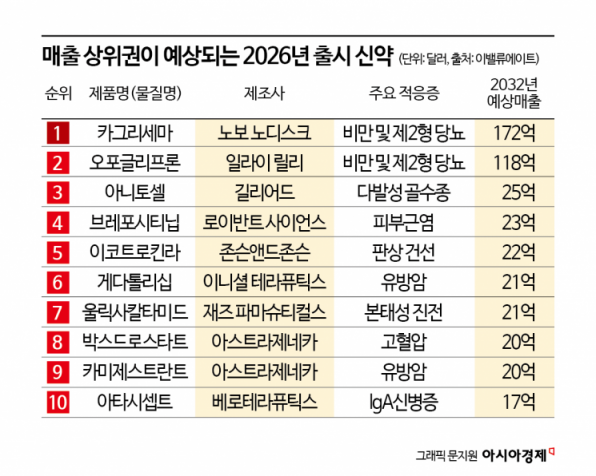
The rapid increase in market value over a short period is attributed to advances in drug mechanisms and the evolution of formulations. A representative example is glucagon-like peptide-1 (GLP-1) class obesity and diabetes treatments, which are expected to account for 63% of the total 2032 sales of new drugs launched in 2026. Evaluate forecast that Novonordisk's Cagrisema and Eli Lilly's Orforglipron will generate 17.2 billion dollars (about 25.126 trillion won) and 11.8 billion dollars (about 17.2445 trillion won), respectively, in sales in 2032.
Although both candidates belong to the GLP-1 class, the direction of their competitiveness differs. Cagrisema is evaluated as a drug that raises the upper limit of weight-loss efficacy compared to existing therapies through a combined mechanism that links GLP-1 with an amylin analogue. Orforglipron, on the other hand, is pursuing a strategy of expanding the largely injectable GLP-1 market itself by emphasizing its innovation as an oral formulation.
In other words, the advancement of mechanisms and the evolution of formulations are each enhancing sales potential in different ways. An industry insider said, "Beyond simply expanding demand, the key factor shaping the prescription market is how clearly a drug can demonstrate clinical superiority in terms of therapeutic efficacy and patient convenience."
The competition for clinical superiority is also anticipated among other candidates included in the top 10 new drugs. The focus is on patient groups that have not been adequately controlled by existing regimens in markets where treatments already exist, or on overcoming limitations that arise over the course of long-term treatment.
Johnson & Johnson's plaque psoriasis treatment candidate Icotrokinra and AstraZeneca (AZ)'s breast cancer drug candidate Camizestrant are positioned as candidates whose core competitiveness lies in improved efficacy or differentiated tolerability compared with the current standard of care. AZ's antihypertensive drug Baxdrostat is likewise pursuing a differentiation strategy by targeting treatment-resistant patients within the existing antihypertensive drug market.
In the rare disease segment as well, therapies that improve upon the limitations of existing regimens are expected to rank among the top sellers. Pfizer's dermatomyositis treatment Brepocitinib, which was licensed in to Roivant Sciences, and Vera Therapeutics' immunoglobulin (Ig) A nephropathy treatment Atacicept had long been viewed as having limited market potential due to the small number of patients. Recently, however, they have emerged as candidates capable of generating sales in the multi-billion-dollar range by demonstrating clear clinical improvement compared with existing therapies.

Existing blockbuster drugs are also moving to defend their positions through formulation changes and indication expansions. Keytruda, Merck (MSD)'s cancer immunotherapy and the world's top-selling oncology drug, is seeking to maintain its presence in the market ahead of patent expiry by introducing a subcutaneous formulation and broadening its approved indications.
© The Asia Business Daily(www.asiae.co.kr). All rights reserved.


















