As the number of civilian members shrinks and legal professionals dominate,
concerns grow over the expertise and fairness of the Sanctions Review Committee
Governor Lee: "The rigid decision-making structure is a problem"
Considering appointing fi
Lee Chanjin, Governor of the Financial Supervisory Service, has hinted at expanding the number of civilian members on the Sanctions Review Committee, which has been left virtually vacant for nearly half a year. He plans to push ahead with a full-scale personnel overhaul, in response to criticism that expertise and fairness have weakened after a large number of civilian members left when their terms expired last year, and that the decision-making structure has become rigid due to an overconcentration of legal professionals.
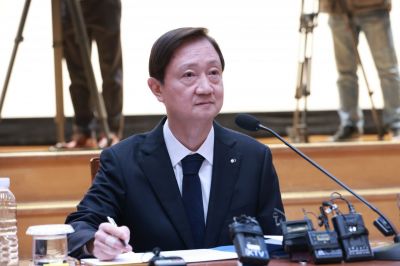 Lee Chanjin, Governor of the Financial Supervisory Service, is taking notes while listening to reporters' questions after announcing the 2026 work plan at the Financial Supervisory Service headquarters in Yeouido, Seoul, on the 9th. Photo by Financial Supervisory Service
Only 8 out of 20 civilian members active... "We will resolve the concentration in specific professions"
On the 9th, the Financial Supervisory Service announced its 2026 work plan, stating, "We will diversify the composition of civilian members of the Sanctions Review Committee from being centered on legal professionals to including academia, research institutes, and others, in order to resolve the concentration in specific professions, and we will preemptively restrict the appointment of those with potential conflicts of interest."
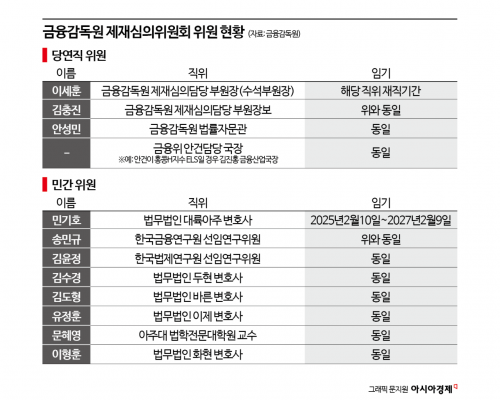
The authorized number of civilian members on the Financial Supervisory Service’s Sanctions Review Committee is 20. Currently, only 8 are active. This is because, after the terms of 7 out of 15 civilian members expired in July last year, no new appointments had been made for 7 months. In the financial sector, there has been persistent criticism that, as the number of civilian members decreases, the influence of ex officio members from the Financial Services Commission and the Financial Supervisory Service grows, undermining the objectivity and fairness of sanctions.
Among the 8 civilian members currently active, 5 are lawyers, meaning the proportion of legal professionals is overwhelmingly high. At a press conference the previous day, Governor Lee said, "We are steering the composition toward strengthening non-legal professionals so that policy consistency and on-the-ground practicality can be better balanced," adding, "To improve the current structure in which practicing lawyers make up the majority, we will consider bringing in figures from academia and research institutes, as well as individuals with investigative agency backgrounds."
Hong Kong ELS sanctions put more weight on 'field practicality' than on 'severe punishment'
A case cited as lacking the policy consistency and field practicality mentioned by Governor Lee is the ongoing sanctions review over the mis-selling of Hong Kong H-share Index (Hang Seng China Enterprises Index, HSCEI) equity-linked securities (ELS) by banks. When the Financial Supervisory Service gave prior notice late last year of a fine measure plan worth around 2 trillion won, the financial sector assessed that the authority was putting more weight on the principle of strict punishment rather than on post-crisis remediation efforts such as customer compensation. This runs counter to the policy intent of the Financial Services Commission, which has emphasized that banks’ post-crisis remediation efforts should be reflected in sanctions. In November last year, the Financial Services Commission revised the system to allow fines for violations of the Financial Consumer Protection Act to be reduced by up to 75%.
Governor Lee also indirectly indicated that the Hong Kong ELS sanctions review process is somewhat out of step with the field practicality demanded by the financial sector. At the press conference, referring to the report on the pending Hong Kong ELS sanctions, he said, "The third sanctions review is scheduled for the 12th, and we will approach it prudently and meticulously by fully gathering the opinions of the sanctions targets and the members of the Sanctions Review Committee," adding, "During the third sanctions review process, we will reflect banks’ post-crisis remediation efforts and voluntary compensation in our decision."
The Financial Supervisory Service plans to accelerate the process of filling committee vacancies, which had been delayed due to the change of governor and executive appointments. An official at the Financial Supervisory Service said, "We were aware of the need to recruit additional civilian members, but we did not have the capacity to push this forward last year due to the inauguration of the new governor and executive personnel changes, and we are now in the process of filling the positions," adding, "We will speed up the recruitment process in accordance with supervisory regulations."
© The Asia Business Daily(www.asiae.co.kr). All rights reserved.


















