JTBC's exclusive coverage draws only 1.8% viewership
Key events pushed to early-morning slots by 8-hour time difference
The public turns away as companies focus on on-site marketing in Italy
Polarization in Olympic marketing becomes more pronounc
Although the 2026 Milan-Cortina d'Ampezzo Winter Olympics opened on the 6th (local time), reactions from the South Korean retail industry and self-employed business owners have been frigid. The large-scale discount events and limited-edition marketing campaigns that used to appear every Olympic season have disappeared, and even the so-called "Olympic boom" that small business owners had been hoping for is nowhere to be seen. Analysts point to a combination of factors behind this atmosphere, including the 8-hour time difference, JTBC's exclusive broadcasting rights, changes in content consumption patterns, and weakened consumer sentiment amid the economic downturn.
 On the 8th (local time), at the Livigno Snowpark in Italy, Kim Sanggyeom, who competed in the final of the men's parallel giant slalom at the 2026 Milan-Cortina d'Ampezzo Winter Olympics, looks disappointed after securing the silver medal. Yonhap News Agency
JTBC's exclusive broadcast and time difference turn Olympic coverage into 'a festival for the few'
One of the main reasons this Olympics has turned so cold, observers say, is that the barrier to accessing coverage has become higher. The 2026 Milan Winter Olympics are being broadcast exclusively by JTBC, and unlike the previous simultaneous coverage by the three terrestrial broadcasters, channel accessibility has declined. According to Nielsen Korea, the opening ceremony broadcast live by JTBC (as of the early hours of the 7th) recorded a viewership rating of 1.8%. The rerun only reached 1.9%, meaning the Olympics' characteristic "ratings boom" has vanished. This is lower even compared with the combined 3.0% opening ceremony viewership rating of the three terrestrial channels during the 2024 Paris Olympics. On top of that, because of the 8-hour time difference between Italy and South Korea, most major events are scheduled after midnight or in the early morning, making it difficult to spur late-night food demand or stimulate group cheering culture.
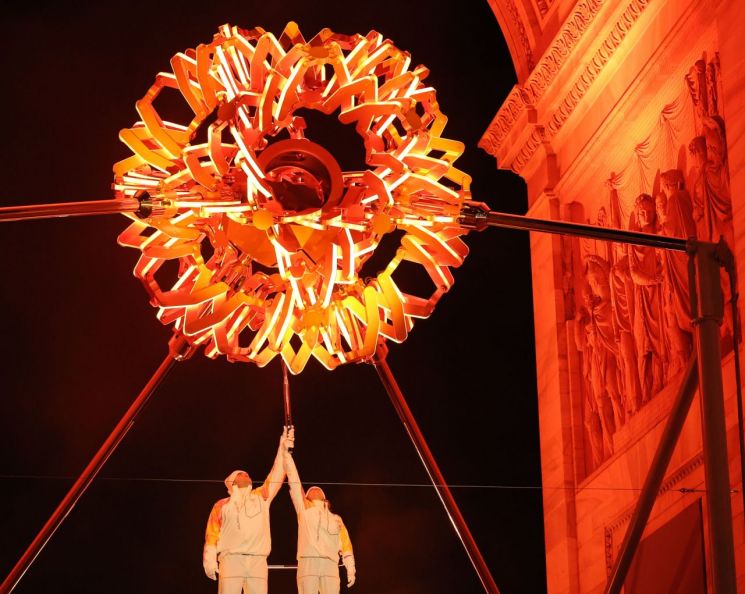 As the 2026 Milan-Cortina d'Ampezzo Winter Olympics opened on the 6th (local time), Italian alpine skiing legends Debora Compagnoni and Alberto Tomba, the final torchbearers, rode a lift up to the cauldron at Milan's "Arch of Peace" (Arco della Pace) and lit the flame. Photo by Yonhap News
This atmosphere is also evident in the self-employed business owners' community "Apeunikka Sajangida." A self-employed business owner who runs a fried chicken restaurant in Gangbuk District, Seoul, said, "In the past, we used to get group orders even for early-morning games, but this time we are not even getting inquiries," adding, "It is quieter than an ordinary February." In fact, posts lamenting that the "Olympic boom" has disappeared are frequently appearing in this community. Some analysts argue that the failure to feel any Olympic boost is not just a matter of time difference or broadcasting, but the result of structural changes in consumption.
The increase in single-person households and a consumption culture centered on OTT content have broken down the traditional Olympic consumption pattern. The familiar scenes of people gathering in front of the living room TV to cheer together while enjoying fried chicken and beer have disappeared, replaced by personalized content consumption and short-form highlight viewing. A source in the food industry said, "The era when everyone watched the same game is over," diagnosing that "the Olympics no longer function as a core theme for mass marketing." According to Google Trends, searches for "Olympic" have been on a steady decline, and interest levels for events held after the pandemic have mostly been recorded below 50.
Quiet at home, 'marketing war' on the ground
As interest in large-scale sporting events such as the Olympics has waned compared with the past, South Korean companies are also changing their marketing strategies. In the domestic market, they are reducing large-scale events and strengthening a "selection and concentration" strategy, while some companies have shifted to focusing on brand promotion in the host city itself.
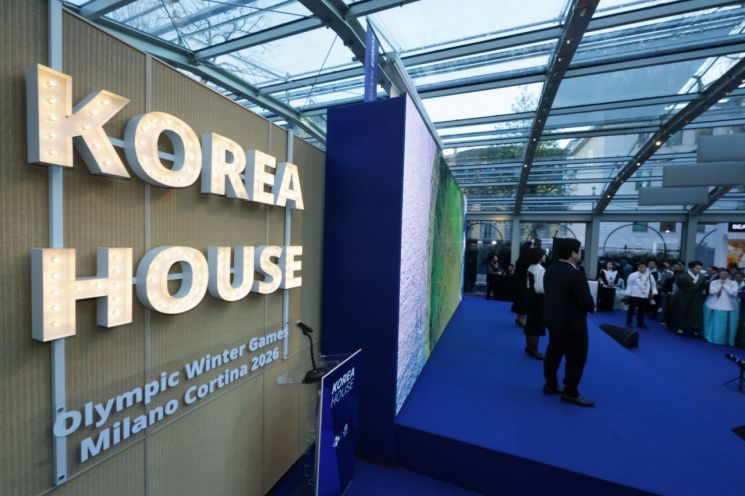 On the 5th (local time), the opening ceremony of Korea House is taking place at Villa Necchi Campiglio in Milan, Italy. Korea House will be used as a venue for sports diplomacy and the promotion of K-culture during the 2026 Milan-Cortina d'Ampezzo Winter Olympics. Yonhap News Agency
Samsung Electronics has opened "Samsung House" at Milan's Piazza del Duomo and Palazzo Serbelloni, where it is operating a Galaxy XR experience zone, large LED billboards, and outdoor advertising campaigns. CJ CheilJedang is running a "Bibigo Zone" inside "Korea House" to promote K-food, and beer brand Cass is also focusing on localized marketing in Italy by providing cheering items on site.
Meanwhile, some point out that marketing strategies relying only on short-term events have reached their limits. In a situation where economic uncertainty and changes in the media environment overlap, it is more important to focus on the sustainability of the brand itself and on strategies to secure loyal customers, rather than simply chasing an "Olympic boom." A source in the retail industry stressed, "We are no longer in an era where consumption naturally occurs just because an event is big," adding, "Marketing strategies need to be redesigned so that they penetrate deeply into consumers' everyday lives."
© The Asia Business Daily(www.asiae.co.kr). All rights reserved.
![Clutching a Stolen Dior Bag, Saying "I Hate Being Poor but Real"... The Grotesque Con of a "Human Knockoff" [Slate]](https://cwcontent.asiae.co.kr/asiaresize/183/2026021902243444107_1771435474.jpg)


















