CEX system where trades exist only on the books
Criticism over weak internal controls such as lack of secondary approval
An incident occurred at virtual asset exchange Bithumb in which as many as 620,000 Bitcoins (BTC) were mistakenly credited, and the “book-entry transaction” method that made this possible has come under fire. There is also criticism that this represents a failure of internal controls, given that procedures such as second-level approval were not in place.

"Drawbacks of 'book-entry transactions' that exist only as numbers exposed"
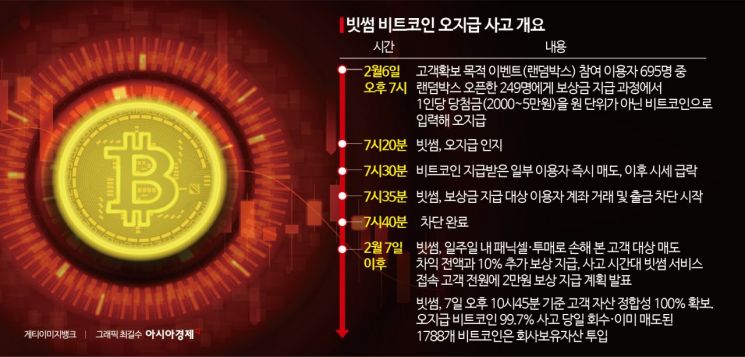
According to the digital asset industry on February 9, the incident occurred during the process of paying out rewards for an event Bithumb held on February 6. Through a random box event, Bithumb intended to pay winners between 200,000 and 50,000 won in cash, but due to a mistake by the staff in charge, “BTC” was entered instead of “won” for 249 people. The total amount of Bitcoin mistakenly paid to them was 620,000 BTC, which was worth about 56 trillion won based on prices at the time. After some users started selling, the price of Bitcoin on Bithumb plunged to 81.11 million won at around 7:30 p.m. that day. Bithumb later stated that it immediately recovered 99.7% of the 620,000 Bitcoins misallocated on the same day, and for the remaining 0.3% (1,788 Bitcoins) that had been sold, it used company-owned assets to restore 100% consistency between customer deposits and the exchange’s own holdings.
Through this incident, more Bitcoins were deposited into customer accounts than the amount of Bitcoin actually held by Bithumb. As of the third quarter of last year, Bithumb held 175 Bitcoins of its own, while customers had entrusted 42,619 Bitcoins. What made such a situation possible was the centralized exchange (CEX) system. Under this system, when customers deposit coins into a virtual asset exchange, only numerical balances are recorded in the internal database without an actual blockchain transfer. Because virtual asset trading takes place around the clock, down to the second, it is difficult to constantly match the quantity of actual virtual assets stored in the exchange’s cold wallets (offline wallets) with every single trade. Therefore, only numbers are recorded in the “books,” and the actual assets are later withdrawn from the wallets to reconcile the balances. This method has many advantages in terms of convenience, such as fast transaction speed and saving on fees, but it also has clear drawbacks in that, in the event of a system error, a discrepancy can arise between the amount actually held by the exchange and the amount recorded in the books. Observers point out that if the funds had actually been fully cashed out, losses of at least tens of billions of won could have occurred. In reality, of the 1,788 Bitcoins that were sold on the market, 125 that were not recovered were either transferred by sellers to their personal accounts or combined with their existing deposits and used to purchase other virtual assets.
Criticism over poor internal controls also raised
This incident resembles the 2018 Samsung Securities dividend error case. While paying out employee stock dividends, Samsung Securities mistakenly entered 1,000 shares instead of 1,000 won per share due to an employee’s error, resulting in 2.8 billion non-existent treasury shares being credited to accounts. At that time as well, some employees sold the shares on the market, causing the stock price to plunge. This shows that the centralized exchange model is also used by securities firms. Securities companies similarly do not physically move cash but instead change balances recorded in electronic ledgers.
For this reason, some argue that the bigger problem is not the CEX system itself, but Bithumb’s weak internal controls. Put simply, the system did not block payouts that exceeded the holdings, and during the compensation process, an abnormal volume of coins was able to circulate based on a single approval. On February 7, Bithumb issued a notice outlining measures to prevent a recurrence of such incidents. Bithumb stated, “When executing payouts under events or company policies, we will strengthen the asset verification system that cross-checks customer and company assets, and we will mandate a multi-approval process in which two or more levels of approval are required for customer asset transfers and reward payments.” A source in the virtual asset industry said, “It is critical that the exchange failed to further improve safety mechanisms such as secondary checks as it grew from a small platform into one of the two largest platforms in Korea.”
Bithumb faces headwinds ahead of IPO and other plans, moves to compensate
Bithumb has been pursuing an initial public offering (IPO) with the goal of completing it in the first half of this year, but it now faces difficulties due to this incident. It is also expected to affect the Financial Services Commission’s review this year for renewing Bithumb’s registration as a virtual asset service provider. The industry is concerned that it will undermine trust in the entire virtual asset market. In particular, as the National Assembly and regulators are currently discussing the “Basic Act on Digital Assets,” observers expect that questions will be raised about how exchanges operate. Bithumb announced that it would pay 20,000 won to customers who were logged into the Bithumb application (app) or website at the time of the incident, and that it would compensate customers who sold at low prices during the incident window by paying them the full difference from the sale plus an additional 10%.
Supervisory authorities announce stronger regulation
Meanwhile, on February 9, the Financial Supervisory Service announced in its “2026 FSS Work Plan” that it would establish a user-centered supervision and investigation framework for virtual assets, as controversy has spread over issues such as Bithumb’s erroneous Bitcoin payouts. As this situation has exposed structural vulnerabilities in the internal control systems of virtual asset exchanges, related regulations are likely to be strengthened. Financial Supervisory Service Governor Lee Chanjin said, “To protect users in the virtual asset market, we will prepare for the effective implementation of the second-phase virtual asset legislation and conduct planned investigations into key high-risk areas such as market manipulation.”
© The Asia Business Daily(www.asiae.co.kr). All rights reserved.


















