Average daily change from previous close reaches 13.93 won over two weeks
Average intraday high-low gap also large at 14.89 won
Depends on digesting Japan's general election result and easing volatility in domestic equities
Recently, the won-dollar exchange rate has been on a roller coaster, swinging an average of 14 won up or down from the previous trading day. From the "U.S.-Japan coordination issue" to the "Anthropic shock," a series of external factors that have swept through the foreign exchange market over the past two weeks have driven this high-volatility environment. Experts assessed that, ahead of the Lunar New Year holiday, the key to stabilizing the won-dollar exchange rate will be, first, how the market digests the landslide victory of Japan's ruling Liberal Democratic Party in the House of Representatives election (general election), which has already been largely priced in by the foreign exchange market, and second, to what extent the correction in the U.S. stock market triggered by concerns over excessive investment in artificial intelligence (AI) will affect volatility in the domestic stock market.
 Dealers are working in the dealing room at Hana Bank's headquarters in Seoul on the 9th. Photo by Yonhap News
A 14-won swing in a single day... From the "U.S.-Japan coordination issue" to the "Anthropic shock"
According to the Bank of Korea's Economic Statistics System (ECOS) on the 9th, the average daily change in the won-dollar exchange rate based on the closing price, compared with the previous trading day, reached 13.93 won over the two weeks (10 trading days) from the 26th of last month to the 6th of this month. On three of those trading days, the rate moved by more than 20 won from the previous day. During this period, the won-dollar rate fluctuated between 1,422.5 won and 1,469.5 won. The intraday gap between the high and low was also large, averaging close to 15 won (14.89 won).
During this period, the exchange rate was driven largely by external factors. As the yen turned stronger on the back of heightened attention to the U.S.-Japan coordination issue aimed at defending the weak yen, the won-dollar rate also fell sharply in tandem. It even calmed down to the 1,420-won level after remarks by Donald Trump in support of a weak dollar. However, it soon climbed back to just below the 1,470-won level, as the nomination of Kevin Warsh as the next chair of the U.S. Federal Reserve (Fed) brought his past hawkish (tightening-biased) comments back into focus and bolstered support for a strong dollar. In addition, in the latter part of last week, concerns that Anthropic's AI product "Claude Co-Work" could replace the core businesses of software firms fueled strong risk-off sentiment, which also had an impact. Increased dollar demand stemming from foreign investors' profit-taking on Korean equities added upward pressure on the won-dollar rate. Over the last two trading days (the 5th and 6th), net selling by foreign investors in the KOSPI market exceeded 8 trillion won.
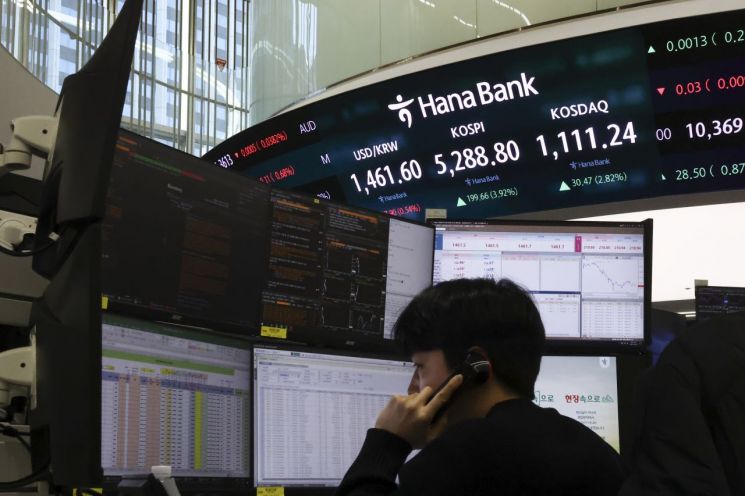 Dealers are at work in the dealing room at Hana Bank's head office in Seoul on the 9th, as the KOSPI opened up more than 4%. Photo by Yonhap News Agency
Volatile trading likely for now... Focus on digesting Japan's general election and the "short-term surge" in domestic stocks
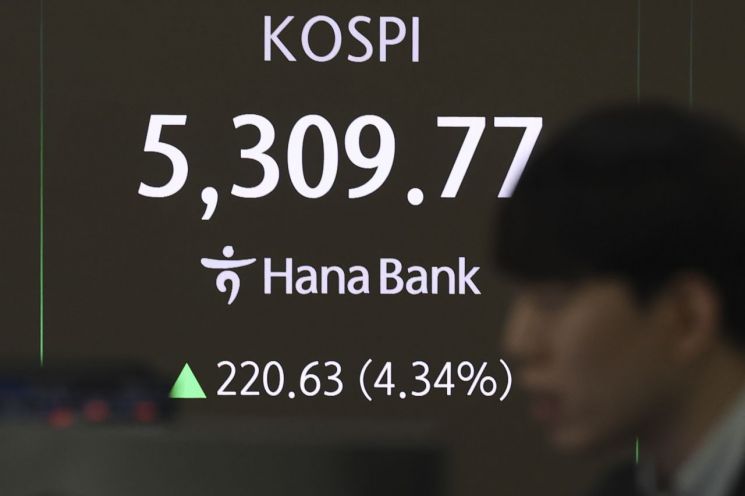
Experts expect the won-dollar exchange rate to remain in a volatile trading pattern for the time being. With the Lunar New Year holiday from the 14th likely to heighten market volatility, they note that calming the stock market, which is currently prone to sharp swings after a short-term surge, is the priority. The New York stock market, which had plunged on the "Anthropic shock," saw all three major indices close around 2% higher on the 6th (local time), easing fears of a broad-based sell-off in technology stocks. In tandem, the domestic stock market (KOSPI) also rebounded sharply, opening up 4.13% on the 9th. The won-dollar rate opened at 1,465.5 won, down 4.0 won, and has been moving around the 1,460-won level.
However, the outcome of Japan's general election is a factor that restrains won appreciation. In the House of Representatives election held on the 8th, Japan's Liberal Democratic Party secured a record number of seats, as the market had expected, achieving a landslide victory. By securing more than two-thirds of the seats in the House of Representatives, the party can re-pass bills that have been voted down in the House of Councillors, thereby strengthening its influence over the legislative process and firmly consolidating its grip on the political landscape going forward. If Prime Minister Sanae Takaichi's expansionary fiscal stance is realized, the value of the won, which tends to move in tandem with the yen, is also highly likely to decline together.
Minkyungwon, an economist at Woori Bank, said, "The yen weakness following the Liberal Democratic Party's landslide election victory is a factor that curbs won appreciation," adding, "During the market closure over the Lunar New Year holiday, uncertainty over the direction of the exchange rate will be high, and even the importers' settlement demand, which usually garners little attention in the week before holidays, will provide support for the lower bound." Choi Gyuho, a researcher at Hanwha Investment & Securities, said, "While the influence of the yuan is waning in Korea's foreign exchange market, the importance of the yen is increasing," and added, "Going forward, the yen will become more important in shaping the won's trajectory."
More weight on won stabilization in March... Variables include easing stock volatility and the Warsh confirmation hearing
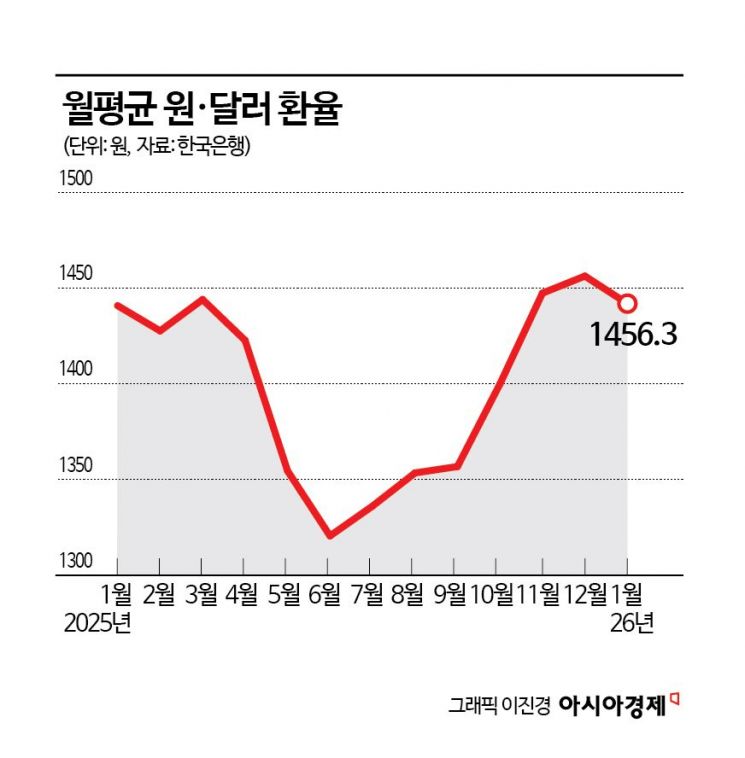
Nevertheless, analysts say expectations remain intact that the exchange rate will stabilize and move lower around March. Park Sanghyun, a researcher at iM Securities, said, "I think the volatility in asset markets themselves will likely calm down around March. If the stock market manages to stabilize its volatility and rises one more leg, that will support a stronger won," adding, "The scheduled inclusion in the FTSE World Government Bond Index (WGBI) in April is also an event, but it will act as a stabilizing factor." However, he projected that if the confirmation hearing for the next Chair Warsh is held during this period, it could become a variable for asset market trends.
Economist Min also said, "The pattern in the U.S. stock market following the Anthropic shock is similar to early last year, when markets wobbled on concerns over China's 'DeepSeek'," adding, "At that time as well, there was a wave of selling on claims that large-scale AI investment was pointless, but the situation quickly calmed down. The exchange rate is also likely to stabilize around March." Researcher Choi said, "This month, we expect the exchange rate to remain in the 1,430- to 1,470-won range, but if expectations for a Fed rate cut this summer coincide with the possibility of tightening by the Bank of Japan, a short-term yen appreciation could emerge," suggesting that, given the correlation between the won and the yen, it is worth considering strategies that take advantage of this relationship.

© The Asia Business Daily(www.asiae.co.kr). All rights reserved.



















