Samsung Biologics, Celltrion, SK Biopharm and others
Overseas sales share above 90%
Korea's pharmaceutical and bio industry is soaring beyond the narrow gate of the domestic market and onto the global stage. As the share of overseas sales at major bio companies has far exceeded 90%, firmly establishing the sector as a truly export-led industry, leading players such as Samsung Biologics, Celltrion, and SK Biopharmaceuticals broke their all-time performance records last year, proving the strength of K-bio.
According to the industry on February 9, Samsung Biologics surpassed 4.5 trillion won in revenue and 2 trillion won in operating profit last year. Overseas sales are estimated to account for about 97% of total revenue. With contract wins continuing with big pharma (large global pharmaceutical companies), the company signed three contracts each worth more than 1 trillion won last year, pushing its total annual order intake above 6 trillion won. This year as well, thanks to full-capacity operation at existing plants and the ramp-up (capacity utilization increase) of Plant 5, the company is highly likely to set another record for all-time high performance.
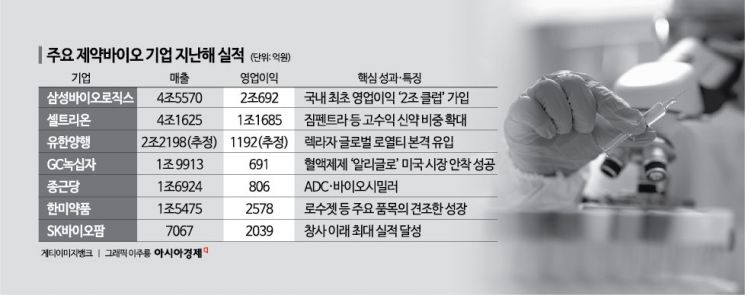
Celltrion, which has declared a "second leap forward," also fully began to realize merger synergies, with the integrated corporation surpassing 4 trillion won in revenue in its first report card after the launch. Within this, global sales grew 24% year-on-year to 3.8638 trillion won. The share of global sales exceeds 92%. Among these, highly profitable new products such as Remsima SC and Yuflyma accounted for 54% of sales, more than half of the total. In particular, the disposal of high-cost inventories, which had been a concern in the early stage of the merger, has been completed, leading to a decline in the cost ratio. At the same time, as the market share of new product lines expanded, operating profit surged by more than 130% year-on-year, enabling the company to successfully capture both "volume and quality."
Remarkable achievements have also continued in the field of new drug development. SK Biopharmaceuticals recorded around 700 billion won in sales as Cenobamate, its self-developed epilepsy drug, saw steeply rising sales in the United States. Notably, sales from the U.S. alone account for close to 90% of the total. This is cited as a case that proves it is possible to succeed under a direct sales model in the United States, the world's largest pharmaceutical market.
Traditional pharmaceutical companies are also seeing their performance shift toward a global focus. Yuhan Corporation surpassed 2 trillion won in annual revenue for the first time in its history in 2024 as global royalties from its non-small cell lung cancer drug Lekraza began to flow in in earnest, and both revenue and operating profit for last year are expected to hit record highs. GC Green Cross escaped its chronic fourth-quarter deficit for the first time in eight years thanks to increased overseas sales of high-margin products. As a result, its provisional annual revenue for last year came to 1.9913 trillion won, up 18.5% year-on-year, while operating profit more than doubled to 69.1 billion won. The successful establishment of the blood product new drug Aliglo in the U.S. market helped lift the share of overseas sales. Aliglo has broken through high entry barriers and been listed on the formularies of major insurers in the United States, leading to the assessment that it has entered a full-fledged profit-generation phase.

Hanmi Pharmaceutical also posted 1.5475 trillion won in revenue and 257.8 billion won in operating profit last year, driven by solid growth of key products such as Rosuzet, as well as increased clinical trial material supply and royalty income from its partner Merck & Co. (MSD) in the United States. Global clinical trials for its innovative new drug pipeline, including treatments for MASH (metabolic dysfunction-associated steatohepatitis), are also progressing smoothly. Chong Kun Dang is likewise pushing to transform itself from a domestically focused company into a global, R&D-centered player, backed by technology exports of innovative new drugs and achievements in global clinical trials. Its revenue last year rose 6.7% to 1.6924 trillion won.
An industry official said, "The fundamentals of our pharmaceutical and bio companies are improving, with profit-generating areas such as CDMO (contract development and manufacturing organization) and biosimilars as the backbone," adding, "This year, the entry into next-generation platforms such as ADCs (antibody-drug conjugates) by Celltrion and Samsung Bioepis Holdings, combined with the acceleration of global commercialization of domestically developed new drugs, will continue to expand the territory of K-bio."
© The Asia Business Daily(www.asiae.co.kr). All rights reserved.


















