Including a 200-trillion-won stimulus package
The push for a constitutional amendment explicitly stating the existence of the Self-Defense Forces in Article 9
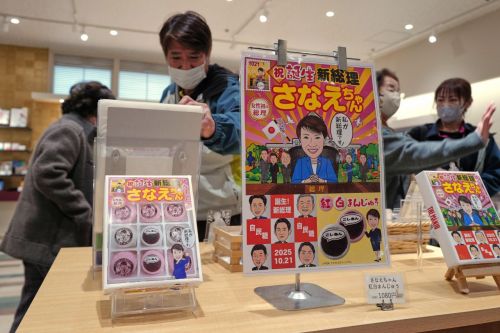 On the 13th of last month (local time), visitors at a shop in Nara Prefecture in western Japan, the hometown of Japanese Prime Minister Takaichi Sanae, were looking at souvenirs related to Prime Minister Takaichi. AP Yonhap News
Japan's ruling Liberal Democratic Party (LDP) scored a historic landslide victory in the House of Representatives election (general election) held on the 8th, powered by Prime Minister Takaichi Sanae's "idol-level popularity." With the ruling party securing a dominant majority of seats, momentum is expected to build behind "Sanaenomics" (Prime Minister Takaichi Sanae's economic stimulus policy) and the push for a constitutional amendment to explicitly stipulate the existence of the Self-Defense Forces in Article 9 of the Constitution.
According to Kyodo News and NHK on the 9th, the LDP secured 316 seats, more than two-thirds of the total 465 seats in the House of Representatives. Its coalition partner, Nippon Ishin, also won 36 seats. This surpasses the LDP's previous record of 300 seats won in the 1986 general election under the Nakasone Yasuhiro administration. During the tenure of Prime Minister Abe Shinzo, the total number of seats was the same as now, but the LDP did not reach 300 seats.
It is reported that this is the first time since the end of the Pacific War that a single party has held more than two-thirds of the seats in the House of Representatives. Excluding the LDP, no other party holds more than 50 seats. NHK pointed out, "This is the first time in the postwar era that a single party has occupied more than two-thirds of the seats in the House of Representatives."
Takaichi's party leader message hits 100 million views
The primary factor behind the ruling LDP's historic landslide victory despite difficult circumstances is, above all, the popularity of Prime Minister Takaichi. Amid the Takaichi popularity boom, issues that had been cited as the LDP's weaknesses, such as the "slush fund scandal" and broader political funding problems, as well as alleged collusion between the LDP and the Family Federation for World Peace and Unification (formerly the Unification Church), drew little attention.
Prime Minister Takaichi's campaign rallies attracted crowds comparable to idol singer concerts, and she appealed for votes by pledging, in clear and direct language, to build a "strong and prosperous Japan" and to strengthen national power. The "Takaichi party leader message" posted on the LDP's YouTube account recorded more than 100 million views, an unusually high figure for political content, and posts related to the LDP on X (formerly Twitter) also increased compared to the House of Councillors (upper house) election in July last year.
Kyodo News commented, "The LDP won a landslide victory because Prime Minister Takaichi projected a sense of renewal," adding, "She drew in not only the traditional conservative base but also independent voters." The Yomiuri Shimbun analyzed that the LDP effectively used a strategy of leveraging "Takaichi's popularity" in closely contested constituencies.
An LDP official also described this general election as "an election that relied entirely on Prime Minister Takaichi's popularity." Naoki Hyakuta, leader of the right-leaning opposition party Japan Conservative Party, said after the vote count trends became clear, "Prime Minister Takaichi's popularity was overwhelming."
Full rollout of Sanaenomics
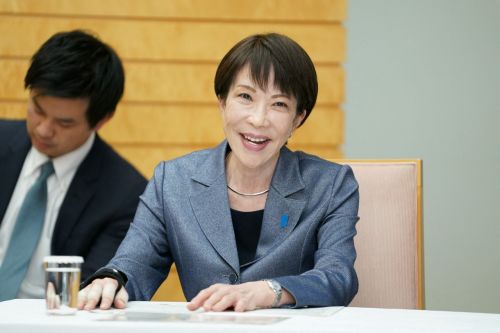
The proactive fiscal policy line championed by Takaichi, which had been included in the LDP's campaign pledges, is also expected to gain traction. This is the so-called "Sanaenomics." A 21 trillion yen (about 200 trillion won) economic stimulus package and aggressive tax cuts, including a temporary exemption of the consumption tax on food, are expected to move into full-scale implementation.
On the 8th, after it became clear that the ruling parties had won, Prime Minister Takaichi told NHK, "What I most wanted to be judged on was responsible proactive fiscal policy that would bring about a major shift in economic and fiscal policy," adding, "In particular, we will steadily push forward crisis management investment and growth investment."
Regarding the lineup of ministers in the second Takaichi Cabinet, which will be launched soon, she said, "I think the current ministers are a good team," and added, "Since everyone is working very hard and delivering results, I have no intention of replacing them." However, she added that if the coalition partner Nippon Ishin were to propose ministerial candidates, "it would be something to consider."
On the campaign pledge to cut the consumption tax rate on food, she said, "We intend to accelerate discussions." This is a measure aimed at directly easing the burden on the public from rising prices, targeting food items currently subject to the 10% consumption tax rate (with a reduced rate of 8%).
Major shift likely in the 'pacifist constitution' framework
Momentum is also expected to build behind efforts to amend the Constitution to explicitly mention the existence of the Self-Defense Forces in Article 9. To submit a constitutional amendment proposal in Japan, at least two-thirds (310 seats) of lawmakers in both the House of Representatives and the House of Councillors (upper house) must approve it. The LDP currently holds 316 seats and Nippon Ishin holds 36 seats. Combined, the seats of parties favorable to constitutional revision total 394.
Previously, the LDP and Nippon Ishin agreed to pursue constitutional revision when their coalition government was formed in October last year. They subsequently decided to establish a working group to draft provisions for revising Article 9 and the state-of-emergency clause. After the general election, if the LDP regains the chairmanship of the House of Representatives Commission on the Constitution, it is highly likely to take the lead in the amendment debate.
The core of the amendment debate is Article 9, which renounces war and prohibits the maintenance of war potential. The LDP's position is that the Self-Defense Forces, which effectively function as a military, must be explicitly stipulated in the Constitution. In recent campaign speeches, Prime Minister Takaichi stressed, "Constitutional revision is necessary to clarify the status and role of the Self-Defense Forces."
The coalition partner Nippon Ishin advocates deleting the ban on maintaining war potential and explicitly recognizing the right of collective self-defense, whereas the largest opposition party and several minor opposition parties have called for preserving the pacifist constitution. However, with pro-amendment forces now holding an overwhelming majority in the House of Representatives, the debate over revising Article 9 is likely to accelerate. If constitutional revision becomes a reality, Japan is expected to undergo a major transformation in the pacifist constitutional framework it has maintained since the end of the war.
© The Asia Business Daily(www.asiae.co.kr). All rights reserved.


















