Iranian President: "We Do Not Tolerate Coercive Language"
The Key Issue in the Talks: "Uranium Enrichment"
The United States Demands Zero Uranium Enrichment
Iran Pushes Back, Calling It a Sovereignty Issue
On February 8 (local time), Iranian President Masoud Pezeshkian described the nuclear talks with the United States as "a step forward," while strongly pushing back against any attempts at intimidation.
President Pezeshkian stated on X (formerly Twitter) that "dialogue has always been our strategy to resolve problems peacefully," but added, "the Iranian people have always responded to respect with respect, but they do not tolerate coercive language."
This is being interpreted as a sign of displeasure over the fact that Jared Kushner, U.S. President Donald Trump's eldest son-in-law, and Steve Witkoff, the U.S. special envoy for the Middle East, visited the U.S. Navy's Abraham Lincoln carrier strike group and delivered a message of "peace through strength" on the 7th, the day after talks with Iran.
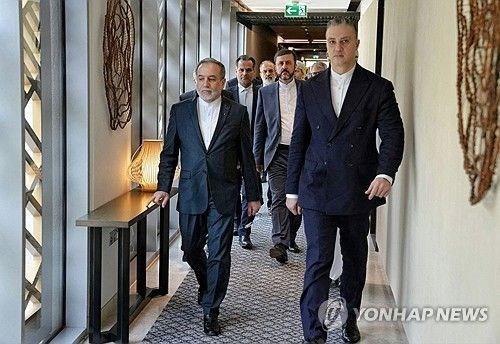
On February 6, Iran resumed negotiations with the United States on the Iranian nuclear issue in Muscat, the capital of Oman. This came eight months after dialogue was suspended when Israel and the United States successively carried out airstrikes on Iranian nuclear facilities in June last year.
On the U.S. side, White House Middle East envoy Steve Witkoff and President Donald Trump's eldest son-in-law Jared Kushner took part. From Iran, Foreign Minister Abbas Araghchi attended as the head of the delegation.
The talks were held in an indirect format in which the U.S. and Iranian representatives did not meet face to face, and Omani Foreign Minister Badr Albusaidi shuttled between the two sides to convey their messages.
The talks took place amid ongoing U.S. military buildup in the Middle East and threats of new sanctions targeting Iran's oil shipments. President Trump has previously made public the possibility of an attack on Iran, pointing to the government's hardline suppression of protests and its nuclear and ballistic missile programs.
The United States is reportedly hoping to address Iran's ballistic missile development program and its support for armed groups in the negotiations, but Iran opposes broadening the agenda beyond the nuclear issue.
The biggest sticking point in the talks is Iran's uranium enrichment activities. According to Bloomberg, Foreign Minister Araghchi stated that the talks with the United States are confined to the nuclear issue and stressed that Iran will not give up its right to enrich uranium on its own soil.
The United States, by contrast, is demanding "zero enrichment," a complete abandonment of uranium enrichment by Iran. Iran regards this as a matter of sovereignty and is firmly rejecting the demand.
Despite concerns that Iran has come close to acquiring the capability to build nuclear weapons due to its stockpile of highly enriched uranium, and despite President Trump's claim that U.S. strikes on Iranian nuclear facilities destroyed its nuclear program, Iran has repeatedly reaffirmed that it does not seek nuclear weapons and is holding fast to its right to enrich uranium.
Foreign Minister Araghchi said, "They fear our nuclear bomb, but we do not pursue nuclear weapons." He went on to stress that the Iranian government is ready to "build trust" and address concerns about its nuclear program, but added, "No one has the right to say you cannot have something simply because I do not want you to."
© The Asia Business Daily(www.asiae.co.kr). All rights reserved.
![Clutching a Stolen Dior Bag, Saying "I Hate Being Poor but Real"... The Grotesque Con of a "Human Knockoff" [Slate]](https://cwcontent.asiae.co.kr/asiaresize/183/2026021902243444107_1771435474.jpg)











