FSS unveils its "2026 Work Plan"
Focus on realizing the "Korea Premium"
Applying AI technology to unfair?trading investigations
Restricting the release of interim inspection results for financial firms
Strengthening preemptive consumer
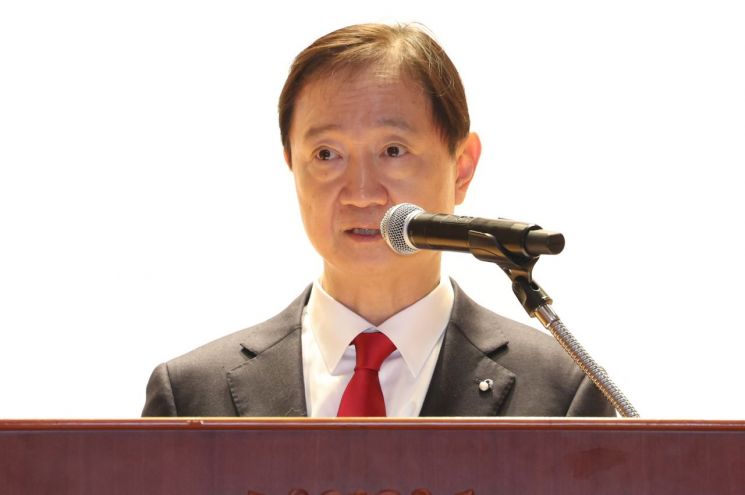
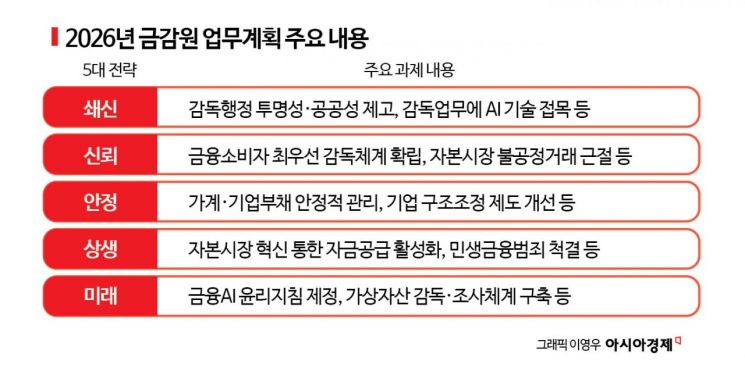
The Financial Supervisory Service (FSS) under Governor Lee Chanjin will move to improve domestic initial public offering (IPO) practices this year to realize the so-called “Korea Premium.” The FSS has concluded that the chronic “Korea Discount” (undervaluation of the Korean stock market) stems from pervasive mistrust across the market in areas such as corporate governance, fairness, and shareholder protection. With local elections coming up in June, the FSS will also strengthen real-time monitoring and investigations into unfair trading in politically themed stocks. In addition, it announced plans to bolster internal reforms across its supervisory administration, including restricting the disclosure of interim inspection results for financial firms. The FSS stressed it will strictly crack down on market-disrupting activities and financial crimes targeting ordinary people and vulnerable groups based on a “zero-tolerance principle.” Governor Lee unveiled the “2026 FSS Work Plan” containing these measures at FSS headquarters in Yeouido, Seoul, on the morning of February 9.
Improving IPO Rules That Favor Only Controlling Shareholders
First, the FSS assessed that, despite the KOSPI recently surpassing the 5,000-point mark for the first time in history on the back of improved corporate earnings and better corporate governance following amendments to the Commercial Act, awareness of the importance of management transparency and shareholder rights protection still remains insufficient. It also judged that, to resolve the Korea Discount, it is necessary to improve capital market infrastructure by strengthening the protection of minority shareholders’ rights and to further advance the response framework for eradicating unfair trading.
Accordingly, the FSS plans to identify and implement measures to improve IPO practices this year, with a focus on protecting the rights and interests of retail investors and enhancing market reliability. This reflects the perception that in the domestic IPO market, the combination of overvalued listings and exit structures that benefit only controlling shareholders and financial investors has become entrenched, while post-listing share price underperformance and recurring overhang risks have severely undermined the trust of ordinary (retail) investors.
Future measures are expected to center on encouraging IPO offer prices to be set based on genuine demand, improving listing and delisting regulations, and strengthening post-listing oversight and accountability for listed companies in order to better protect retail investors. In addition, following its move to tighten disclosure standards and frequency for treasury stock transactions by listed companies (currently set at 1% or more and twice a year), the FSS will impose stricter sanctions for violations.
Tracking Market-Disrupting Conduct to the End
The FSS will also further advance its response framework to prevent unfair trading in the capital market. In particular, it will step up monitoring and investigations into politically themed stocks in connection with local elections and other political events. In the investment banking (IB) segment, the FSS plans to closely examine cases involving the use of undisclosed information and unfair practices by listed companies. It will also promptly investigate suspected unfair trading disguised as new business initiatives in areas such as artificial intelligence (AI), semiconductors, data centers, and robots. The review and inspection cycle for the accounting of major listed companies will be shortened as well.
Governor Lee stated, “We will strictly crack down on market-disrupting activities and enhance confidence in the capital market,” adding, “We will continuously strive to more faithfully fulfill the FSS’s core role by newly applying AI technology to our unfair trading investigation system and upgrading our AI-based illegal information monitoring system.” The Lee Jaemyung administration, which has championed a “one-strike-out” policy on unfair trading, has already expanded the joint task force on stock price manipulation and is working on granting and implementing ex officio investigative authority for the FSS’s special judicial police.
At the same time, the FSS plans to strengthen its investor protection stance across the entire life cycle of high-risk financial investment products, from planning and structuring to sales and post-sale management. This is based on the recognition that securities firms have not adequately communicated investment risks to retail investors in the past. The FSS therefore intends to overhaul risk awareness and communication frameworks for high-risk products such as funds and equity-linked securities (ELS) from an investor-centric perspective. For high-risk funds, including those investing in overseas real estate, it will reinforce due diligence responsibilities and verification procedures at the product launch stage and mandate key risk disclosures tailored to investors’ level of understanding. For ELS, it will strengthen requirements for underlying assets and product structures, while introducing enhanced information provision for reinvesting clients and an early warning system.
Strengthening Confidence in the Capital Market
This year’s FSS work plan also includes measures to enhance confidence in the capital market by improving foreign investors’ access, thereby laying the groundwork for inclusion in the MSCI Developed Markets Index, a key pledge of the Lee Jaemyung administration, and by focusing inspections on improper business practices by securities firms and asset management companies. In connection with the government’s push for “productive finance,” the plan covers reviewing the current supply of venture capital following the expansion of comprehensive investment banking firms, establishing management and supervisory frameworks, building a venture capital supply platform, and setting authorization and fund review standards for business development companies (BDCs).
In addition, the FSS will establish a user-centric supervisory and investigative framework for virtual assets, following the controversy sparked by erroneous Bitcoin payouts at Bithumb. As that incident exposed structural vulnerabilities in internal control systems at virtual asset exchanges, there is a strong likelihood that related regulations will be tightened. For innovative new products such as fractional investment schemes and security token offerings (STO), the FSS plans to develop supervisory measures to ensure trading stability and protect investors. Governor Lee said, “To protect users in the virtual asset market, we will prepare for the effective implementation of the second-stage virtual asset legislation and conduct targeted investigations into major high-risk areas such as market manipulation.”
Improving Inspection Work Processes
The FSS will, in principle, restrict the disclosure of interim inspection results, allowing exceptions only when there is a compelling public interest, and will establish the relevant procedures in consultation with the Financial Services Commission. This move takes into account the controversy over legality that arose when interim findings were disclosed before inspections were completed during former Governor Lee Bokhyun’s tenure. The FSS will also extend the advance notice period for ad hoc inspections and explicitly stipulate in its rights protection standards that sanctioned entities have the right to request a hearing with the head of the inspection department. Furthermore, the FSS will upgrade its systems so that, when the responsible inspector inputs the progress of post-inspection processing, the relevant financial company is automatically notified, thereby increasing procedural transparency.
The sanction process will also be refined. For minor violations, sanctions may be waived on the condition that the party completes compliance training, and the composition of civilian members on the Sanctions Review Committee will be diversified beyond a concentration of legal professionals. The FSS will additionally establish an integrated authorization system that digitizes the entire process of licensing and registration for financial companies.
Preemptive Consumer Protection
Financial consumer protection will be further strengthened. To this end, the FSS plans to raise consumer protection standards across the full life cycle of financial products, from design and manufacturing through review, sales, and post-sale management, and to shift its consumer protection supervision framework from ex post remediation to preemptive, risk-based oversight.
In preparation for the introduction of “one-sided binding force,” under which financial companies will be obligated to comply with decisions by the Dispute Mediation Committee (a body under the FSS), the FSS will establish criteria for referring cases to the committee and will upgrade the dedicated consultative mechanism for indemnity health insurance to facilitate faster dispute resolution.
Strengthening Management of Potential Risks
The FSS plans to review the independence of the boards of directors and CEO appointment procedures at bank holding companies and banks, and, where shortcomings are identified, promote institutional improvements through a financial company corporate governance task force (TF) to help foster a sound management culture.
The FSS will also strengthen financial market risk management. It will establish mechanisms for monitoring and swiftly responding to major risks such as abrupt exchange rate volatility, and will seek to manage household and corporate debt in a stable manner by encouraging adherence to aggregate household debt targets and improving corporate restructuring systems. It will also work to reduce non-performing exposure in real estate project financing (PF), including by encouraging the sale of bad loans.
Governor Lee emphasized, “We will closely monitor potential risk factors stemming from rising household debt, higher lending rates, and external shocks, and establish a framework that allows for an immediate response,” adding, “We will ensure that the necessary funds are supplied to the right places at the right time so that finance can effectively support the real economy.”
© The Asia Business Daily(www.asiae.co.kr). All rights reserved.
![Clutching a Stolen Dior Bag, Saying "I Hate Being Poor but Real"... The Grotesque Con of a "Human Knockoff" [Slate]](https://cwcontent.asiae.co.kr/asiaresize/183/2026021902243444107_1771435474.jpg)

















